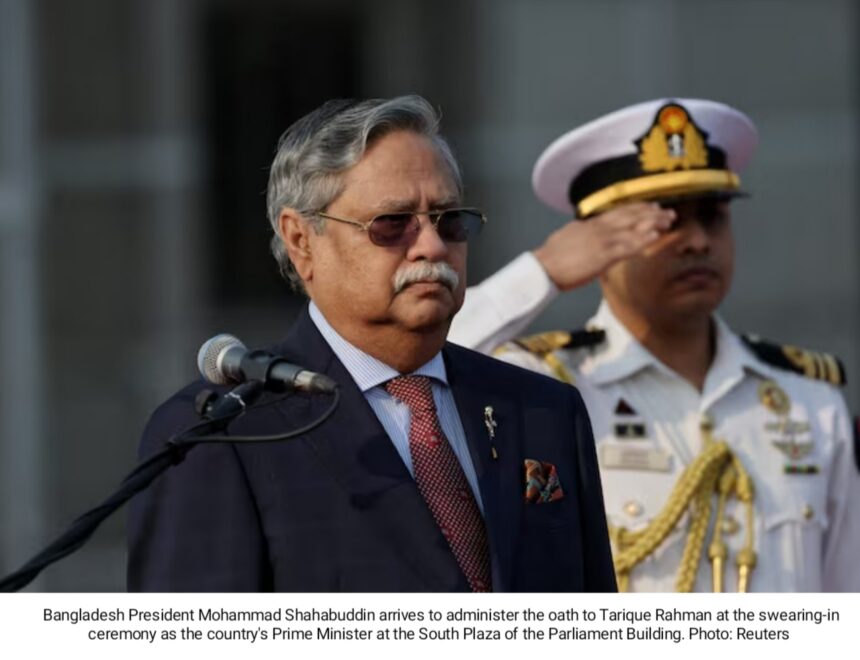
Bangladesh has entered another pivotal moment in its political transition after President Mohammed Shahabuddin resigned from office, citing serious health complications, a move that comes amid an already fragile political landscape following the 2024 uprising that ended former Prime Minister Sheikh Hasina’s long tenure in power. In an official statement released by the President’s Office on Friday, the 76-year-old head of state disclosed that he had recently been diagnosed with Autonomic Neuropathy, a neurological disorder that causes occasional episodes of sudden loss of consciousness, making it increasingly difficult for him to fulfil the constitutional responsibilities of the presidency. Describing his decision as one taken in the best interests of the nation and the continuity of state institutions, Shahabuddin said that stepping down was necessary to ensure the smooth functioning of the country’s highest constitutional office.
Shahabuddin assumed the presidency in April 2023 and remained in office during one of the most turbulent periods in Bangladesh’s modern political history. His tenure witnessed the unprecedented student-led uprising of 2024 that forced then-Prime Minister Sheikh Hasina to leave the country, triggering sweeping political changes, the banning of the Awami League, and the detention or disappearance of many of its senior leaders and activists. Although the Bangladeshi presidency is largely ceremonial, the office carries significant constitutional authority as the guardian of the state, the supreme commander of the armed forces, and a key figure in maintaining institutional continuity during periods of political uncertainty.
Under Bangladesh’s Constitution, the Speaker of the Jatiya Sangsad (National Parliament) will assume the duties of the President until a successor is elected, ensuring there is no constitutional vacuum. While executive authority remains vested in the Prime Minister and the Cabinet, the transition at the highest level of the state comes at a politically sensitive time, with speculation continuing over Sheikh Hasina’s reported plans to return to Bangladesh in the coming months despite the dramatic collapse of her government and the continued ban on her political party.
Political observers believe Shahabuddin’s resignation could have far-reaching implications for Bangladesh’s evolving political landscape. The departure of a president widely viewed as having close ties to the former administration removes one of the last remaining figures associated with the previous political establishment from high office. Analysts say the selection of Bangladesh’s next president will be closely watched both domestically and internationally, as it may provide important signals about the direction of the country’s democratic transition, constitutional governance, and institutional stability.
The resignation also underscores the broader transformation underway in Bangladesh since the events of 2024. As the country navigates a period of political restructuring, constitutional succession, and heightened public expectations, attention is now turning to how national institutions will manage the transition and whether the coming months will strengthen political stability or deepen existing divisions. With Bangladesh remaining a strategically important nation in South Asia, the developments surrounding the presidency are expected to draw continued attention from regional partners, international governments, and global observers monitoring the country’s democratic trajectory.
President Mohammad Shahabuddin resigns