Saudi Arabia would hold a decisive advantage over Iran in any conventional air war, thanks to its modern Western-built fighter fleet, advanced surveillance systems and close operational integration with the United States and NATO partners. However, military analysts argue that Tehran has spent decades preparing for a different kind of conflict—one that relies less on air superiority and more on missiles, drones and asymmetric warfare to offset its ageing air force. As regional tensions continue to rise, defence experts say a direct confrontation between the two Middle Eastern rivals would likely evolve into a complex campaign in which conventional air power and unconventional strike capabilities are employed simultaneously.
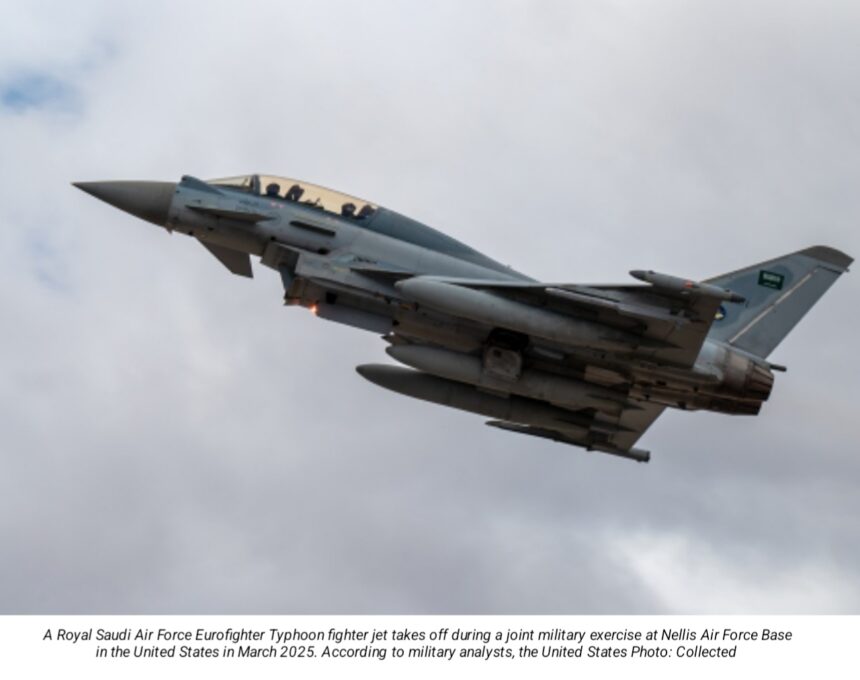
The Royal Saudi Air Force is widely regarded as one of the most capable air forces in the Middle East, operating hundreds of modern combat aircraft including F-15 Eagles, Eurofighter Typhoons and Panavia Tornado strike aircraft equipped with advanced radars, precision-guided munitions and sophisticated electronic warfare systems. Supported by airborne early warning aircraft, aerial refuelling capabilities and integrated command-and-control networks, Saudi pilots would enter any conventional air campaign with significant technological and operational advantages over Iran. Analysts note that the kingdom’s extensive training with Western allies, combined with a well-developed logistics and maintenance infrastructure, further strengthens its ability to sustain high-intensity air operations.
Iran’s conventional air force, by contrast, continues to rely largely on ageing platforms such as the F-14 Tomcat, MiG-29, Su-24, F-4 Phantom and F-5 Tiger, many of which date back several decades. Years of international sanctions have complicated maintenance, spare parts procurement and fleet modernisation, leaving the Islamic Republic of Iran Air Force at a considerable disadvantage in a traditional fighter-to-fighter conflict. Defence specialists generally assess Iran’s conventional air arm as one of the weaker components of its broader military structure.
Yet analysts caution that measuring military power solely through fighter aircraft presents an incomplete picture of Iran’s overall capabilities. Over the past two decades, Tehran has invested heavily in an extensive arsenal of ballistic missiles, cruise missiles, long-range attack drones, loitering munitions, mobile launchers and underground missile facilities designed to survive sustained aerial bombardment. Rather than attempting to match Saudi Arabia aircraft for aircraft, Iran’s strategy focuses on imposing heavy military, economic and political costs on any adversary through large-scale missile and drone attacks against strategic infrastructure.
Military experts believe that in the event of a wider conflict, Saudi Arabia would seek to establish air superiority by targeting Iranian air defences, command centres and military airfields during the opening stages of the campaign. Iran, meanwhile, would likely limit the use of its ageing fighter fleet while launching coordinated salvos of ballistic missiles and unmanned aerial vehicles against military bases, oil installations, ports, airports, desalination plants and other critical infrastructure across the Gulf. Such a strategy aims to complicate the operational environment, overwhelm air-defence systems and increase the financial and strategic cost of prolonged military operations.
The evolution of modern warfare has increasingly highlighted the growing role of relatively inexpensive drones and precision-guided missiles alongside advanced fighter aircraft. While Saudi Arabia maintains a clear edge in conventional air power through superior technology, pilot training and networked operations, Iran’s asymmetric capabilities are widely viewed as a significant deterrent that could complicate any sustained military campaign. Defence analysts therefore conclude that although Saudi Arabia would likely dominate the skies in a conventional air battle, the broader conflict could prove far more complex, with Tehran relying on its expanding missile and drone arsenal to offset its weaknesses and challenge a technologically superior opponent.
Saudi Arabia’s modern air force versus Iran’s asymmetric warfare tactics—how terrifying is the potential conflict?