

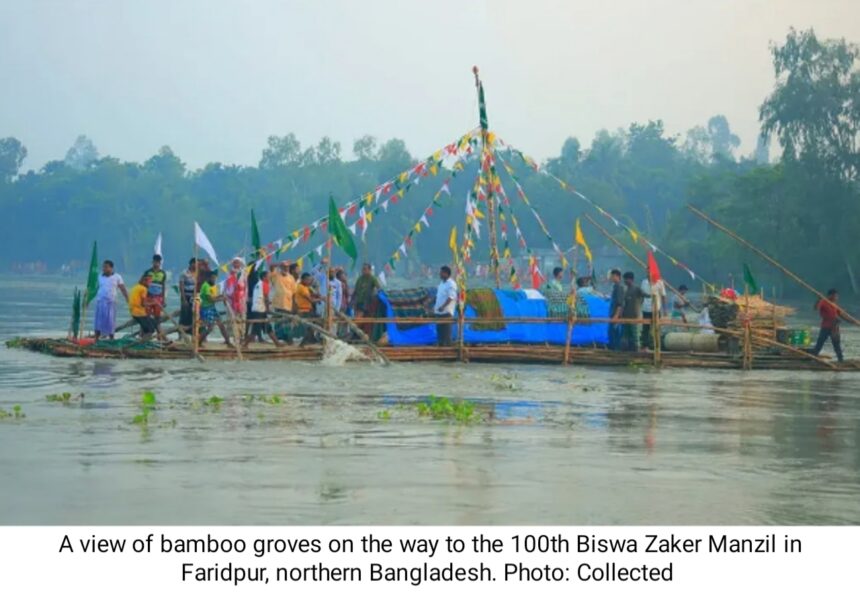
As evening falls over Meghai Ghat in Sirajganj, people begin gathering along the bank of the Jamuna. They are waiting to see an unusual sight on the river. Slowly, a large floating structure appears in the distance and moves towards the shore. From far away, it may look like a large boat. But as it comes closer, it becomes clear that it is something different. Hundreds of bamboo poles have been tied together to create a wide floating platform known locally as a bhur.
Several dozen devotees are travelling on the raft. Some are rowing, some are cooking, while others are watching the river and helping guide the raft. At times, the sound of zikr can be heard from the river. Food offered as tabarruk is also shared with people along the bank. For many local residents, the sight is unusual. But for devotees travelling towards Bishwa Zaker Manzil in Atroshi, it is part of a journey that takes place every year.
The bamboo-raft journey is connected with a nazrana, or religious offering, organised by the Zaker Party. According to people involved in the arrangement, the bamboo raft programme is organised as a dedicated nazrana of the Zaker Party. Devotees from different parts of Bangladesh take part in the journey. Some contribute financially, while others contribute their labour. For several days, they remain on the river, rowing, cooking, pushing the raft when it becomes stuck, checking the bamboo structure and carrying out other tasks needed to keep the journey moving.
For the participants, the journey is more than a way of transporting bamboo. They regard the work as part of their khedmat, or service.
The rafts begin their journey from different waterways in northern Bangladesh. They gradually connect with some of the country’s major rivers and move south. Depending on the route, they travel through the Teesta and Brahmaputra before reaching the Jamuna. From there, they continue through the Padma towards the Arial Kha River. The final part of the journey takes them through the Piyajkhali canal towards Bishwa Zaker Manzil in Atroshi, Faridpur.
There is no fixed timetable for the journey. A raft may reach its destination in six or seven days when river conditions are favourable. But if it becomes stuck repeatedly or faces difficult currents and shallow water, the journey can take 15 or even 20 days.
Building a bhur itself requires considerable work. Hundreds of bamboo poles are placed lengthwise and crosswise and tied tightly together with ropes. Depending on the size of the raft and the condition of the river, a single bhur may carry between 500 and more than 1,000 bamboo poles.
One of the most distinctive features of the raft is that it has no engine. There is no propeller and no conventional hull. When the current is strong and moving in the right direction, the raft can travel largely with the river. But when the current becomes weak or the water becomes shallow, the people on board have to provide the power themselves.
Usually, four oars are used on each side, making eight in total. When the raft gets stuck on a shallow section or near a sandbar, the devotees may have to climb into the water and push it towards deeper water. Sometimes 20 to 25 people work together to move the raft.
One devotee described how difficult the journey can become when the Jamuna has little current. Instead of simply allowing the river to carry the raft, the group has to row for long periods. After Fajr prayer, the day’s work begins. Some take the oars, others prepare food, while others watch the river ahead and behind the raft. When the raft becomes stuck, everyone has to stop what they are doing and help.
For the devotees, the physical hardship has a spiritual meaning. They consider the work part of their service. Spending several days on the river, cooking on the raft, rowing, sleeping under the open sky and pushing the raft through shallow water are all treated as part of the journey.
But the river does not always make the journey easy. The Padma can be particularly difficult to navigate. Strong currents can push a raft away from its intended channel, while newly formed sandbars can make familiar routes difficult to follow.
Zaker Party leader Khorshed Alam has been involved in these river journeys for many years. He has travelled by bhur since 2001 and has experienced some of the difficulties that can arise on the route.
He recalls a journey in which the current pushed their raft away from the channel they needed to follow towards the Arial Kha River. The raft was being carried towards the Munshiganj and Mawa areas. Fifteen to 20 people repeatedly pulled the raft towards the bank using ropes. They first moved it upstream and then released it back into the current in an attempt to enter the correct channel.
Khorshed also remembers a more difficult experience from one of his earlier journeys. After crossing the Padma, the raft was caught in a strong current and swept towards a sandbar. Fifteen people remained stranded there for two days and two nights.
Surrounded by water, they had no easy way to leave. They had some dry food with them and drank river water. At the time, there were no mobile phones or other convenient means of communication. Other rafts continued towards Atroshi, but when the group failed to arrive, boats were eventually sent to search for them. The men were found and brought back so that they could continue their journey.
For those who take part, such incidents have become part of the experience of travelling by bhur. The journey involves uncertainty, physical work and a close dependence on the river.
There is also a practical reason for transporting the bamboo to Atroshi. Bishwa Zaker Manzil hosts large religious gatherings, during which temporary facilities are needed for large numbers of people. Bamboo is used to build samiana, pandals, shelters, toilets and other temporary structures. Older bamboo can later be reused for other purposes, including as fuel for cooking.
According to people involved in the programme, large quantities of bamboo are transported to Atroshi in this way every year. The number of poles carried by each raft varies depending on its size and the river conditions. Some rafts carry around 500 poles, while larger ones can carry more than 1,000.
For the devotees, however, the bamboo represents more than construction material. The journey itself is considered part of their nazrana and khedmat. They contribute money, time and physical labour. Some help prepare the raft, some travel with it, while others take responsibility for cooking, rowing and maintaining the structure throughout the journey.
Life on the raft is not easy. Cooking has to be done on the floating platform. Rain can make both cooking and resting difficult. At night, the devotees sleep under the open sky. During the day, they have to deal with the heat, wind, currents and changing water levels.
Despite these difficulties, the group works together. Some people row while others monitor the route. Some prepare meals and distribute food. Others check the ropes holding the bamboo together. When the raft becomes stuck, everyone may have to leave their regular duties and help push or pull it free.
Religious practices also remain part of the journey. The devotees perform their prayers on the raft and engage in zikr and wazifa. Some long-time participants have also described giving the call to prayer from the raft during earlier journeys.
For several days, therefore, the bhur becomes more than a means of transportation. It becomes a temporary religious space on the river, where people pray, eat, work and rest together.
Rajob Ali, a Zaker Party organiser responsible for overseeing the raft operation, also describes a spiritual connection between the devotees and the bamboo. According to him, some devotees speak about their personal difficulties and concerns while preparing the bamboo. They believe that the bamboo carries those concerns to Khaja Baba, who presents them to Allah. This is part of their own spiritual belief.
The belief is connected with Khaja Baba Faridpuri, whose name was Maulana Muhammad Hashmatullah. He established Bishwa Zaker Manzil in Atroshi and is regarded by his followers as a spiritual leader. He died in 2001.
Rajob Ali recalls an incident from the mid-1990s that he regards as a significant spiritual experience. His group’s raft had been carried towards Munshiganj by the current of the Padma. After spending much of the day struggling against the river, they reached an area that looked almost like a pond. They believed that a section of the riverbank had broken away and created an enclosed area of water within the Padma.
Their food had become soaked and they had gone without eating for some time. Then a trawler arrived from Atroshi carrying tabarruk for them.
Rajob said there were no mobile phones or social media at the time. He therefore did not understand how people at Atroshi had learned where they were or that they needed food. He attributes the incident to a spiritual connection and considers it a miracle. That interpretation reflects his personal religious belief and experience.
Another important part of the journey is the knowledge required to navigate Bangladesh’s major rivers. Travelling on a bamboo raft is not simply a matter of rowing. The people operating the raft need to understand the river’s current, water depth, sandbars and channels.
The river can change from one year to the next. A route that was open one year may become shallow the following year. A new sandbar may appear in the middle of a channel. Strong currents may push a raft in an unexpected direction.
This is why experienced participants such as Khorshed Alam play an important role. Their knowledge of the river helps the group decide when to row, when to pull the raft with ropes and when to allow the current to carry it.
The journey can sometimes become a test of patience. A section that looks easy from a distance may take hours to cross. A raft can become stuck several times in a single day. When that happens, the people on board have to work together.
Yet the journey continues every year.
For the Zaker Party and the devotees who participate, the bamboo raft is part of a nazrana offered towards the activities and needs of Bishwa Zaker Manzil. The participants contribute according to their ability. Some provide financial support, while others give their time and labour.
The bamboo itself eventually reaches its practical destination. After travelling hundreds of kilometres through Bangladesh’s river system, it is used for temporary structures and other needs during religious gatherings at Atroshi.
But the journey remains important to the people who make it. They spend days on the water, facing currents, shallow channels, sandbars and changing weather. They cook together, pray together and work together. The hardship becomes part of the experience they carry with them.
Along the Jamuna, the sight of a bamboo bhur can therefore tell several stories at once. It is a story of Bangladesh’s rivers and the people who depend on them. It is a story of physical labour and cooperation. And for the people travelling on the raft, it is also a story of religious devotion, nazrana and khedmat.
From the northern waterways, the rafts move through the Teesta, Brahmaputra, Jamuna and Padma before making their way towards the Arial Kha and eventually Atroshi. Sometimes the current carries them forward. At other times, the passengers have to step into the water and push their raft themselves.
The journey may take a week, or it may take several weeks. The river decides much of that.
When the bamboo finally reaches Atroshi, the long journey comes to an end. The poles that travelled hundreds of kilometres by river can then be used for the facilities needed during religious gatherings. For the devotees who carried them there, the journey remains a record of their time, labour, faith and service.
Every year, the rivers change. Channels shift, sandbars appear and currents rise and fall. Yet the bamboo rafts continue to make their way towards Atroshi, carrying not only bamboo but also the people who have chosen to spend days on Bangladesh’s rivers as part of what they regard as their nazrana and khedmat.