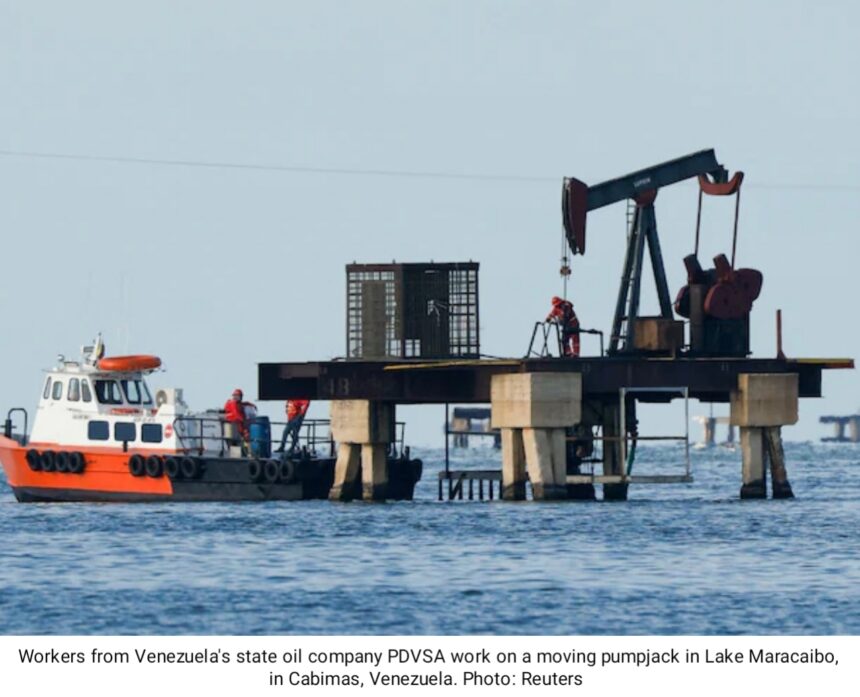
WASHINGTON, September 1, 2026: A major shift is underway in Venezuela’s strategically important oil sector as U.S.-backed North American Blue Energy Partners (NABEP) prepares to assume operational control of several oilfields previously managed by Chinese companies and a Russian firm, according to U.S. officials cited by Reuters, in a sweeping energy arrangement announced by President Donald Trump. The development marks a potentially significant transformation in Venezuela’s energy landscape, placing a greater share of the country’s vast oil resources within the economic and strategic orbit of the United States while reducing the role of Chinese and Russian interests that have maintained a strong presence in Venezuela’s petroleum industry for years. Under the new arrangement, NABEP is expected to control 17 projects across Venezuela, including 14 newly awarded projects granted by the Venezuelan government, with five of those 14 fields previously operated by Chinese companies and another previously managed by a Russian company. The projects form part of a broader effort by Washington and Caracas to revive Venezuela’s struggling oil industry, attract foreign investment and increase production, while directing a larger share of Venezuelan crude toward the U.S. market. NABEP was previously owned by U.S. oil entrepreneur Harry Sargeant and is now controlled by Venezuelan businessman Alejandro Betancourt, who confirmed the transaction and described it as an opportunity to unlock Venezuela’s enormous natural-resource potential for the benefit of both Venezuelans and Americans. The agreement gives NABEP operational control of the business, while the U.S. government will hold rights to a 35% stake in the company and receive preferential access to 20% of its production at cost. The White House has also said that the U.S. Department of State has been granted a right of first refusal to purchase the remaining 80% of the company’s oil production, potentially giving Washington substantial influence over the destination and commercial distribution of Venezuelan crude. The United States will additionally have veto power over NABEP’s board and directors, while a majority of board members will be required to be American citizens, according to the White House. Several of the oil projects covered by the agreement were previously linked to major Chinese energy interests. U.S. officials said two projects had been operated by China Concord Resources, a company sanctioned by Washington in 2019 over Iran-related activities, while other projects were previously operated by major Chinese energy groups including Sinopec and China National Petroleum Corp. The restructuring could therefore have consequences well beyond Venezuela’s domestic oil industry, potentially weakening China’s position in one of Latin America’s most strategically significant energy markets. It could also reduce Russia’s role in Venezuela’s petroleum sector, as at least one project included in the new arrangements had previously been operated by a Russian company. U.S. officials described the shift as an opportunity not only for American companies and the U.S. government to benefit from Venezuela’s oil resources but also to redirect crude that had previously been exported to China toward the United States. The move comes as the Trump administration seeks to establish a more direct role in Venezuela’s energy industry and reshape the country’s oil sector around increased production, foreign investment and access to U.S. markets. Last week, Trump announced that the United States had secured access to roughly 64 billion barrels of Venezuela’s proven oil reserves through a partnership involving private business. Venezuela possesses some of the world’s largest proven petroleum reserves, but years of economic crisis, sanctions, underinvestment, declining infrastructure and political instability have severely weakened its ability to produce and export crude at its potential capacity. Trump said Monday that millions of barrels of Venezuelan oil are already being shipped to refineries in Texas and Louisiana, underscoring the administration’s intention to integrate Venezuela’s petroleum output more closely with the U.S. refining system. The president was also expected to meet with oil and gas retailers and refinery representatives as Washington considers the next steps in expanding the flow of Venezuelan crude into the American market. Beyond the commercial dimensions, however, the agreement is closely linked to Venezuela’s broader political transition. U.S. officials said representatives of Venezuela’s interim authorities and members of the 2015 National Assembly are engaged in discussions aimed at restoring a degree of constitutional order and resolving legal questions surrounding the country’s transition. The Trump administration considers the 2015 National Assembly to be the last Venezuelan legislative body elected and functioning under the country’s constitution, although it currently has no formal governing authority. One U.S. official said an agreement with the former assembly could provide a constitutional and legal foundation for the broader political transition, including major economic decisions required to rebuild Venezuela’s oil industry. The restructuring also involves oilfields previously associated with individuals connected to Venezuela’s former political establishment. According to U.S. officials, two projects had been operated by affiliates of Alex Saab, a former close associate of ousted President Nicolas Maduro who is currently in U.S. custody, while another oilfield was linked to a nephew of Maduro’s wife, Cilia Flores. The removal of those interests and the arrival of a U.S.-backed operator could further alter the ownership and management structure of Venezuela’s petroleum industry. For Washington, the emerging arrangement represents a convergence of energy, economic and geopolitical interests. Increasing Venezuelan oil production could provide the United States with an additional source of crude close to its own refining infrastructure, while reducing Venezuela’s dependence on distant markets and limiting the influence of strategic competitors such as China and Russia. For Caracas, meanwhile, access to U.S. capital, technology, equipment and markets could offer a potential route toward restoring production and generating badly needed economic revenues. Yet the agreement is likely to face scrutiny over questions of sovereignty, legal authority, ownership and the long-term distribution of Venezuela’s oil wealth. The extent to which the new structure can be implemented will depend heavily on Venezuela’s political transition, the legal framework governing the oil concessions, the condition of the country’s energy infrastructure and the willingness of international investors to commit substantial capital. The developments nevertheless signal a potentially profound realignment of Venezuela’s energy sector. If the planned projects proceed, U.S. companies could gain a much stronger foothold in Venezuela’s most important oil assets, while Chinese and Russian operators could see their longstanding positions significantly reduced. The emerging partnership could therefore reshape not only Venezuela’s oil industry but also the broader balance of economic and geopolitical influence in Latin America, placing the country’s enormous petroleum reserves at the center of a renewed contest between Washington, Beijing and Moscow over energy, investment and strategic access.
U.S. Firm to Take Over Venezuelan Oilfields Previously Run by Chinese and Russian Companies