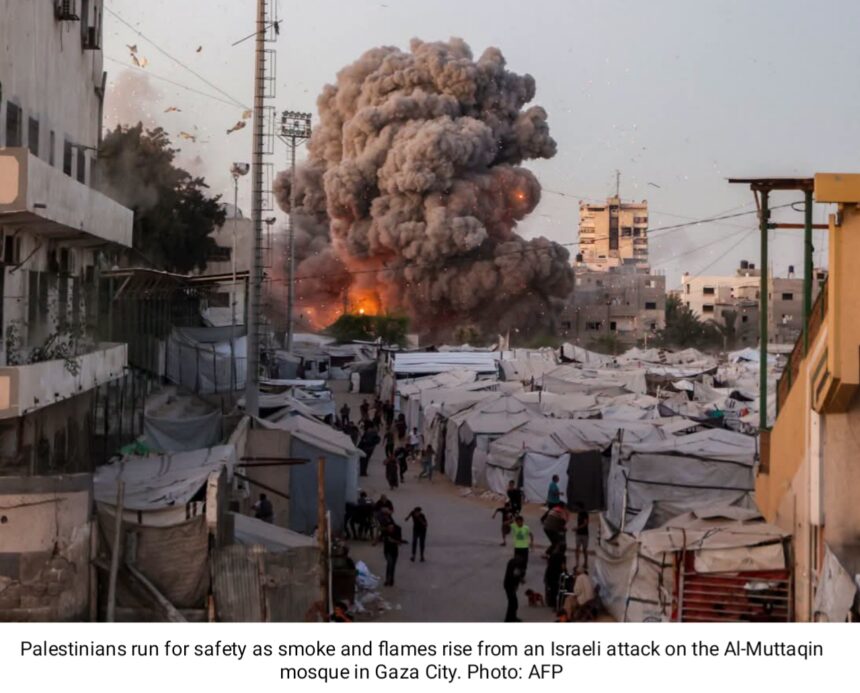
Israeli air strikes across the Gaza Strip have killed at least one Palestinian, wounded more than a dozen others and destroyed a mosque along with tents sheltering hundreds of displaced civilians, as renewed violence continues to deepen the humanitarian crisis in the besieged territory. According to reports, Israeli warplanes carried out a series of attacks targeting central and northern areas of Gaza, with one of the strikes hitting the Al-Muttaqin Mosque near the Young Men’s Christian Association (YMCA) building in Gaza City. The attack caused widespread destruction in the area, damaging religious infrastructure and nearby shelters where displaced Palestinians had been seeking safety after being forced from their homes by months of fighting.
Al Jazeera correspondent Tareq Abu Azzoum, reporting from Deir el-Balah, said Israeli aircraft carried out multiple strikes across Gaza, particularly focusing on densely populated areas in the centre and north of the territory. He said residents had received warnings before some of the attacks, but the timeframe given for civilians to evacuate or take protective measures was extremely limited, leaving many people trapped in dangerous areas with few options for escape.
A separate Israeli strike targeted a group of Palestinians in the Nuseirat refugee camp in central Gaza, killing at least one person and injuring several others. According to local health officials cited in reports, the attack struck an area near a busy market where civilians were gathered. Witnesses described scenes of panic and fear, saying residents remain trapped in a constant cycle of uncertainty as they fear further bombardment at any moment.
The latest attacks come amid ongoing concerns over the fragile ceasefire arrangements and international efforts aimed at stabilising Gaza. On Sunday, Israel’s security cabinet approved a measure that could allow the first members of an International Stabilisation Force to enter Gaza as part of a US-backed ceasefire framework. However, continued military operations and civilian casualties have raised questions about the future of the agreement and whether it can lead to a lasting reduction in violence.
Meanwhile, tensions have also intensified in the Israeli-occupied West Bank, where Palestinian residents and international observers have reported a rise in attacks by Israeli settlers. The Palestinian Red Crescent said eight Palestinians were forced to flee their home in Abu Najim, near Bethlehem, after settlers allegedly set fire to the building. Local residents said attackers also torched a vehicle and sprayed graffiti on walls before setting the property ablaze.
Palestinian officials and human rights groups have warned of increasing settler violence across the West Bank, with attacks targeting Palestinian homes, communities and public spaces. Reports indicate that incidents involving organised groups of settlers have created growing fear among Palestinian civilians, particularly in areas near Israeli settlements.
At the same time, Palestinian authorities have accused Israel of expanding land confiscation efforts in the occupied West Bank. The Palestinian news agency Wafa reported that Israeli authorities issued military orders seizing around 200 dunums of land in the Jenin governorate. Local officials said the confiscation orders have increased in recent days, particularly affecting areas including Arrabeh, Qabatiya and Misilya.
According to Palestinian settlement affairs officials, some of the confiscated land has reportedly been allocated for the construction and expansion of military roads linked to Israeli settlement outposts. Palestinian authorities argue that such measures are part of a broader effort to expand Israeli control over occupied territory, while Israel has previously stated that security considerations are behind many of its military actions and restrictions.
The escalation in Gaza and the West Bank has drawn renewed international attention, with the United Nations and several governments warning that continued violence threatens regional stability and could undermine diplomatic efforts for a political solution. UN officials have repeatedly criticised settlement expansion in the occupied West Bank, calling it a violation of international law, while Israeli authorities reject such accusations and maintain that their actions are necessary for national security.
As fighting continues and diplomatic efforts struggle to gain momentum, civilians in Gaza and the West Bank remain at the centre of the crisis, facing displacement, destruction and growing uncertainty over what lies ahead. International observers warn that without a comprehensive political agreement, the cycle of violence and humanitarian suffering may continue to intensify across the region.
Israeli air force bombs mosques and refugee camps in the West Bank of Gaza.