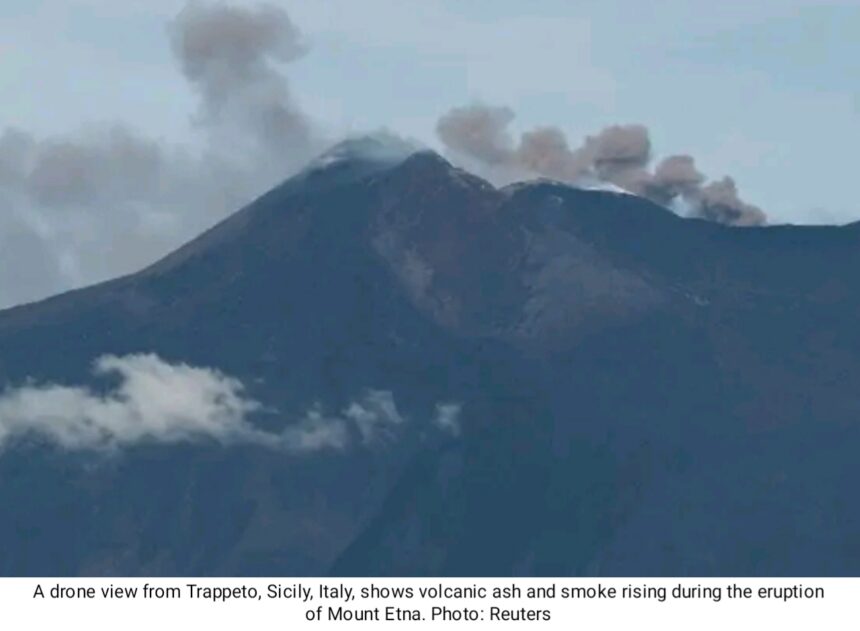
ROME, September 14, 2026 — Air traffic at Italy’s Catania Airport was suspended again on Monday as ash from the continuing activity of Mount Etna spread across the area, forcing authorities to restrict flight operations at one of Sicily’s busiest aviation hubs and raising the prospect of further disruption for thousands of passengers. The airport operator, SAC, initially announced that all arriving flights would be suspended until 4 p.m. local time as volcanic ash created unsafe conditions for normal aviation operations. The suspension was later extended until 10 p.m. and was expanded to include departing flights, effectively bringing much of the airport’s scheduled air traffic to a halt for the day. Catania Airport is Italy’s fifth-busiest airport by passenger traffic and plays a major role in connecting eastern Sicily with other parts of Italy, Europe and international destinations, particularly during the busy summer travel period. The latest disruption comes as Mount Etna, Europe’s highest and one of its most active volcanoes, continues to produce significant volcanic activity, with ash emissions once again affecting the region’s aviation network. Volcanic ash poses a serious risk to aircraft because fine particles can enter jet engines, potentially affecting engine performance and damaging critical aircraft components. For this reason, aviation authorities and airport operators closely monitor volcanic activity and atmospheric ash concentrations before allowing flights to operate normally. Catania has repeatedly experienced flight disruptions because of Mount Etna, but the intensity of ash emissions this summer has caused particularly significant problems, affecting thousands of travellers during the peak holiday season. The repeated closures have created uncertainty for passengers, airlines and airport authorities, with flights having to be delayed, cancelled or rescheduled depending on the movement and concentration of the volcanic ash cloud. Monday’s suspension once again highlighted the challenges faced by Sicily’s aviation system because of the island’s proximity to an active volcano. While Mount Etna is an important natural feature and a major attraction for visitors to Sicily, its frequent eruptions can have immediate consequences for transportation, tourism and regional connectivity. Airport officials are expected to continue monitoring the situation and assess whether flight operations can safely resume as volcanic conditions change. The reopening of the airport will depend largely on the level and movement of volcanic ash in the surrounding airspace. Until normal operations are restored, passengers travelling through Catania are likely to face delays and changes to their scheduled journeys, while airlines may need to adjust routes and flight schedules in response to the evolving conditions. The latest closure adds to a series of aviation disruptions caused by Etna’s activity in recent months and underscores the continuing impact that volcanic eruptions can have far beyond the immediate area surrounding an active volcano. For Sicily, where air travel is particularly important for tourism, business and connections with mainland Italy and the wider European region, prolonged disruption at Catania Airport could create wider logistical difficulties if the volcanic activity continues at a high level.
Catania Airport Suspends Flights Again as Mount Etna Ash Disrupts Air Travel Across Sicily