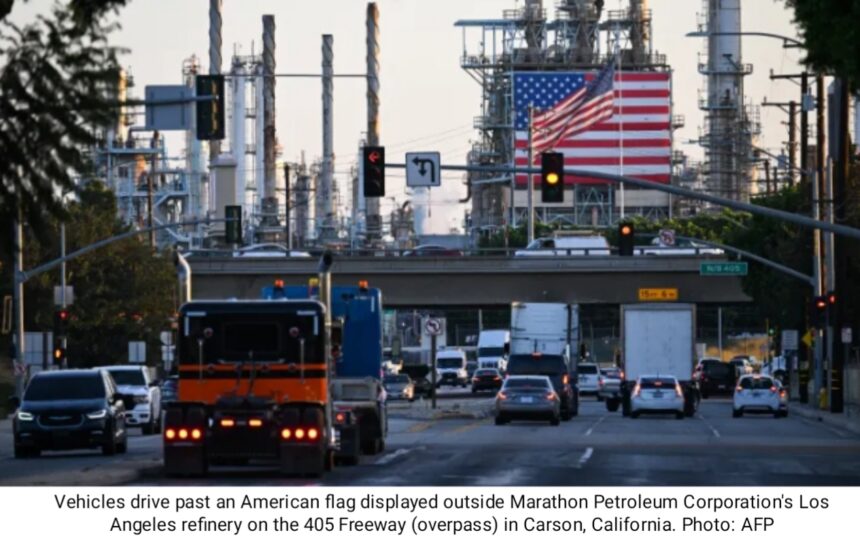
U.S. President Donald Trump has said his administration is seriously considering a possible ban or restriction on diesel exports as rising fuel prices put increasing pressure on American consumers, farmers and businesses ahead of the November midterm elections. Speaking to a Fox News reporter on Sunday while attending the Presidents Cup golf tournament in Illinois, Trump said the White House was looking closely at the proposal and could still move ahead with an export ban. “We’re thinking about it very seriously,” Trump said, while acknowledging that restricting diesel exports could also have an effect on gasoline prices. “That can oftentimes lead to a little bit of an increase on gasoline for cars, so we’re looking at it very seriously. We may do it,” he added. Trump has raised the possibility of restricting diesel exports several times in recent weeks as U.S. diesel prices have climbed to record or near-record levels. Earlier in September, he indicated that a decision would be made quickly on whether to impose restrictions. The administration has yet to announce a final policy, however, and Energy Secretary Chris Wright has suggested that officials are examining measures that could limit exports rather than imposing a complete ban. Politico previously reported that the administration was preparing a plan for a 90-day diesel export ban, although the precise form and timing of any measure remained uncertain. The debate comes as the global diesel market faces growing supply pressures linked to disruptions in major oil-producing and trading regions. Hostilities involving the United States and Iran, the continuing Russia-Ukraine war and disruptions to important energy routes have contributed to tighter fuel markets and higher prices. In the United States, average diesel prices were around $6.50 a gallon on Friday, according to AAA, close to the record high of $6.53 reached on September 22. Higher diesel costs are particularly significant for farmers, trucking companies, construction businesses and other industries that rely heavily on diesel-powered machinery and transportation. The possibility of an export ban has also raised concerns across the U.S. energy industry and in international fuel markets. The American Petroleum Institute has argued that restricting U.S. energy exports could create additional problems for refiners and ultimately increase costs for consumers. API chief executive Mike Sommers said the focus should instead be on increasing supply and maintaining flexibility in energy markets. Analysts have also warned that an export restriction could have consequences beyond the U.S. domestic market. Morgan Stanley commodity strategists said a U.S. restriction could initially push American diesel prices lower, but the effects could spread through the wider fuel market and potentially create higher prices elsewhere. According to the analysts, reduced U.S. exports could raise global diesel prices and could also create pressure on U.S. gasoline prices if refiners adjust their operations in response to changing market conditions. The United States has become an important source of diesel supplies for international markets, particularly as fuel flows from Russia and parts of the Middle East have been disrupted. Benedict George, head of European product pricing at Argus Media, said any significant U.S. restriction on diesel exports could push European diesel prices and premiums to unusually high levels. He noted that the United States had supplied roughly half of Europe’s diesel imports during the previous couple of months, highlighting the importance of American exports to the European market. George also stressed that no final decision had been taken and that it remained unclear whether the United States would introduce restrictions at all or what form such restrictions might take. European oil traders, he said, have questioned whether Washington would impose a major export restriction because of the potential difficulties it could create for U.S. oil companies and the broader energy market. The pressure on diesel supplies is also connected to the wider disruption of global oil markets. Ukrainian attacks on Russian oil refineries have affected fuel production and exports, while the continuing conflict has created uncertainty over future supplies. Trump has previously urged Ukrainian President Volodymyr Zelenskyy to stop attacks on Russian oil refineries, arguing that the strikes were contributing to higher fuel prices and hurting global markets. Ukraine, meanwhile, has described Russian oil refineries as legitimate military targets as it prepares for another difficult winter and remains concerned about possible Russian attacks on its energy infrastructure. At the same time, uncertainty surrounding the Strait of Hormuz has added another layer of risk to global energy markets. The waterway is a major route for international oil and fuel shipments, meaning any prolonged disruption could have consequences far beyond the Middle East. Energy market analysts say the combination of geopolitical conflicts, disrupted supply routes and uncertainty over U.S. policy has made the outlook for diesel particularly difficult to predict. Argus Media’s George described diesel as one of the biggest problems facing the global oil system, saying the current situation had become more difficult because of developments involving Russia, Ukraine and the Middle East. The duration of the global diesel supply pressure remains uncertain. George said some traders have become reluctant to make long-term forecasts because of the number of unpredictable factors affecting the market. If Washington eventually introduces an export restriction, market participants expect it could initially be limited in duration, potentially lasting only a few months. However, the broader supply problems linked to the Russia-Ukraine war and disruptions around the Strait of Hormuz could continue for much longer, depending on developments on the ground and the outcome of diplomatic efforts. For the Trump administration, the issue has become increasingly sensitive as American consumers face higher fuel costs and the November midterm elections approach. A decision to restrict diesel exports could affect domestic prices, international fuel supplies and the operations of U.S. refiners, while leaving policymakers to balance the goal of reducing domestic fuel costs against the possible consequences for global markets. For now, the White House has not announced a final diesel export policy, leaving energy companies, farmers, traders and consumers waiting to see whether the administration will introduce a temporary restriction, a voluntary limit or a full export ban. The decision could become an important test of how Washington responds to the current global fuel supply squeeze while trying to limit the impact of higher energy costs on the U.S. economy.
Trump administration considering ban on diesel exports to US amid rising fuel prices