

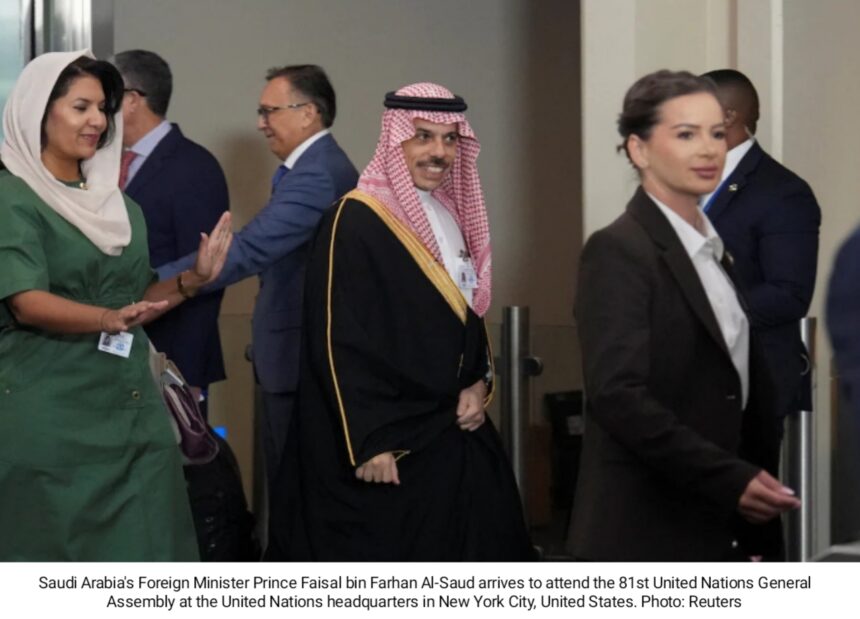
Saudi Arabia’s Foreign Minister Prince Faisal bin Farhan arrived in Washington on Monday for talks with U.S. Secretary of State Marco Rubio, as tensions between Saudi Arabia and Yemen’s Iran-aligned Houthi movement continue to escalate. The visit comes at a sensitive moment for the region, with Riyadh facing increased security pressure from Houthi missile and drone activity and Washington weighing how far it should become directly involved in the conflict. Saudi state news agency SPA said Faisal and Rubio are expected to discuss bilateral relations as well as major regional and international developments.
The Washington talks are taking place against the backdrop of a broader Middle East conflict that has placed additional pressure on Saudi Arabia’s security position. The Houthis have expanded their military activity in Yemen in recent weeks, while Saudi Arabia has sought greater international support as the group’s operations have threatened the kingdom and important maritime routes around the Red Sea and Bab el-Mandeb. Reuters reported that Saudi Crown Prince Mohammed bin Salman sought U.S. military assistance earlier this month to counter the Houthi threat. According to sources cited by Reuters, Washington declined to conduct direct strikes against the Houthis but agreed to provide intelligence and targeting support.
The Saudi request highlights a difficult issue for Washington. The United States has longstanding security ties with Saudi Arabia and has an interest in protecting regional stability and freedom of navigation, but direct military action against the Houthis would open another potential front in an already complex regional conflict. Reuters previously reported that Washington had emphasized protecting core U.S. national security interests, including freedom of navigation in the Red Sea, while encouraging regional partners to take the lead in addressing local security challenges.
For Riyadh, the immediate concern is the growing ability of the Houthis to threaten Saudi territory and strategic infrastructure. The latest escalation follows a period in which Houthi forces have made significant advances in Yemen. Reuters reported earlier in September that Houthi fighters had pushed into strategic areas near the Red Sea coast and sought positions overlooking the Bab el-Mandeb Strait, one of the world’s major maritime chokepoints. The development has increased concern about the potential impact on shipping, energy supplies and regional security.
The Bab el-Mandeb Strait is particularly important because it connects the Red Sea with the Gulf of Aden and provides a major route for international shipping between Europe and Asia. Any prolonged disruption in the area could increase shipping costs and create additional pressure on global energy markets. The latest Saudi-U.S. discussions therefore extend beyond the immediate confrontation with the Houthis and into wider questions about maritime security and the stability of international trade routes.
Saudi Arabia has already faced direct attacks as the confrontation has intensified. Reuters reported earlier this month that Houthi forces claimed missile and drone attacks targeting sensitive sites in Riyadh, while Saudi authorities said they intercepted missiles and prevented additional attacks in several locations. The escalation also raised concerns about threats to Saudi energy infrastructure and Red Sea shipping.
The security situation has also affected Saudi Arabia’s calculations regarding its traditional relationships with Washington and other international partners. Riyadh has historically relied heavily on U.S. military equipment, intelligence cooperation and security partnerships, but the current conflict is testing the limits and expectations of those relationships. The Saudi government’s request for U.S. assistance against the Houthis indicates that Riyadh wants Washington to play a greater role in addressing the immediate threat, while the U.S. response so far has remained more limited.
The disagreement over direct military strikes does not mean that Washington and Riyadh have broken from their longstanding security relationship. Instead, it reflects different calculations over the risks of military escalation. For the United States, direct strikes against the Houthis could lead to retaliation against U.S. interests or further destabilization of the Red Sea region. For Saudi Arabia, continued Houthi missile and drone activity represents a direct security concern that could affect population centers, energy infrastructure and transport routes.
The situation has become more complicated because the Houthi escalation is occurring alongside the wider conflict involving Iran. The Houthis are aligned with Iran, and their expanding military activity has become part of a broader regional confrontation. Reuters has reported that the Houthi advance has increased pressure on Washington at a time when the United States is already dealing with the consequences of the wider Iran conflict.
The regional implications are also being felt by other Gulf states. Saudi Arabia has sought support from regional partners while emphasizing its right to defend itself. In a joint statement issued during the United Nations General Assembly, the foreign ministers of Saudi Arabia, Türkiye, Egypt and Pakistan expressed support for Riyadh’s right to defend itself under international law and called for safe navigation in the region. They also stressed dialogue and diplomacy as the path toward resolving regional conflicts.
The United Kingdom has also responded to Saudi security concerns. Reuters reported that Britain agreed to provide defensive air-to-air refuelling support following a Saudi request, while emphasizing that the assistance was intended to help protect Saudi Arabia and important regional routes. The move illustrates how the Houthi conflict has begun to draw a range of international actors into efforts to strengthen Saudi Arabia’s defensive capabilities without necessarily committing them to direct offensive operations against the group.
For Saudi Arabia, the current situation is particularly sensitive because the kingdom has spent recent years seeking greater economic diversification and regional stability. The security environment created by missile attacks, drone threats and disruptions to maritime routes presents challenges not only for national defence but also for trade, investment and energy exports.
The escalation also comes after years of attempts to reduce tensions in Yemen. Saudi Arabia and the Houthis had maintained a period of relative calm, but the latest fighting has broken that stability. Reuters reported that the escalation dates back to early July, when Houthi forces confronted what they said were Saudi warplanes near Sanaa. That confrontation contributed to the collapse of a period of relative calm between Riyadh and the Iran-aligned movement.
The Houthis’ recent battlefield gains have added another layer to the problem. Reuters reported that the group has made advances along Yemen’s Red Sea coast and captured strategically important territory and islands near the Bab el-Mandeb Strait. Those developments have increased concerns that the conflict could affect one of the world’s most important maritime corridors.
The United States therefore faces a difficult policy balance. Washington has an interest in protecting Saudi Arabia and maintaining freedom of navigation, but it also faces the risk that deeper military involvement could expand the regional conflict. The current arrangement, under which Washington provides intelligence and targeting assistance while Saudi Arabia manages much of the military response, represents a more limited form of U.S. involvement than direct airstrikes.
Prince Faisal’s meeting with Rubio could provide an opportunity for both governments to discuss the limits and scope of that cooperation. The Saudi side is likely to focus on immediate security concerns, while Washington will also have to consider the wider consequences of any additional military assistance. The two sides are also expected to discuss bilateral relations and other regional and international developments, according to Saudi state media.
The talks also come as the United States, Saudi Arabia and other regional governments continue to deal with the economic consequences of instability in the Middle East. Energy markets have already been affected by disruptions around the Strait of Hormuz and concerns over shipping routes in the Red Sea. Saudi Arabia has had to adjust its oil-export logistics amid attacks and infrastructure concerns, adding to the importance of keeping alternative routes and maritime corridors operational.
The wider economic implications could become more serious if the Houthi conflict continues to expand. The Red Sea and Bab el-Mandeb are critical for international trade, and prolonged insecurity can force ships to take longer routes, increasing fuel consumption, insurance costs and delivery times. Energy markets are particularly sensitive because the Middle East remains central to global oil supplies.
At the same time, the diplomatic dimension remains important. Regional governments have repeatedly called for dialogue and efforts to prevent the conflict from spreading further. Saudi Arabia’s engagement with Washington does not necessarily indicate that Riyadh has abandoned diplomatic options. Rather, the kingdom appears to be seeking security assistance while managing a rapidly changing regional environment.
The meeting between Prince Faisal and Rubio will therefore be watched closely in the region. The immediate question is how the United States will respond if Houthi attacks continue or intensify. Another question is whether Saudi Arabia will receive additional defensive assistance or whether Washington will maintain its current position of providing intelligence and targeting support without launching direct strikes.
For Washington, the challenge is to balance its longstanding security partnership with Saudi Arabia against the risks associated with deeper involvement in Yemen. For Riyadh, the priority is protecting its territory, infrastructure and economic interests while confronting a Houthi movement that has demonstrated an increasing ability to operate beyond Yemen’s immediate battlefield.
The outcome of the talks may not resolve the wider conflict, but the discussions could provide a clearer indication of how Saudi Arabia and the United States intend to manage the latest escalation. With the Houthi threat extending from Yemen toward Saudi territory and key maritime routes, the security situation remains closely connected to the broader Middle East crisis.
For now, Prince Faisal’s arrival in Washington underscores the importance Saudi Arabia places on its relationship with the United States at a time of heightened regional insecurity. The talks with Rubio are expected to cover both the immediate Houthi threat and the broader strategic relationship between the two countries, while the region continues to face uncertainty over the direction of the wider conflict.