

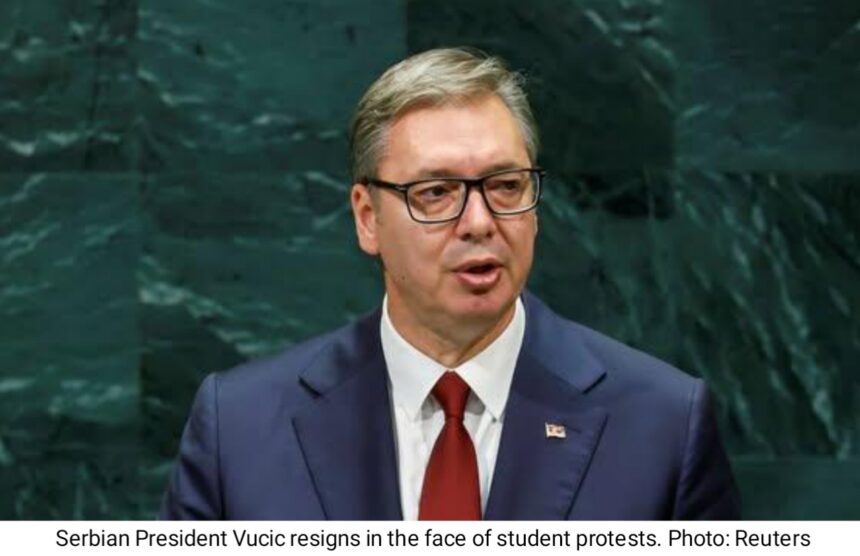
BELGRADE, September 28, 2026: Serbian President Aleksandar Vucic has resigned from office, bringing his second five-year presidential term to an early end and setting the stage for a presidential election later this year. His resignation comes less than a month before Serbia is due to hold an early parliamentary election on October 25, a vote that is taking place after months of political tension and student-led protests across the country.
Vucic announced his resignation on Sunday, September 27, in Belgrade. He had previously said that he planned to leave the presidency before the end of his mandate and take part in the parliamentary election as an ordinary citizen. His resignation allows him to campaign for his Serbian Progressive Party, or SNS, and potentially seek the position of prime minister if the party forms the next government.
The Serbian government had already dissolved parliament and formally scheduled the early parliamentary election for October 25, 2026. The decision was announced on September 9 after the government proposed dissolving the National Assembly and holding an early vote.
The political change comes at a sensitive moment for Serbia. For more than a year, the country has experienced demonstrations linked to demands for accountability, transparency and action against corruption. The protests intensified after the collapse of a railway station canopy in the northern city of Novi Sad in November 2024, which killed 16 people.
The disaster became a major political issue and triggered a sustained student-led protest movement. Demonstrators called for accountability for those responsible, greater transparency in public procurement, action against corruption and an early parliamentary election. The government has denied allegations that it mistreated protesters, while rights groups and opposition figures have continued to raise concerns about the treatment of demonstrators.
Vucic Ends His Presidency
Vucic, 56, has been one of the dominant figures in Serbian politics for more than a decade. He served as prime minister before becoming president in 2017 and was re-elected in 2022. His second presidential term was due to continue into 2027, but he chose to resign early.
In his resignation announcement, Vucic said he had served Serbia and its citizens faithfully. Supporters gathered outside the Presidency building in central Belgrade as he addressed the crowd shortly before formally submitting his resignation.
The Serbian government confirmed that Vucic had signed his resignation on September 27. Under the country’s constitutional arrangements, parliamentary Speaker Ana Brnabic is to assume the duties of acting president until a new president is elected.
The resignation therefore does not create a permanent vacancy in the presidency. Instead, the constitutional system provides for an interim arrangement while preparations are made for a new presidential election.
Vucic said the first round of the presidential election would take place by the end of December. Serbian rules require a presidential election to be completed within a limited period after the presidency becomes vacant.
Why the October Election Matters
The parliamentary election scheduled for October 25 was originally not expected until later, but the government moved to an early vote following months of political pressure.
The election will determine the composition of Serbia’s next parliament and, indirectly, the government that will emerge from it.
Vucic’s Serbian Progressive Party and its allies are expected to face several political groups, including a student-backed movement and opposition parties seeking closer integration with the European Union.
The student movement emerged from protests following the Novi Sad railway station disaster. What initially focused on accountability for the deaths later developed into a broader political campaign involving demands related to corruption, public institutions, elections and the rule of law.
The upcoming election will therefore take place in an environment marked by a strong divide between the governing political establishment and groups demanding political change.
The student movement has entered the electoral process under the name Students Win, according to Reuters. A separate coalition of pro-European opposition parties, known as European Serbia, is also taking part.
The different opposition groups have not all taken the same approach to Serbia’s domestic and foreign policy, making the election a contest involving several political positions rather than a simple two-sided race.
Vucic’s Possible Move to the Prime Minister’s Office
Vucic’s resignation is closely connected to his political plans after leaving the presidency.
The Serbian president has indicated that he wants to participate in the parliamentary campaign without using the powers of the presidency. By resigning, he can campaign as a party leader and seek a parliamentary role.
If the Serbian Progressive Party and its allies form the next government, Vucic could potentially become prime minister.
This would mark a change in position rather than an exit from national politics. Serbia’s political system gives the prime minister a central role in running the government, while the president has important constitutional responsibilities as head of state.
Vucic has already spent years moving between the two offices. He was prime minister from 2014 to 2017 before becoming president.
His decision to leave the presidency before the end of his term therefore creates a new political phase rather than necessarily ending his influence within Serbian politics.
Ana Brnabic Becomes Acting President
Following Vucic’s resignation, parliamentary Speaker Ana Brnabic is expected to serve as acting president.
Brnabic is a close political ally of Vucic and previously served as Serbia’s prime minister. Her temporary role will include carrying out the duties of the presidency until a new head of state is elected.
The arrangement is taking place while Serbia’s parliament itself has been dissolved ahead of the October election. Once a new parliament is elected, the country’s political institutions will move into another phase as parties negotiate the formation of a government.
The new parliament will be central to determining who becomes prime minister and what political direction the government takes.
The presidential election will then provide another major political test later in the year.
Protests Changed Serbia’s Political Environment
The current political situation cannot be separated from the protests that began after the Novi Sad railway station disaster.
In November 2024, a concrete canopy at the city’s newly reconstructed railway station collapsed, killing 16 people. The incident generated widespread public anger and led to student demonstrations.
Students demanded that authorities explain how the reconstruction was carried out and identify those responsible for the disaster. They also called for greater transparency in public procurement and stronger action against corruption.
The protests expanded beyond universities and became a broader national political movement.
Several government officials faced legal or political consequences following the disaster. The government, however, rejected accusations that it had failed to respond appropriately or that it had systematically mistreated protesters.
Rights groups have separately accused the authorities and Vucic’s allies of increasingly authoritarian rule. Protesters have alleged that police used excessive force and that some demonstrators were unfairly detained. Serbian authorities have denied those allegations.
These competing accounts are now part of the political debate surrounding the October election.
Vucic Pardons Protest-Related Defendants
On the day of his resignation, Vucic also announced pardons involving people connected with the protests.
According to Reuters, he granted amnesty and pardons to 49 people, including activists and supporters of his own political movement who had been arrested or prosecuted in connection with the protests.
The decision came as Serbia entered the final stages of campaigning for the parliamentary election.
The pardons have added another element to the political discussion surrounding the protests and the government’s response to them.
Vucic has argued that his government has worked to maintain stability and protect Serbia’s interests. Protesters and opposition groups have continued to demand accountability and institutional changes.
Vucic’s Political Background
Vucic entered national politics during the period of Slobodan Milosevic’s rule in the 1990s, when he served as information minister. He later moved toward a more moderate political position and became a leading figure in the Serbian Progressive Party.
He became deputy prime minister in 2012 and prime minister in 2014. In 2017, he moved to the presidency.
Although Serbia’s presidency is formally distinct from the government, Vucic maintained a strong role in the country’s political decision-making during his years as president.
His political influence has also extended to the Serbian Progressive Party, which has remained a central force in Serbian politics.
The October election will therefore be closely watched because Vucic will be campaigning without the formal powers of the presidency.
Serbia Between the EU, Russia and China
Foreign policy will also be an important issue in Serbia’s political debate.
Vucic has pursued a policy that maintains relations with several major international powers.
Serbia has formally sought membership in the European Union, while also maintaining close relations with Russia and China.
Russia remains an important energy partner for Serbia, while China has become a significant investor in Serbian infrastructure and other parts of the economy.
At the same time, Serbia has sought stronger relations with Western countries, including the United States, and has maintained diplomatic contacts with Israel.
This balancing approach has sometimes created tensions with Serbia’s European integration process.
The war in Ukraine has further complicated the situation. Serbia has not followed the European Union in imposing sanctions on Russia, while continuing to state that EU membership remains a strategic objective.
The country’s next government will therefore face questions over how to balance relations with the EU, Russia, China and the United States.
The Economic and Political Stakes
The election will also take place against a background of economic and infrastructure issues.
The Serbian government has promoted investment, infrastructure development and preparations for international events, while the opposition and protest movement have focused heavily on transparency and accountability.
The Novi Sad railway station disaster brought infrastructure projects and public procurement under intense public scrutiny.
For voters, the election is therefore likely to involve both political questions and concerns about public administration, corruption, economic policy and relations with Europe.
The outcome will determine the composition of the next parliament and influence the formation of the next government.
What Happens After October 25?
The October 25 parliamentary election will be followed by negotiations over the formation of a new government.
The party or coalition able to secure sufficient parliamentary support will be in a position to form the government.
If Vucic’s party and its allies obtain enough support to form a government, he could seek the prime minister’s position.
At the same time, the presidential election must be held by the end of December. That means Serbia will face two major national elections within a short period.
The parliamentary vote will determine the country’s government, while the presidential election will determine who succeeds Vucic as head of state.
The two elections could therefore shape Serbia’s political direction for the next several years.
A New Phase for Serbian Politics
Vucic’s resignation marks the end of his second presidential term but does not necessarily mark the end of his role in Serbian politics.
His decision to leave the presidency before the October parliamentary election allows him to campaign directly for his party while avoiding the use of presidential office during the final stage of the election campaign.
The move also creates an unusual political situation in which a former president could potentially return to the executive branch as prime minister.
At the same time, the emergence of the student-led movement has changed the political environment. The movement has transformed from a protest campaign into an electoral force, bringing issues such as accountability, corruption, public procurement and institutional reform into the centre of the national debate.
The October election will provide an opportunity for Serbian voters to choose a new parliament, while the presidential election later in the year will determine the country’s next head of state.
For Serbia, the coming months will therefore involve a transition at the presidency, a parliamentary election and a subsequent presidential contest, all against the background of continued debate over the country’s domestic institutions and its foreign-policy direction.
Vucic’s resignation has opened a new chapter in Serbia’s political process. The immediate focus now turns to the October 25 parliamentary election, the formation of the next government and the presidential election expected by the end of December.