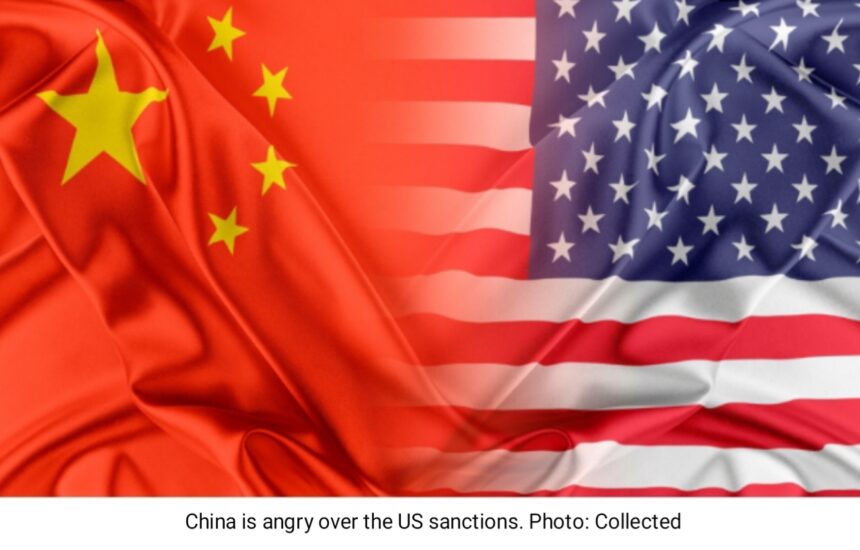
BEIJING — China has unveiled a sweeping package of countermeasures against the United States, targeting American companies, tightening export controls on drones and related technologies, and restricting the role of U.S.-based certification agencies in Chinese manufacturing inspections. The latest actions mark another significant escalation in the increasingly strategic rivalry between the world’s two largest economies, as Beijing responds to a series of recent U.S. trade, technology, and human rights measures.
According to China’s Ministry of Commerce, seven American entities have been placed under business restrictions, prohibiting Chinese organizations and individuals from conducting commercial dealings or cooperation with them. The ministry also announced stricter licensing procedures for drones, critical drone components, and related technologies destined for the United States, while suspending the participation of U.S. agencies in follow-up factory inspections required under China’s mandatory product certification system.
Chinese officials said the measures were introduced in direct response to a succession of U.S. actions affecting Chinese telecommunications companies, testing laboratories, drone manufacturers, consumer networking equipment, submarine cable projects, advanced robotics technologies, and power electronics. Beijing also pointed to Washington’s recent decision to add more than 40 Chinese entities to the Uyghur Forced Labor Prevention Act entity list, arguing that the move unjustly targeted Chinese businesses and disrupted normal commercial activities.
The announcement comes shortly after reports that the Trump administration is preparing a new national security initiative aimed at blocking imports of next-generation Chinese data center components, including advanced optical transceivers. The proposal is part of Washington’s broader strategy to reduce dependence on Chinese technology while tightening export and import controls on products considered strategically sensitive.
Industry analysts view Beijing’s latest response as part of a carefully calibrated strategy rather than an attempt to trigger a full-scale economic confrontation. Alfredo Montufar-Helu, Managing Director of Ankura China in Beijing, described the measures as a predictable retaliation, noting that Chinese authorities have spent months expanding their legal and regulatory tools to respond to U.S. restrictions. He suggested that both governments continue to favor targeted actions over sweeping sanctions, indicating a shared interest in preventing the dispute from escalating into a broader economic crisis.
Among the companies directly affected is Arizona-based Compliance Testing LLC, which Beijing accused of supporting recent actions by the U.S. Federal Communications Commission (FCC). Chinese authorities claim the company assisted measures that undermined the legitimate rights and commercial interests of Chinese technology firms. The FCC had previously introduced a faster review process for devices tested in laboratories located in the United States or reciprocal partner countries while proposing to stop recognizing certification bodies in countries lacking equivalent arrangements with Washington. If fully implemented, those changes could make it significantly more difficult for Chinese laboratories to obtain FCC equipment authorization for products sold in the U.S. market.
China also imposed identical business restrictions on Applied DNA Sciences, Stratum Reservoir, Altana Technologies, the Responsible Business Alliance, Verité Group, and Human Rights in China. Beijing accused these organizations of supporting U.S. sanctions and human rights initiatives related to Xinjiang. While the restrictions prohibit commercial cooperation with Chinese entities, the announced measures do not include asset freezes or travel bans.
In the technology sector, China’s export control regime has become noticeably stricter. Government officials confirmed that exports of controlled drones, key drone components, and associated technologies destined for the United States will now undergo enhanced case-by-case licensing reviews without access to streamlined approval procedures. Although the policy does not constitute a blanket export ban, experts believe it could significantly delay shipments and disrupt supply chains involving dual-use technologies.
Beijing has also suspended U.S.-based certification agencies from conducting follow-up inspections under China’s compulsory product certification system. Manufacturing experts warn that the decision could increase compliance costs, delay product approvals, and complicate international supply chains for companies operating across both markets.
In a separate move, China’s Commerce Ministry announced a national security investigation into imported printers, photocopiers, and office equipment. While the investigation does not specifically identify the United States or individual manufacturers, officials explicitly described it as part of China’s broader response to recent U.S. policy actions.
The latest developments highlight the growing strategic competition between Washington and Beijing, extending far beyond tariffs into advanced technology, telecommunications, artificial intelligence, supply chain security, export controls, and industrial standards. Rather than imposing comprehensive trade embargoes, both governments appear to be relying on increasingly sophisticated and narrowly targeted regulatory tools designed to maximize political and economic leverage while minimizing broader market disruption.
Despite continued diplomatic engagement between the two countries, tensions remain elevated as each side strengthens its defensive economic policies and seeks greater control over critical technologies. Analysts believe the expanding cycle of retaliatory measures will continue to reshape global supply chains, increase compliance costs for multinational corporations, and deepen the technological divide between the United States and China. As geopolitical competition intensifies, businesses worldwide are likely to face growing uncertainty in navigating the increasingly fragmented landscape of international trade and technology.
China retaliates in response to US sanctions, bans business with 7 US companies in Beijing