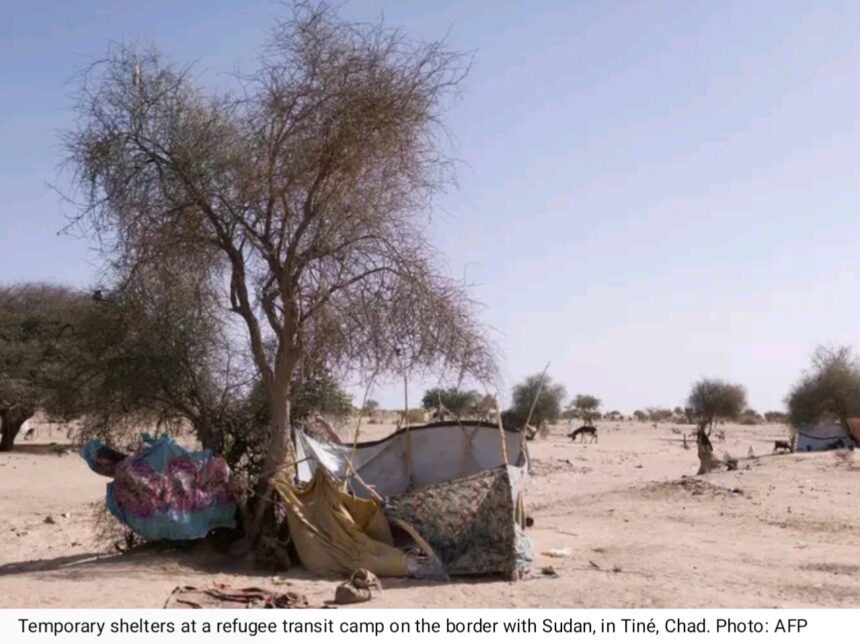
A deadly air strike near the Chad–Sudan border has heightened fears of a wider regional escalation after Chadian authorities accused Sudan’s army of attacking a fuel market, killing at least 12 people and wounding seven others. The strike, reportedly carried out on Thursday, comes as Sudan’s devastating civil war enters its fourth year and continues to generate severe humanitarian and security pressures across the region. According to Chadian security officials cited by Agence France-Presse, the strike targeted a fuel market used by members of Sudan’s Rapid Support Forces to obtain fuel. The identities of those killed and wounded, and the extent of their links to the paramilitary force, could not be independently verified. The latest incident has raised fresh concerns that Sudan’s internal conflict could increasingly spill across its borders, particularly into Chad, which has received a large number of Sudanese refugees. Chadian authorities had already accused the Sudanese army of conducting an air strike inside Chadian territory the previous week, saying the attack struck a military convoy more than 100 kilometres inside the eastern Ennedi region, with no Chadian casualties reported. Following the incidents, Chad increased its security alert along parts of the eastern border over concerns about possible attacks involving unmanned aircraft. A local source also told Reuters that approximately 100 armoured vehicles and electronic signal-jamming vehicles had been deployed near eastern Tine, close to the Sudanese border. The deployment highlights growing concern in N’Djamena that the conflict in neighbouring Sudan could evolve into a direct security threat to Chadian territory. Sudan has rejected the allegations against its armed forces and called for a professional and independent investigation before responsibility is assigned. Sudan’s Foreign Ministry said it was surprised by the accusations before any independent investigation into the circumstances of the incident and said the Sudanese armed forces were carrying out their constitutional responsibility to protect the country’s sovereignty, security and safety while respecting the sovereignty of neighbouring countries. The conflicting claims have made it difficult to establish the precise circumstances of the attack, while independent verification of the location, target and origin of the strike remains limited. The United States embassy in Khartoum has also accused the Sudanese army of carrying out the recent strikes inside Chad and condemned the attacks, adding another layer of international pressure to the dispute. The latest confrontation is rooted in Sudan’s wider civil war, which began in April 2023 when fighting erupted between the Sudanese Armed Forces and the Rapid Support Forces. The conflict has spread across large parts of Sudan, including Khartoum, Darfur and Kordofan, triggering one of the world’s largest displacement crises. Millions of people have been forced from their homes, while access to food, clean water, healthcare and shelter has deteriorated sharply. Chad has absorbed a particularly large number of Sudanese refugees, placing enormous pressure on communities already facing poverty, food insecurity and limited access to basic services. Nearly one million displaced Sudanese people have fled across the border into Chad, according to reports cited in recent coverage, with many living in makeshift camps where access to clean water has become an increasingly serious problem. Relations between Chad and Sudan have also been strained by competing accusations over support for forces involved in the Sudanese conflict. Sudan’s army has previously accused Chad of aligning itself with the Rapid Support Forces, while Chad has rejected allegations that it is directly participating in Sudan’s war. The border region remains vulnerable to the movement of armed groups, weapons and other supplies, while the presence of large numbers of displaced people has added further pressure to an already fragile security environment. If attacks continue to cross the border, Chad could face growing domestic pressure to respond militarily, potentially transforming Sudan’s primarily internal conflict into a broader regional security crisis. The security concerns come at a time when Chad is already under severe humanitarian pressure, with many Sudanese families depending on humanitarian assistance for food, water and medical care. Any further escalation along the border could trigger another wave of displacement and place additional pressure on limited resources, while insecurity could restrict humanitarian access and disrupt the delivery of essential supplies. For international observers, the most serious concern is that repeated attacks along the Chad–Sudan border could gradually expand the geographical scope of Sudan’s war. If allegations of attacks on Chadian territory are confirmed and continue, the conflict could become increasingly regional, with possible consequences for other neighbouring states such as Libya and the Central African Republic. The use of unmanned aircraft and long-range military capabilities could further increase the risks, while even a single miscalculation could trigger retaliation and rapidly escalate tensions between neighbouring governments. The immediate priority is therefore an independent investigation capable of establishing what happened, where the strike originated, what its intended target was and who was responsible. Without reliable evidence, competing accusations between Chad and Sudan could further inflame tensions. The latest incident underscores the need for stronger mechanisms to prevent Sudan’s war from spilling into neighbouring countries, while diplomatic engagement, border monitoring and humanitarian coordination could become increasingly important as the conflict continues. For Chad, the challenge is particularly difficult: it must protect its territory while continuing to provide shelter to people escaping one of Africa’s most devastating conflicts. For Sudan, continued fighting near the border risks deepening diplomatic isolation and creating additional pressure from neighbouring states and the international community. The deaths at the fuel market therefore represent more than another tragic episode in Sudan’s long-running war; they are a warning that the conflict’s consequences are increasingly extending beyond Sudan’s borders. As accusations continue to circulate and military deployments increase, the coming days will be crucial, with the findings of an independent investigation, the actions of the Sudanese and Chadian authorities, and the ability of regional and international actors to prevent further escalation likely to determine whether the latest confrontation remains a contained border incident or develops into a broader regional crisis.
Airstrike on Chad-Sudan border, 12 killed: Chad accuses Sudanese army