The reported attack in the Caspian Sea has raised fresh concerns that the Russia-Ukraine war may be entering a new strategic phase, extending beyond its established battlefields and drawing Iran more directly into an already complex geopolitical confrontation. While key aspects of the incident remain independently unverified, the competing claims from Tehran and Kyiv underscore how the conflict is increasingly targeting military logistics, supply corridors and critical infrastructure far from the front lines.
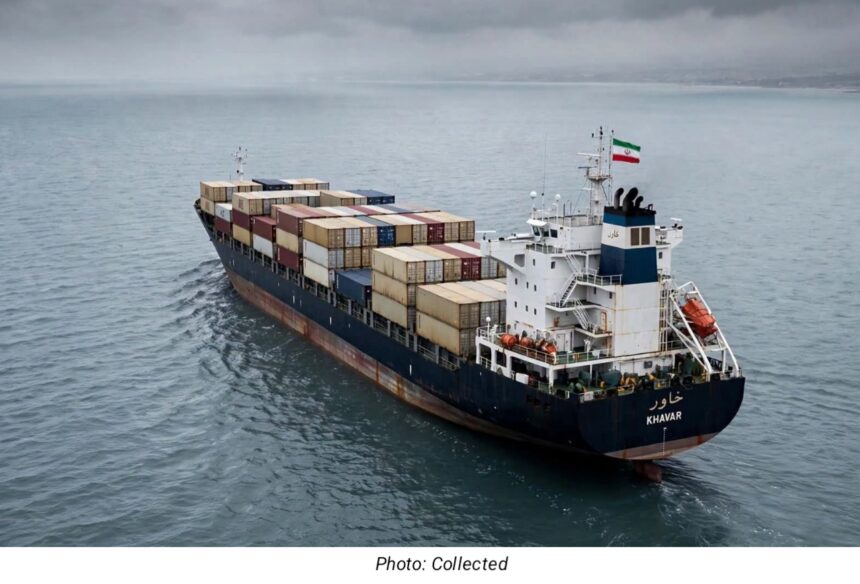
Iran’s Foreign Ministry has accused Ukraine of attacking one of its commercial vessels in the Caspian Sea, claiming the strike killed one crew member and injured another. Tehran condemned the incident as an act of aggression, warning that it reserves the right to defend its national interests and maritime security. Iranian officials further alleged that Kyiv is deliberately attempting to widen the scope of the conflict by targeting assets linked to Iran.
Ukraine, however, has presented a markedly different account. President Volodymyr Zelenskyy stated that Ukrainian forces struck a Russian warship along with vessels allegedly transporting military cargo connected to Iran. According to Ukrainian Special Operations Forces, the operation was carried out near Russia’s Kalmykia coastline in coordination with a local resistance movement. Ukrainian sources claimed the targeted vessels were part of a logistics network allegedly used to transport military equipment between Iran and Russia and were already under US sanctions.
Military analysts have long viewed the Caspian Sea as one of the most strategically important supply corridors connecting Iran and Russia. As sanctions and heightened security risks complicated transport routes elsewhere, the inland sea reportedly became an increasingly valuable channel for moving drones, missile components, ammunition and other military equipment to southern Russian ports before shipment onward to the Ukrainian battlefield. Any successful disruption of this route could therefore have significant implications for Russia’s logistical capacity and operational sustainability.
The broader significance of the reported incident lies in its potential geopolitical consequences. If Iranian-linked commercial shipping has indeed been struck, Tehran could face growing domestic and diplomatic pressure to respond more forcefully. Such a development would risk adding another regional actor to an already volatile conflict and further complicate international efforts to prevent escalation.
From Kyiv’s perspective, however, disrupting Russian supply chains has become a central element of its military strategy. Over recent months, Ukraine has increasingly focused on long-range operations targeting logistics hubs, energy infrastructure, naval assets and transportation networks deep inside Russian-controlled territory. A reported strike in the Caspian Sea would represent a continuation of that strategy by attempting to weaken Moscow’s military support system rather than solely confronting frontline forces.
Nevertheless, many of the central claims surrounding the incident remain unverified by independent international observers. The identities of the targeted vessels, the extent of the reported damage, casualty figures and the precise circumstances of the operation have not been conclusively confirmed. As with many developments during wartime, both sides are engaged in an intense information campaign, making independent verification essential before definitive conclusions can be drawn.
Regardless of the eventual findings, the reported events highlight an evolving reality of the Russia-Ukraine war: the battlefield is increasingly defined not only by territorial gains but also by the contest over strategic supply networks stretching across multiple regions. Should the Caspian Sea emerge as another active theatre of military operations, the implications would extend well beyond Russia and Ukraine, potentially affecting Iran, the South Caucasus, Central Asia and wider international security dynamics. Such a shift would mark another significant escalation in a conflict whose geopolitical consequences continue to expand far beyond Eastern Europe.
Explosion in the Caspian Sea, new dimension in the conflict – is Iran directly involved?