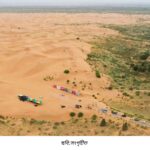
China’s decades-long effort to transform some of the world’s harshest deserts into thriving forests is now attracting global scientific attention after researchers uncovered an unexpected phenomenon that could reshape future climate strategies. Over the past five decades, China has planted an estimated 66 billion trees across the Gobi and Taklamakan deserts under its ambitious “Great Green Wall” project, one of the largest ecological restoration initiatives ever undertaken. Originally launched in 1978 to halt the rapid expansion of desertification, reduce devastating dust storms, and protect fertile farmland, the project has already produced remarkable environmental benefits, including a dramatic increase in forest cover and a significant decline in airborne dust affecting major cities such as Beijing. However, a newly published study in the journal Geophysical Research Letters suggests the project may be delivering an even more surprising outcome: trees growing in these human-created forests are expanding at a considerably faster rate than those in many natural forests. Scientists believe the accelerated growth could be linked to rising atmospheric carbon dioxide levels, indicating that these engineered ecosystems may be responding differently to climate change than previously understood. Yet researchers caution that the underlying mechanisms remain largely unknown. According to lead researcher Yuhang Luo, an environmental scientist at Peking University in Shenzhen, fundamental questions remain unanswered about how artificial forests differ from naturally evolved ecosystems and whether they can sustainably absorb carbon dioxide over the long term. These uncertainties are becoming increasingly important as governments around the world invest billions of dollars in large-scale tree-planting campaigns to combat global warming. China’s experience also highlights the importance of ecological planning rather than simply planting trees indiscriminately. Early phases of the project suffered major setbacks when fast-growing species failed to survive the harsh desert environment, forcing Chinese scientists to redesign their approach by selecting vegetation better suited to local climatic and soil conditions. Their persistence ultimately transformed the project into one of the world’s most successful ecological restoration programs. According to published research, China’s forest coverage in the project region has increased from approximately 5 percent in 1978 to around 14 percent by 2023, delivering measurable improvements in air quality, reducing sandstorms, protecting agricultural land, and strengthening regional ecological resilience. Nevertheless, scientists emphasize that existing climate models often fail to distinguish between natural forests and human-created plantations or account adequately for differences in forest age and ecological complexity. The findings underscore the urgent need for more sophisticated scientific assessments to determine how effectively artificial forests capture atmospheric carbon over time and what role they should play in global climate policy. As nations race to achieve carbon neutrality and address accelerating climate change, China’s Great Green Wall is evolving from an anti-desertification project into a globally significant natural laboratory whose unexpected ecological behavior may redefine how the world understands forest restoration, carbon sequestration, and the future of nature-based climate solutions.
China’s 66 Billion-Tree Desert Transformation Reveals a Scientific Mystery Beyond Climate Restoration