

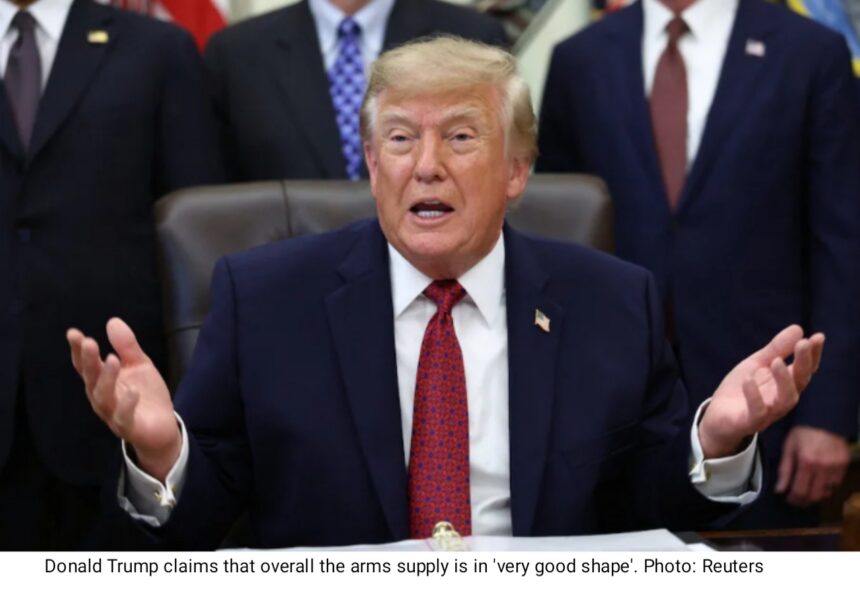
The United States is facing growing pressure on parts of its weapons stockpiles as the prolonged conflict with Iran places heavy demands on American military resources, with President Donald Trump acknowledging that supplies of some types of ammunition have fallen.
Trump has nevertheless rejected the idea that the United States is broadly running out of weapons. In a recent interview with TIME, he said the country has substantial weapons available and is continuing to replenish its stocks. His comments came as a Pentagon watchdog report raised concerns about strategic munitions shortages, production bottlenecks and the difficulty of replacing weapons consumed during sustained military operations.
The issue has become increasingly important because the United States has been engaged in a prolonged military confrontation with Iran while continuing to maintain significant commitments elsewhere, including support for European allies and military assistance related to the war in Ukraine.
The combination of high operational demand and the slow pace of some weapons production has exposed vulnerabilities in the US defence supply chain. Although the United States retains one of the world’s largest and most advanced military arsenals, replacing certain precision-guided missiles and air-defence interceptors can take months or even years.
Trump acknowledges lower ammunition supplies
In his TIME interview, Trump acknowledged that some forms of ammunition are at lower levels than the United States would normally prefer. At the same time, he argued that the overall condition of the American arsenal remains strong.
The distinction is important. A reduction in particular categories of munitions does not mean that the United States has exhausted its military capability. Rather, it indicates that prolonged combat operations can rapidly consume weapons faster than industrial production can replace them.
Trump has also blamed the previous administration for transferring large quantities of weapons to Ukraine, arguing that those transfers contributed to pressure on US stockpiles.
The issue of weapons availability has therefore become connected to two separate questions: how much the United States has already used in the conflict with Iran, and how quickly the American defence industry can replenish those supplies.
Pentagon watchdog warns of strategic shortages
A Pentagon Inspector General report has added weight to concerns about specific munitions.
According to reporting on the September report, the US military has experienced strategic inventory shortfalls following the heavy use of weapons during the conflict. The report also identified problems within the defence industrial base that could slow efforts to rebuild stocks.
The Pentagon has disputed some of the report’s conclusions and maintained that the US military continues to have the capabilities necessary to conduct its missions.
The disagreement illustrates the difference between having enough weapons to conduct current operations and having sufficient reserves for a prolonged conflict or an unexpected second major crisis.
For a military power such as the United States, maintaining reserve stocks is strategically important. A country may be capable of continuing combat operations while simultaneously facing a serious challenge in rebuilding its reserves.
Why ammunition production has become a problem
Modern warfare consumes enormous quantities of ammunition.
Precision-guided missiles, air-defence interceptors, cruise missiles and other advanced weapons are highly complex systems. They require specialised components, sophisticated electronics, propulsion systems and extensive testing.
Increasing production is therefore not as simple as ordering factories to make more weapons.
The US defence industry has been trying to expand production capacity for several important weapons systems, but manufacturers face shortages of components, limited production lines and long procurement cycles.
Some weapons require years of investment before additional manufacturing capacity becomes fully operational.
This creates a potential gap between military consumption and industrial replacement.
If a conflict continues for months or years, that gap can become strategically significant.
Missile defence is particularly demanding
One of the most important areas of concern is missile defence.
The United States has used sophisticated air and missile-defence systems to protect American forces and military facilities from Iranian missile and drone attacks. Interceptors used by systems such as THAAD and other air-defence platforms are expensive and difficult to manufacture quickly.
During an intense conflict, defensive missiles can be fired at incoming threats even when the attacker uses relatively inexpensive missiles or drones.
This creates an economic and logistical challenge.
A relatively low-cost attacking system can force a defender to use an interceptor worth millions of dollars. If attacks continue at a high rate, the defender must constantly replace those interceptors.
For the United States, maintaining adequate stocks of defensive missiles is therefore just as important as maintaining offensive weapons.
The Iran conflict and the Ukraine factor
The pressure on US weapons inventories cannot be viewed separately from the war in Ukraine.
Since Russia’s full-scale invasion of Ukraine in 2022, Washington has provided Kyiv with large quantities of ammunition, air-defence systems, artillery rounds, missiles and other military equipment.
Those transfers were made while the United States was also attempting to maintain its own readiness.
The Iran conflict has introduced a new challenge.
Instead of simply supplying an ally involved in a major war, the United States is now directly using significant quantities of military equipment in a separate theatre.
This creates competing demands on the same defence industrial base.
The American government must balance immediate battlefield requirements with the need to preserve sufficient reserves for future contingencies.
Washington moves to increase weapons production
The Pentagon has already taken steps to accelerate production of certain weapons.
In September, the US government awarded a multiyear contract worth more than $20 billion to RTX’s Raytheon division to expand production of AIM-120 AMRAAM air-to-air missiles.
The agreement is part of a broader effort to increase manufacturing capacity and rebuild stocks.
The US defence industry has also been under pressure to increase production of artillery ammunition, missile-defence interceptors and other systems.
However, expanding production takes time.
Factories require additional machinery, skilled workers, suppliers and raw materials. Some components are produced by a limited number of specialised companies, meaning that a problem at one point in the supply chain can affect the entire production process.
The financial cost is also rising
The weapons shortage issue is not only a military problem. It is also a major financial challenge.
The Pentagon watchdog report cited billions of dollars in spending related to the conflict. A substantial portion of that spending has gone toward munitions.
Replacing weapons that have already been fired requires additional government funding.
At the same time, the United States must finance the operation of aircraft carriers, combat aircraft, missile-defence systems, logistics networks and military personnel.
A prolonged conflict can therefore increase defence spending even if the number of American troops directly involved remains relatively limited.
The cost of rebuilding weapons inventories can continue long after active fighting has ended.
Trump signals continued pressure on Iran
The weapons issue has emerged alongside uncertainty over the future of the US-Iran conflict.
Trump has indicated that military action could resume after the US midterm elections if an acceptable diplomatic settlement is not reached.
That possibility creates another layer of uncertainty for military planners.
If fighting resumes or intensifies, demand for precision weapons and defensive interceptors could rise again.
The United States could therefore face a difficult balance between maintaining military pressure on Iran and preserving sufficient stocks for other possible security crises.
Three aircraft carriers and a wider military presence
The United States has also maintained a significant military presence in the wider Middle East.
American aircraft carriers, combat aircraft, naval assets and support forces provide Washington with substantial military power in the region.
However, large military deployments also require enormous quantities of fuel, spare parts, maintenance and ammunition.
Aircraft carriers themselves do not operate independently. They depend on extensive logistics networks involving supply ships, bases, aircraft maintenance facilities and regional partners.
The longer such a deployment continues, the greater the logistical burden becomes.
What the Pentagon dispute tells us
The disagreement between Trump and Pentagon officials over the condition of US weapons stocks should not be reduced to a simple question of whether America has enough weapons.
The more important issue is the composition of the stockpile.
The United States may have large overall inventories while simultaneously facing shortages of specific weapons that are particularly important in a modern conflict.
For example, a military can possess large numbers of conventional weapons but still face pressure if it lacks sufficient quantities of advanced air-defence interceptors or long-range precision missiles.
Military readiness therefore depends not only on the total number of weapons but also on their type, location, readiness status and replacement rate.
A challenge for the US defence industry
The situation is also forcing the American defence industry to reconsider how quickly it can respond to a major conflict.
For decades, many advanced weapons programmes were designed around relatively low peacetime production rates.
Large-scale wars have demonstrated that those assumptions may no longer be sufficient.
The conflict in Ukraine has already shown how quickly artillery ammunition can be consumed. The Iran conflict has highlighted the importance of missile defence and precision-guided weapons.
The result is growing pressure on Washington to expand production capacity before another major crisis occurs.
That process could require long-term contracts, new factories, additional suppliers and substantial investment in manufacturing technology.
Implications for US allies
The issue also matters to American allies.
Countries that rely on US weapons and missile-defence systems are watching the situation closely.
If American production capacity remains under pressure, Washington could face difficult decisions about how to distribute available weapons between its own forces and allied militaries.
This does not necessarily mean that US allies will stop receiving military assistance. But it does highlight the importance of maintaining diversified defence production and adequate national stockpiles.
European countries in particular have been discussing greater investment in their own defence industries since Russia’s invasion of Ukraine.
Diplomacy and military pressure
The weapons question also has a diplomatic dimension.
Military power is often used as leverage in negotiations, but prolonged military operations can create financial and logistical costs.
If Washington wants to maintain pressure on Tehran while avoiding an indefinite military campaign, diplomacy could become increasingly important.
At the same time, Iran’s military capabilities and regional relationships mean that any future confrontation could place further demands on US forces.
The balance between military pressure and diplomatic engagement is therefore likely to remain an important part of Washington’s Iran strategy.
What happens next
The immediate question is whether the conflict continues at its current level, expands or moves toward a negotiated settlement.
If military operations continue, the United States will need to maintain a steady flow of precision weapons and defensive interceptors while simultaneously rebuilding its strategic reserves.
If fighting decreases, Washington could use the opportunity to accelerate replenishment and expand production capacity.
Either way, the Pentagon’s ability to rebuild weapons stocks will remain an important measure of long-term military readiness.
The United States still possesses a vast and technologically advanced military arsenal. The current situation does not indicate that the country has simply run out of weapons.
Instead, the conflict has highlighted a more complicated problem: certain advanced munitions can be consumed much faster than they can be replaced.
Trump’s admission that some ammunition supplies are lower, combined with warnings from Pentagon oversight officials about strategic shortages and industrial bottlenecks, has brought that issue into sharper public focus.
For Washington, the challenge now extends beyond winning individual military engagements. It also involves ensuring that the American defence industrial base can sustain prolonged operations, replenish depleted inventories and remain prepared for other potential crises.
The experience of the Iran conflict, alongside lessons from the war in Ukraine, could therefore influence US defence planning for years to come. The central question is not simply how many weapons the United States possesses today, but whether its industrial system can produce enough of the right weapons quickly enough to meet the demands of a prolonged and increasingly complex security environment.