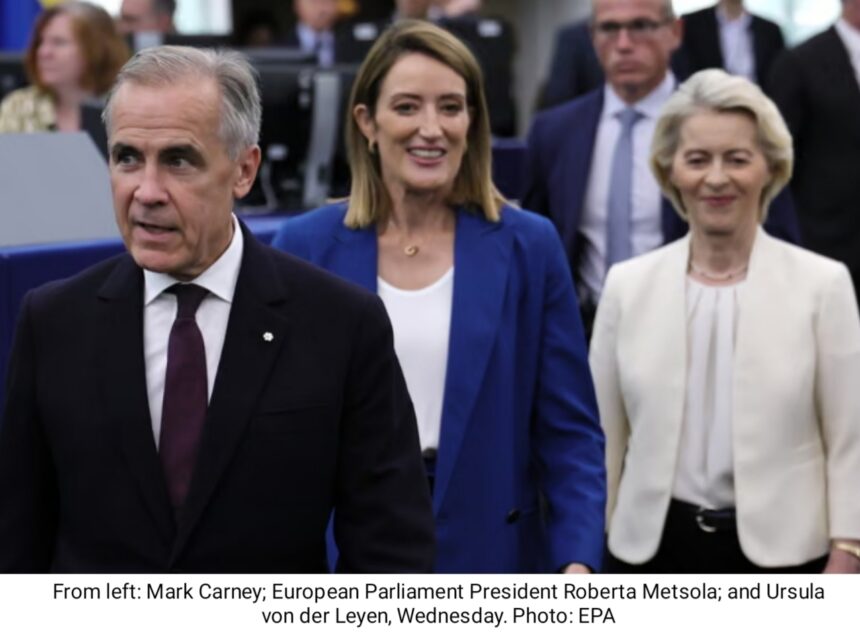
BRUSSELS, September 16, 2026 — The European Union has proposed opening a new form of partnership with Canada that could make it the bloc’s first-ever “associate member,” in a move that would significantly deepen cooperation between the two sides on trade, defence, technology, energy and economic security. European Commission President Ursula von der Leyen made the proposal on Wednesday during a speech at the European Parliament in Strasbourg alongside Canadian Prime Minister Mark Carney, saying the EU and Canada share democratic values and similar positions on a range of major global challenges, including artificial intelligence, climate change, the war in Ukraine and wider geopolitical tensions. “We want to bring the relationship with Canada to the highest level possible,” von der Leyen said, arguing that the changing international environment required Europe to rethink its partnerships. She proposed working with Canada on creating a new associate membership relationship that would give the country a closer connection to the European bloc without making it a full EU member. The proposal comes as Canada seeks to strengthen economic and strategic ties with Europe while reducing its dependence on the United States. Canada and the EU already maintain a comprehensive trade relationship through the Comprehensive Economic and Trade Agreement, known as CETA, as well as a broad network of bilateral agreements. However, relations between Ottawa and Washington have become more difficult following the return of US President Donald Trump to the White House and the imposition of tariffs on Canadian and other allied economies. Trump has also repeatedly raised the idea of Canada becoming the 51st US state, comments that have contributed to a stronger Canadian focus on diversifying its international partnerships. Carney has called for a “unique alliance” with Europe and has argued that Canada and European countries share common interests at a time of growing uncertainty in the global economic and security system. Under von der Leyen’s proposal, the existing EU-Canada trade relationship would be developed into what she described as an “alliance for the future”, aimed at creating a wider area of economic cooperation and security. The proposed partnership could extend well beyond trade. European and Canadian officials are considering closer cooperation in areas including critical minerals, energy, batteries, artificial intelligence, quantum computing, cybersecurity and broader economic security. Defence cooperation is also expected to become a major part of the relationship, with discussions focusing on closer integration between the European and Canadian defence industries. The Arctic is another major area of interest, with von der Leyen describing the region as a potential flagship project for joint EU-Canada cooperation. Canada’s large reserves of energy resources and critical minerals are of particular interest to European governments seeking to strengthen supply chains and reduce strategic dependence on external suppliers. Despite the political significance of the proposal, major questions remain about what “associate membership” would actually mean. The EU has never previously created a formal associate membership category for a non-member country. Countries such as Norway, Iceland and Switzerland have developed close relationships with the European bloc through separate agreements and arrangements that allow extensive economic integration and participation in selected European programmes, but they are not members of the EU. The proposed Canadian model could therefore represent a new framework rather than an existing EU status. One of the most sensitive issues will be Canada’s possible relationship with the EU single market. During the negotiations over the United Kingdom’s post-Brexit relationship with the EU, European officials repeatedly rejected the idea of a status that would allow a country to remain partly inside the single market while avoiding the obligations associated with membership. The EU has traditionally treated the four freedoms of its internal market, covering the movement of goods, services, people and capital, as closely connected. It remains unclear how those principles would apply to any future Canadian associate membership arrangement. The proposal is expected to be discussed further at an EU-Canada summit scheduled for late October, when officials from both sides are expected to examine the details of a possible new framework. Carney’s visit to the European Parliament comes at a politically significant moment in Canada’s relations with both Europe and the United States. European lawmakers have broadly welcomed his efforts to strengthen ties with European countries, particularly as Canada attempts to respond to changing trade and security conditions. In recent months, Ottawa has taken a tougher approach to trade tensions with Washington, including retaliatory measures against US goods. The EU, meanwhile, has pursued its own negotiations with the Trump administration to avoid a broader transatlantic trade conflict. The differences in approach have added another dimension to the growing political interest in closer Canada-EU cooperation. European officials have also stressed that the proposed relationship should not be interpreted as conventional EU enlargement. Instead, the emerging idea appears to involve deeper participation by Canada in selected European programmes, institutions and strategic initiatives while maintaining Canada’s status as a sovereign non-EU country. Analysts in Brussels have suggested that the concept could eventually involve Canadian participation in areas such as European defence cooperation and other EU programmes without requiring the country to join the union in the traditional sense. The initiative also comes as the EU faces a broader debate about how it should build partnerships with countries outside Europe. Rising geopolitical competition, trade disputes, the war in Ukraine, pressure on supply chains and growing competition over strategic technologies have encouraged European governments to seek closer relationships with like-minded countries. Canada, with its large territory, Arctic position, natural resources, advanced economy and membership in Western security institutions, occupies a distinctive position in that debate. For Ottawa, stronger links with Europe could provide additional markets, investment opportunities and strategic partnerships at a time when the United States remains Canada’s largest trading partner. For Brussels, closer cooperation with Canada could strengthen access to energy and critical minerals while expanding the EU’s strategic presence in the Arctic and strengthening transatlantic cooperation outside its traditional relationship with Washington. However, the proposal is still at an early stage and does not establish any new legal form of EU membership. Significant negotiations will be required before the scope, obligations and institutional structure of any associate membership arrangement can be determined. Questions surrounding trade rules, the single market, defence cooperation, regulatory alignment and Canada’s participation in EU programmes will likely shape the next phase of discussions. The EU-Canada summit later this year is therefore expected to provide an important opportunity for both sides to define what the proposed “associate membership” could mean in practice. If developed, the initiative could create a new model for how the European Union works with major non-European partners without offering full membership. For now, however, the proposal remains a political opening rather than a completed agreement, with Brussels and Ottawa facing negotiations over how far their increasingly close economic and strategic relationship should go.
European Union’s unprecedented proposal: Initiative to make Canada its first ‘associate member’