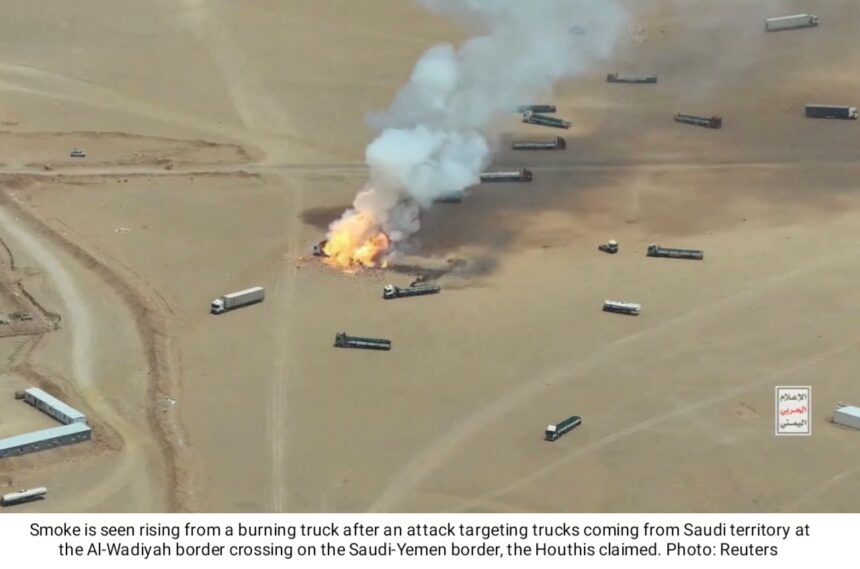
RIYADH/SANA — International Desk: Yemen’s Iran-backed Houthi movement has claimed a major military operation against targets in southern Saudi Arabia, marking a potentially significant escalation in the wider Middle East conflict. Saudi authorities said at least 73 people, including women and children, were wounded after attacks struck four cities and triggered fires at several sites.
The Houthis said they launched drones and missiles at a Saudi airbase in Khamis Mushait and targeted facilities linked to Saudi Arabia’s state oil company in nearby Abha and Najran, as well as the major Red Sea port city of Jazan. Saudi authorities confirmed fires at several locations but did not immediately provide a full assessment of the damage.
The attacks represent one of the most serious escalations involving Saudi Arabia in recent months and come after a period of relative calm between Riyadh and the Houthis. The Saudi-led coalition, which has fought the Houthi movement in Yemen for more than a decade, vowed to take what it called all necessary operational measures against the group.
Coalition spokesperson Colonel Turki al-Malki said the alliance would confront the Houthis’ “hostile approach,” while Houthi military spokesperson Yahya Saree accused Saudi Arabia of escalating the conflict through airstrikes in Yemen and warned that the group would respond.
The latest escalation has raised particular concern over the security of Saudi Arabia’s energy infrastructure. Any sustained disruption to the kingdom’s oil facilities could have consequences well beyond the region, potentially tightening global energy supplies at a time when oil markets are already facing severe uncertainty.
Brent crude prices rose by more than 2 percent on Tuesday, moving above $99 a barrel, as investors assessed the growing risks surrounding Middle Eastern energy supplies. The renewed fighting comes amid heightened tensions between Iran and the United States over the strategically vital Strait of Hormuz, through which a significant share of the world’s oil and liquefied natural gas shipments passed before the war.
The conflict is also worsening Yemen’s already severe humanitarian crisis. The International Organization for Migration has reported that around 18,500 people have been displaced in Yemen’s Taiz and Hodeida areas following the latest Saudi-Houthi escalation. Many of those displaced have already been forced from their homes several times.
Yemen’s civil war began in 2014, when the Houthis seized the capital, Sanaa, and large parts of northern Yemen. Saudi Arabia and its Arab allies intervened the following year in support of the internationally recognized government. The conflict has since killed at least 150,000 people, according to UN estimates, while repeatedly pushing Yemen toward famine and humanitarian catastrophe.
The latest attacks also threaten to widen the geographic reach of the regional conflict. Houthi military capabilities have previously posed risks to commercial shipping in the Red Sea and around the Bab al-Mandab Strait. A sustained confrontation involving Saudi energy infrastructure and regional shipping routes could therefore add further pressure to global supply chains.
Meanwhile, the broader confrontation between Washington and Tehran continues to deepen. The United States has sought to maintain the flow of oil through the Strait of Hormuz while imposing pressure on Iranian exports. Tehran has threatened to establish a maritime exclusion zone extending across the Gulf toward the perimeter of the US blockade.
Iranian Supreme National Security Council Secretary Mohsen Rezaei said Washington had received a warning from Iran’s newer missile capabilities and indicated that Tehran’s military posture toward US forces had been fundamentally recalibrated.
The convergence of conflicts in Yemen, the Persian Gulf and the Red Sea has created a volatile regional security environment. If the latest Saudi-Houthi escalation continues, the consequences could extend beyond the battlefield, affecting energy prices, international shipping, inflation and global economic stability.
For Saudi Arabia, the immediate challenge will be protecting its critical energy and military infrastructure while preventing the conflict from developing into another prolonged confrontation. For Yemen, however, renewed fighting threatens to deepen an already devastating humanitarian crisis.
The latest Houthi attacks therefore represent more than another exchange of fire in Yemen’s long-running war. They could become a significant new front in the wider Middle East conflict, with potentially far-reaching consequences for regional security and the global energy market.