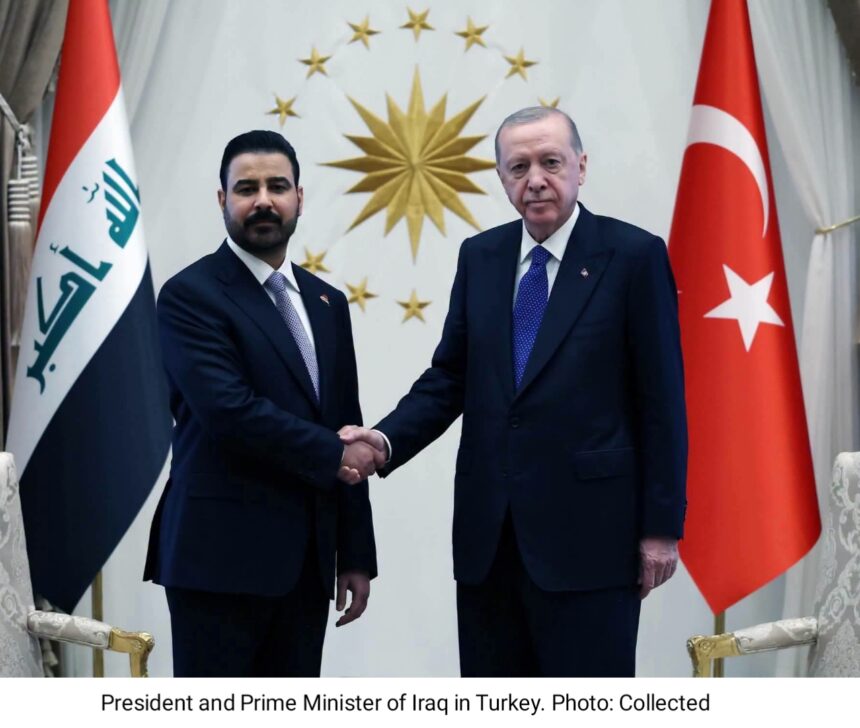
ANKARA — Turkish President Recep Tayyip Erdoğan formally welcomed Iraqi Prime Minister Ali Faleh al-Zaidi with a full state ceremony at the Presidential Complex in Ankara, underscoring the growing importance both governments attach to strengthening bilateral relations amid an evolving security and geopolitical landscape across the Middle East.
The official reception featured the national anthems of both countries, an inspection of the guard of honour, and the introduction of senior members of the Turkish and Iraqi delegations before the two leaders proceeded to closed-door talks followed by broader high-level meetings involving ministers and senior officials from both governments.
The visit comes at a time when regional security concerns, economic uncertainty, and shifting geopolitical dynamics are encouraging neighbouring states to deepen cooperation on issues ranging from trade and investment to border security, energy infrastructure and regional diplomacy.
According to officials, discussions are expected to focus on expanding bilateral relations across multiple sectors, including economic cooperation, investment, energy, transportation, border management and counterterrorism coordination. Regional developments and the latest political and security situation in the Middle East are also expected to feature prominently during the talks.
Analysts say the visit reflects a broader effort by Ankara and Baghdad to transform their relationship into a more comprehensive strategic partnership. While security cooperation has long been a defining element of ties between the two neighbours, both governments have increasingly sought to expand collaboration into economic development, infrastructure, logistics and regional connectivity.
Trade is expected to remain one of the central pillars of the discussions. Türkiye is among Iraq’s most significant commercial partners, while Iraq represents an important market for Turkish exports and investment. Officials from both countries have repeatedly emphasised the importance of increasing bilateral trade, facilitating cross-border commerce and encouraging greater private-sector participation in infrastructure, manufacturing, construction and industrial development.
Economic observers note that improving customs procedures, modernising border crossings and expanding investment opportunities could significantly strengthen commercial ties between the two countries. Such measures would not only benefit Turkish and Iraqi businesses but could also contribute to wider economic integration across the region.
Energy cooperation is also expected to occupy a prominent place on the agenda. Iraq possesses some of the world’s largest oil reserves, while Türkiye serves as a critical geographical bridge linking the Middle East with European markets. As global energy security continues to dominate international policy discussions, closer cooperation between Ankara and Baghdad on energy infrastructure, transportation networks and long-term investment could become increasingly important.
Experts argue that enhanced energy cooperation would support both countries’ economic priorities while contributing to broader regional energy stability. Investments in energy infrastructure, electricity cooperation and future transport networks are widely viewed as areas offering considerable potential for mutual benefit.
Transportation and regional connectivity are also expected to feature prominently in the leaders’ discussions. Both governments have expressed interest in strengthening transport corridors linking Iraq with Türkiye and, ultimately, European markets. Improved road networks, railway connections, logistics infrastructure and border facilities could facilitate faster trade flows while supporting long-term regional economic development.
Strategic infrastructure projects have gained increasing attention in recent years as governments across the Middle East seek to diversify their economies and improve regional integration. Analysts believe stronger transportation links between Türkiye and Iraq could generate substantial economic opportunities extending well beyond their shared border.
Security cooperation remains another key priority for both governments. The two countries share a lengthy border and continue to face complex security challenges, including cross-border militant activity, organised crime and illicit trafficking. Strengthening intelligence sharing, improving border management and enhancing coordination between security institutions are expected to be among the principal issues discussed during the meetings.
Diplomatic observers note that maintaining stability along the Turkish-Iraqi frontier remains essential not only for national security but also for encouraging investment, facilitating trade and supporting long-term economic growth. Greater security cooperation could therefore have significant economic as well as strategic implications.
Regional developments are also expected to receive considerable attention. Ongoing instability across parts of the Middle East, maritime security concerns affecting international shipping routes, fluctuations in global energy markets and continuing diplomatic efforts to reduce regional tensions have reshaped the strategic environment facing governments throughout the region.
Against this backdrop, Türkiye and Iraq are expected to exchange views on regional stability, diplomatic engagement and opportunities for closer political coordination. Analysts argue that sustained dialogue between neighbouring states has become increasingly important as governments seek cooperative approaches to shared regional challenges.
The visit also highlights Türkiye’s broader ambition to strengthen its diplomatic and economic influence across the Middle East while positioning itself as a key hub connecting Europe, Asia and the Gulf region. Iraq, meanwhile, continues to pursue reconstruction, economic recovery and stronger regional partnerships following years of political instability and security challenges.
Political analysts suggest that closer Turkish-Iraqi cooperation could contribute to wider regional stability by promoting economic integration, improving cross-border infrastructure and strengthening institutional cooperation. They argue that long-term prosperity in the region will increasingly depend on partnerships that combine economic development with effective security coordination.
Although no official outcomes had been announced at the time of the meetings, diplomatic circles expect the visit could pave the way for future agreements or expanded cooperation across several sectors. Any joint statements or memoranda emerging from the talks are likely to provide a clearer indication of the direction both governments intend to pursue.
Regardless of the immediate outcomes, the high-level meeting in Ankara is widely viewed as an important diplomatic engagement between two neighbouring countries whose political, economic and security interests are becoming increasingly interconnected. As the Middle East continues to experience rapid geopolitical change, closer coordination between Türkiye and Iraq may play a growing role in shaping regional stability, economic cooperation and strategic dialogue in the years ahead.
Iraqi PM on Erdogan’s red carpet in Ankara, hints at strengthening strategic ties