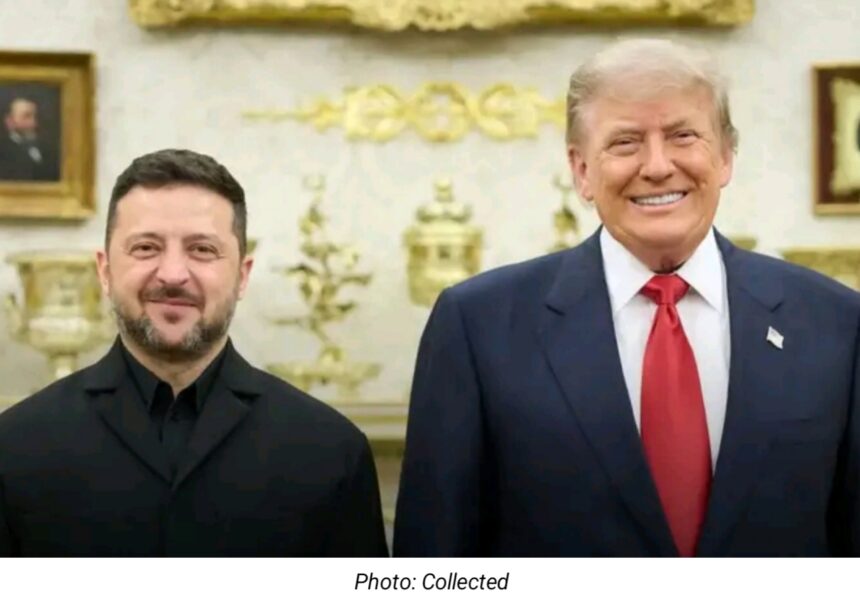
WASHINGTON — United States President Donald Trump and Ukrainian President Volodymyr Zelenskyy have met for high-level talks in a closely watched diplomatic engagement that could shape the future direction of US–Ukraine relations after months of uncertainty surrounding Washington’s policy toward Kyiv.
Following the meeting, President Trump described the discussions in positive terms, saying that “many things were discussed” and that the talks “went very well.” While neither side immediately released detailed information about the substance of the meeting or announced any concrete agreements, Trump’s remarks have renewed international attention on the trajectory of one of the West’s most consequential strategic partnerships.
The meeting comes at a pivotal moment in the ongoing Russia–Ukraine conflict, as questions continue to surround the future of American military, financial and diplomatic support for Ukraine. Since returning to office, President Trump has repeatedly stated that he seeks a path toward ending the war while also emphasizing that US foreign policy should prioritize American national interests and carefully evaluate long-term overseas commitments. Ukraine, meanwhile, continues to stress the importance of sustained Western support as it confronts continued security challenges.
Diplomatic observers say the meeting represents more than a routine bilateral discussion. Instead, it is being viewed as an opportunity for both leaders to reassess their strategic priorities, clarify expectations and explore areas of continued cooperation amid an increasingly complex geopolitical environment.
Although officials have not disclosed the full agenda, analysts believe the leaders likely exchanged views on Ukraine’s security situation, future US military assistance, economic support, reconstruction efforts, European security coordination, sanctions policy and broader diplomatic initiatives aimed at reducing regional tensions. Regional developments, NATO cooperation and the wider security architecture of Europe are also expected to have featured prominently during the discussions.
The meeting has drawn significant international attention because US policy remains central to Ukraine’s ability to sustain its defence capabilities and pursue long-term economic recovery. Washington has been one of Kyiv’s most important international partners since the conflict intensified, providing military equipment, financial assistance, intelligence cooperation and diplomatic backing. Any shift in American policy could therefore carry significant implications not only for Ukraine but also for European security and the broader transatlantic alliance.
Political analysts note that recent months have been characterised by considerable speculation regarding the future of US–Ukraine relations. Debate has intensified over the scale of future assistance, the prospects for diplomatic negotiations and the conditions under which any potential ceasefire or political settlement might be pursued. Against this backdrop, the latest meeting between Trump and Zelenskyy is widely seen as an important opportunity to maintain direct communication between the two governments.
The talks also take place amid continuing international efforts to prevent further escalation of the conflict while exploring possible diplomatic pathways toward a lasting peace. Although no breakthrough was announced following the meeting, diplomats argue that sustained dialogue between Washington and Kyiv remains essential as governments across Europe continue to monitor developments closely.
Analysts say President Trump’s brief but positive assessment of the discussions may indicate a willingness to maintain open channels of communication with the Ukrainian leadership even as his administration reviews broader foreign policy priorities. However, they caution that the long-term direction of US policy will ultimately depend on future diplomatic engagements, official policy decisions and evolving developments on the ground.
European governments are expected to follow the outcome of the discussions closely, given that American policy plays a central role in the continent’s collective security framework. NATO allies have consistently emphasised the importance of transatlantic coordination, and any future decisions emerging from Washington are likely to influence broader allied planning and regional security strategies.
Beyond military considerations, economic recovery and post-war reconstruction remain major concerns for Ukraine. International financial institutions, donor governments and private investors continue to assess the country’s long-term reconstruction needs. Continued international engagement, analysts argue, will be essential for rebuilding critical infrastructure, restoring economic growth and strengthening institutional resilience.
Diplomatic observers also point out that the meeting sends a broader political message: despite periods of uncertainty and differing policy approaches, direct engagement between Washington and Kyiv remains active. Maintaining regular high-level dialogue is widely regarded as an important component of managing one of the world’s most closely watched geopolitical crises.
For now, no official joint statement outlining new initiatives, agreements or policy commitments has been released. As a result, international attention is expected to remain focused on any subsequent announcements from the White House and the Ukrainian government, which may provide greater clarity regarding future cooperation and strategic priorities.
Regardless of the immediate outcomes, the meeting marks another significant chapter in US–Ukraine relations at a time when the conflict continues to shape global diplomacy, European security and international strategic calculations. As governments around the world monitor developments, the discussions between President Donald Trump and President Volodymyr Zelenskyy are likely to remain an important reference point in ongoing debates over the future of the war, Western support for Ukraine and the prospects for long-term regional stability.
Trump-Zelensky dialogue: Is there a new direction in US policy?