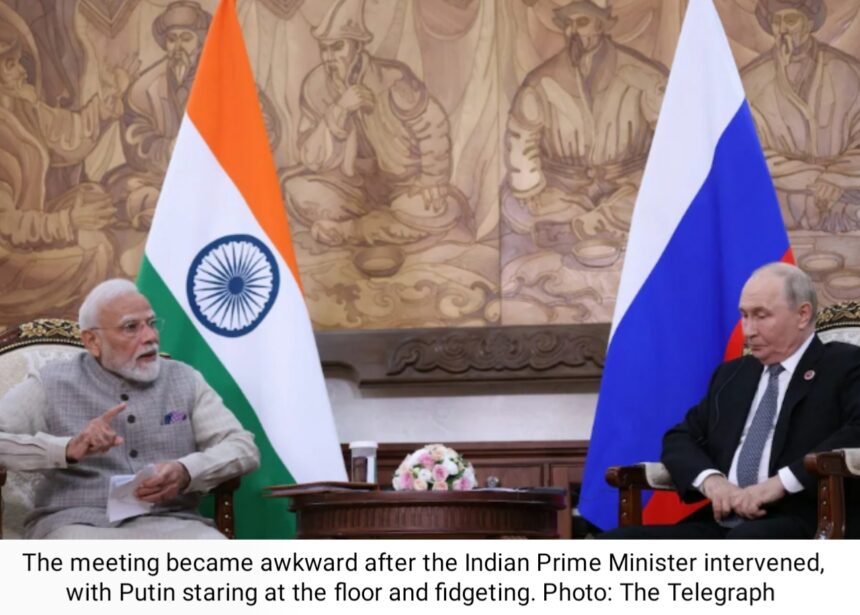
BISHKEK, Kyrgyzstan, September 2, 2026: Indian Prime Minister Narendra Modi has urged Russian President Vladimir Putin to move away from what he described as an “endless war” and work toward an end to the conflict in Ukraine, delivering an unusually direct message during a meeting on the sidelines of the Shanghai Cooperation Organisation (SCO) summit in Bishkek, Kyrgyzstan. Modi’s remarks underline the increasingly complex diplomatic position of India, which has maintained close strategic, economic and defence ties with Moscow while simultaneously calling for a peaceful resolution to the war that began with Russia’s full-scale invasion of Ukraine in February 2022. Speaking ahead of the SCO summit, Modi said that every additional day of warfare represents a setback for humanity, while progress toward peace could provide hope for the international community. “We need to move from endless war to an end to the war, to a cessation of hostilities,” Modi said, signalling New Delhi’s continued preference for dialogue and diplomacy despite its deepening partnership with Russia. The intervention is particularly significant because India has remained one of Moscow’s most important economic partners since the outbreak of the war, purchasing large volumes of Russian crude oil at discounted prices while maintaining extensive cooperation with Russia in defence, energy, space and other strategic sectors. Modi has repeatedly referred to Putin as a friend and described bilateral relations as a “Special and Privileged Strategic Partnership,” reflecting the longstanding strategic importance of Moscow to New Delhi. Russia, meanwhile, has continued to insist that any settlement must address its security and political demands, positions that Ukraine has rejected as unacceptable. Putin responded to Modi by saying that the two countries were continuing to move forward along the path of bilateral cooperation, according to Russian state media. The exchange came as the Ukraine conflict shows little sign of a decisive end, with fighting continuing and Russian attacks intensifying in recent weeks. The latest developments at the SCO summit also demonstrated the broader geopolitical significance of the gathering, which brought together leaders from major Eurasian powers including China, India, Russia, Iran, Pakistan, Turkey and Central Asian states. The summit provided an important platform for leaders whose countries maintain varying degrees of cooperation and competition with both Moscow and the West. Iranian President Masoud Pezeshkian also held talks with Putin on the sidelines of the summit, thanking Russia for its support to Tehran during the recent Iran conflict and praising the depth of the relationship between the two countries. Pezeshkian described the Russia-Iran relationship as strategic rather than an ordinary partnership, while Putin reiterated Moscow’s solidarity with the Iranian people and opposition to what he described as US unilateralism. The summit further highlighted Russia’s expanding network of strategic partnerships across Eurasia, with Putin also meeting Turkish President Recep Tayyip Erdogan to discuss bilateral cooperation, including energy and nuclear projects. Erdogan said relations between Ankara and Moscow had reached an advanced level and highlighted cooperation surrounding the Akkuyu nuclear power plant on Turkey’s Mediterranean coast, a major Russian-backed energy project that is expected to strengthen Turkey’s electricity-generation capacity. The discussions in Bishkek therefore reflected a broader transformation in Eurasian diplomacy, where traditional alliances are increasingly being accompanied by pragmatic partnerships involving energy security, defence, trade and regional stability. For India, Modi’s direct appeal to Putin represents an attempt to balance its longstanding strategic relationship with Moscow with New Delhi’s stated commitment to peace and diplomatic engagement over Ukraine. While the remarks do not necessarily signal a fundamental shift in India’s relationship with Russia, they demonstrate that New Delhi is prepared to publicly encourage Moscow to pursue a cessation of hostilities even as bilateral economic and strategic cooperation continues. The SCO summit has consequently emerged not only as a forum for regional cooperation but also as an important stage for competing diplomatic priorities, with India advocating dialogue, Russia defending its strategic interests, China strengthening its Eurasian influence, Iran deepening its partnership with Moscow and Turkey expanding cooperation with Russia while maintaining its own independent foreign-policy agenda. Modi’s message to Putin thus carries significance beyond the immediate India-Russia relationship, reflecting the growing diplomatic pressure among major non-Western powers for an eventual political pathway out of the Ukraine conflict while preserving their own strategic interests in a rapidly changing international order.
Modi Urges Putin to End Ukraine War as SCO Summit Highlights Shifting Eurasian Diplomacy