
Growing diplomatic and economic engagement between South Korea and China has drawn renewed attention in Washington, with a senior Republican lawmaker calling on the Trump administration to closely examine Seoul’s expanding relationship with Beijing.
Representative John Moolenaar, the Republican chair of the congressional committee focused on China, urged U.S. Secretary of State Marco Rubio to increase scrutiny of South Korea’s relations with China. In a letter to Rubio, Moolenaar cited deeper engagement between the leaders of the two countries, South Korean semiconductor investments in China and what he described as concerns about the treatment of American companies operating in South Korea.
Moolenaar described South Korea as a major U.S. ally but warned that growing differences over China policy, trade, technology and regional security could create tensions between Washington and Seoul. He called for what he described as heightened vigilance over the relationship and said developments could potentially lead to a structural change in South Korea’s strategic alignment.
The South Korean foreign ministry did not comment in detail on the contents of the letter. It said, however, that the U.S.-South Korea alliance remains the cornerstone of Seoul’s foreign policy and that the two countries are continuing to strengthen cooperation in several areas.
The issue comes at a sensitive time for the U.S.-South Korea relationship. Washington and Seoul remain closely linked through their military alliance, which dates back to the Korean War, while China remains one of South Korea’s most important economic partners. Seoul therefore faces the difficult task of maintaining its security relationship with Washington while managing its extensive economic and diplomatic ties with Beijing.
South Korean President Lee Jae Myung has repeatedly emphasized the importance of maintaining both relationships. In a recent post on X referring to South Korea’s expanding trade with China, Lee said the South Korea-U.S. alliance was the most important element of Seoul’s diplomacy while also stressing the need to manage relations with China.
That approach has become increasingly significant as competition between Washington and Beijing extends beyond trade into technology, supply chains, military security and regional diplomacy.
One of the main concerns raised by Moolenaar involves South Korea’s semiconductor industry. Major South Korean technology companies have substantial production operations in China. Moolenaar pointed specifically to Samsung’s semiconductor facility in Xi’an and SK Hynix operations in Wuxi and Dalian.
According to Moolenaar, the presence of important South Korean semiconductor production in China could create vulnerabilities for U.S. and allied supply chains. He argued that such facilities could potentially give Beijing leverage over technology production linked to countries allied with the United States.
The semiconductor issue is particularly sensitive because advanced chips are increasingly connected to artificial intelligence, telecommunications, military systems, data centers and advanced computing. The United States has imposed restrictions on certain advanced semiconductor technologies and has encouraged allies to reduce strategic dependence on China in sensitive technology sectors.
South Korea is one of the world’s leading semiconductor producers, with companies such as Samsung Electronics and SK Hynix playing major roles in global memory-chip production. Any significant change in their manufacturing strategies could therefore have consequences beyond the Korean Peninsula.
At the same time, South Korean technology companies are expanding their activities in the United States. Reuters has reported that SK Hynix has been considering leasing part of Intel’s Ohio chip facility and potentially building a new NAND memory manufacturing plant through its Solidigm subsidiary.
These developments illustrate the complexity of Seoul’s position. South Korea is increasing technology investment in the United States while maintaining important production and commercial interests in China.
Moolenaar also raised concerns about Chinese e-commerce companies operating in South Korea. His letter referred to platforms including Alibaba’s AliExpress and Temu and raised questions involving data privacy, consumer protection, cybersecurity and product safety.
He argued that Chinese companies could be receiving more lenient treatment from South Korean regulators than American companies such as Coupang. The companies mentioned in the letter did not immediately respond to requests for comment, while Coupang declined to comment.
South Korea’s foreign ministry said that its regulatory authorities treat companies operating in the country fairly.
The disagreement highlights a broader issue in U.S.-China economic competition: how allied countries regulate Chinese companies while maintaining open markets and protecting domestic consumers.
Washington has increasingly viewed Chinese technology and digital platforms through a national-security lens. South Korea, meanwhile, has to balance those concerns against its own economic interests and its position as a major trading nation in Asia.
Another major issue raised by Moolenaar is Taiwan.
He expressed concern about South Korea’s position on a potential regional crisis involving Taiwan and argued that Seoul had effectively ruled out supporting a regional response to Chinese aggression against Taiwan.
Moolenaar cited remarks made by Lee during his 2024 election campaign concerning the Taiwan Strait. In a January interview with Japan’s NHK, Lee also said South Korea should avoid unnecessary involvement in regional conflicts and that respecting the positions of other countries was in Seoul’s national interest.
South Korea’s position reflects the complicated security environment surrounding the Korean Peninsula. Seoul is primarily focused on North Korea’s nuclear and missile programs and does not necessarily want to become directly involved in conflicts elsewhere in the region.
At the same time, South Korea’s security relationship with the United States means that developments involving Taiwan could create difficult strategic questions for Seoul.
The Taiwan issue has become one of the most sensitive points in the wider U.S.-China relationship. Washington has sought stronger coordination with its Asian allies, while Beijing strongly opposes what it views as foreign interference in the Taiwan issue.
South Korea has generally sought to avoid taking positions that could unnecessarily damage its relationship with China while maintaining its alliance with the United States.
The recent increase in direct contact between Seoul and Beijing has also attracted attention in Washington.
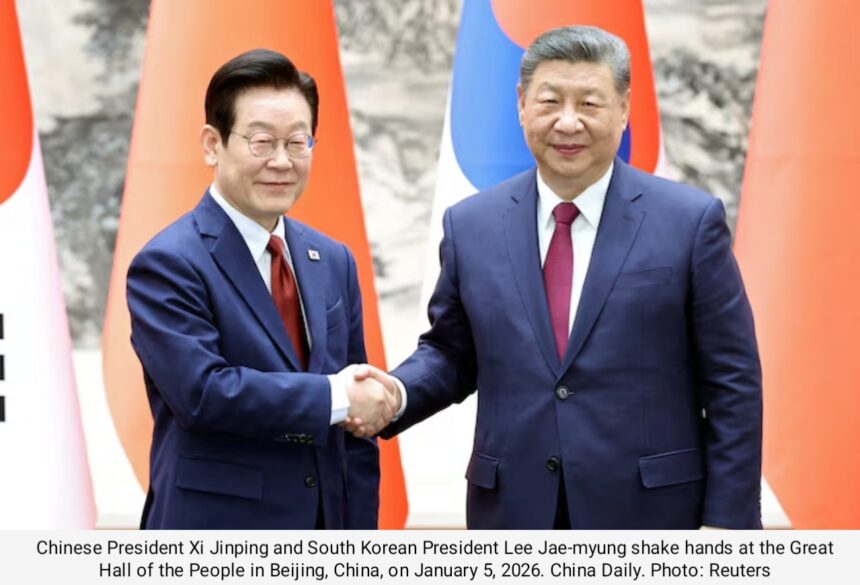
Moolenaar pointed to what he described as an unprecedented pace of leader-level engagement. Chinese President Xi Jinping visited South Korea in 2025, his first visit to the country in 11 years. Lee then visited China in 2026, marking the first visit by a South Korean president to China since 2019.
The renewed diplomatic contact reflects Seoul’s interest in stabilizing relations with Beijing after years of tensions linked to security, trade and regional politics.
China is also important to South Korea because of its role in regional diplomacy involving North Korea. Beijing remains a major economic and political actor in Northeast Asia, giving Seoul practical reasons to maintain communication with the Chinese government.
For Washington, however, closer South Korea-China relations raise questions about how Seoul would respond if U.S.-China competition intensified further.
The issue is particularly important because South Korea remains a key U.S. security partner in East Asia. American forces are stationed in South Korea, and the two countries conduct military cooperation aimed primarily at deterring threats from North Korea.
Recent tensions between Washington and Seoul have included disagreements over trade, military exercises and broader security policy. U.S. President Donald Trump has also publicly criticized Seoul at various points.
Despite these tensions, the two countries have continued to deepen economic cooperation.
South Korea has pledged hundreds of billions of dollars in investment in the United States, covering sectors including energy, manufacturing, technology and infrastructure. Reuters has reported that the Trump administration has been working to use South Korean strategic investment funds for several major U.S. projects, including a proposed Alaska liquefied natural gas facility.
The proposed Alaska LNG project has become part of a wider effort to strengthen U.S.-South Korean economic ties. However, South Korean officials have also emphasized the need to consider commercial feasibility and legal issues surrounding major investments.
This creates a complicated picture of the bilateral relationship. On one side, Washington is pressing Seoul to address concerns about China, technology and strategic alignment. On the other, the United States is seeking greater investment from South Korean companies and deeper cooperation in key industries.
For Seoul, the challenge is equally complex.
South Korea depends heavily on the United States for security cooperation and maintains deep economic connections with China. A sharp shift toward one side could create costs in the other relationship.
Reducing semiconductor operations in China could help address some U.S. concerns about supply-chain security, but it could also increase costs for South Korean companies and complicate their business strategies.
Maintaining extensive operations in China, meanwhile, could expose South Korean companies to increasing pressure from Washington as the United States seeks to reduce Chinese influence over sensitive technologies.
The situation also has implications for South Korea’s broader industrial strategy. Semiconductor production, batteries, artificial intelligence, advanced manufacturing and energy infrastructure are increasingly connected to national-security policy.
As the United States and China compete for technological and economic influence, South Korea has become an important part of the global supply chain.
The country’s decisions on investment, technology exports and manufacturing locations could therefore affect companies and industries far beyond East Asia.
North Korea remains another major factor in Seoul’s calculations.
South Korea continues to face direct security threats from North Korea, including its nuclear weapons and missile programs. This makes the U.S.-South Korea alliance central to Seoul’s defense policy.
At the same time, China’s influence over North Korea means that Seoul has an interest in maintaining communication with Beijing.
This creates a strategic triangle involving Washington, Beijing and Seoul, with North Korea adding another layer of complexity.
The coming months could therefore bring greater scrutiny of South Korea’s economic and security policies. Moolenaar has requested a State Department briefing on developments in South Korea-China relations by October 31.
Such a briefing could lead to further discussion inside Washington about South Korea’s semiconductor operations in China, its trade relationship with Beijing, Chinese companies operating in South Korea and Seoul’s position on Taiwan.
For now, there is no clear indication that South Korea intends to abandon or fundamentally replace its alliance with the United States. Seoul continues to describe the alliance as the cornerstone of its foreign policy.
At the same time, South Korea is making clear that it intends to maintain working relations with China.
The central issue is therefore how Seoul manages these two relationships as competition between Washington and Beijing becomes more intense.
South Korea’s position is particularly significant because it sits at the intersection of major security and economic interests in East Asia. Its semiconductor industry is important to global technology supply chains, its alliance with the United States is central to regional security, and its economic relationship with China remains significant.
The debate in Washington over Seoul’s China ties reflects a broader question facing U.S. allies across Asia: how to maintain close security cooperation with Washington while continuing economic relations with Beijing.
For South Korea, the answer will likely depend on developments in technology, trade, regional security, North Korea and the future direction of U.S.-China relations.
The immediate focus will be on whether Washington and Seoul can maintain their security alliance while addressing disagreements over China policy, and whether South Korea can continue managing its economic relationship with Beijing without creating deeper friction with its most important security partner.