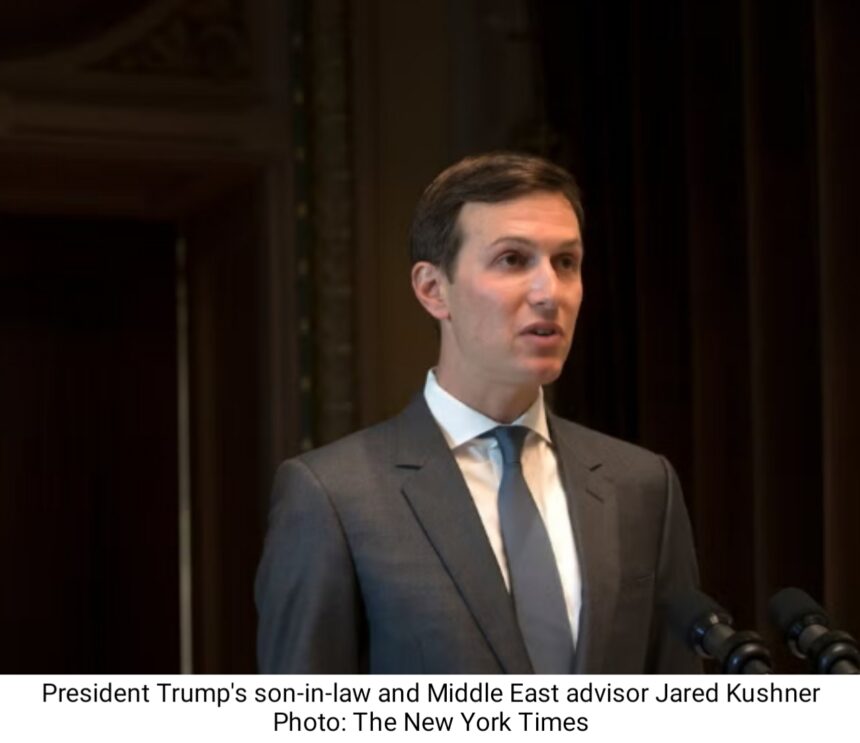
Jared Kushner, the son-in-law of US President Donald Trump and founder of the private investment firm Affinity Partners, is facing renewed scrutiny over the relationship between Gulf money invested in his company and its growing financial interests in Israel. The issue has drawn particular attention because Kushner has also become closely involved in US diplomatic efforts in the Middle East, including negotiations involving Israel, Arab governments and the war in Gaza. Recent reporting has highlighted that Affinity Partners has received billions of dollars from sovereign wealth funds and investment institutions in the Gulf while building substantial positions in Israeli businesses, creating questions about the intersection of private investment, foreign capital and Kushner’s political role. The available evidence, however, does not show that Gulf governments simply transferred money to Kushner for the specific purpose of financing Israel. Rather, the investments were made into Affinity Partners, which operates as a private investment firm and has subsequently invested in companies in several countries, including Israel. Reuters reported in March 2025 that Affinity’s assets under management had increased by about 60 percent in 2024 to $4.8 billion after receiving an additional $1.5 billion in capital from existing Gulf investors, including Abu Dhabi-based Lunate and Qatar’s sovereign wealth fund, the Qatar Investment Authority. The firm had previously received a $2 billion commitment from Saudi Arabia’s Public Investment Fund, according to congressional investigators cited by Reuters. Kushner established Affinity Partners in 2021 after leaving the first Trump administration, where he had played a major role in Middle East policy. His relationship with Saudi Crown Prince Mohammed bin Salman had developed during Trump’s first presidency, and six months after leaving the White House, Kushner’s newly created investment firm secured the $2 billion Saudi commitment. Reporting based on documents later obtained from the Saudi fund showed that some members of an internal investment panel had raised concerns about the deal, including questions about Affinity’s limited experience, the size of the Saudi exposure, proposed fees and potential reputational risks arising from Kushner’s previous government position. Despite those concerns, the investment went ahead. The Gulf connection expanded beyond Saudi Arabia. According to Reuters, Affinity received another $1.5 billion in capital in 2024 from Lunate and the Qatar Investment Authority, lifting its reported assets under management to $4.8 billion by the end of that year. Kushner said the additional capital had been arranged before Trump won the 2024 presidential election. The question of Israel became more significant as Affinity expanded its portfolio. In 2023, the firm made its first reported investment in Israel by purchasing a 15 percent stake in the Shlomo Group’s car-rental and credit business for about $150 million. In July 2024, Affinity invested approximately $128.5 million for a 4.95 percent stake in Phoenix Financial, one of Israel’s major financial services groups. In January 2025, Israeli regulators approved a further purchase that allowed Affinity to increase its stake by another 4.95 percent. Bloomberg reported at the time that the approval would allow the Saudi-backed investment firm to proceed with the transaction. The investment in Phoenix later became one of Affinity’s most valuable positions. By 2026, Kushner’s firm had become Phoenix Financial’s largest shareholder. In July 2026, Affinity sold roughly a quarter of its Phoenix holding for about $343 million while retaining a 7.4 percent stake valued at more than $1 billion, according to Israeli financial reporting. The financial relationship has attracted additional attention because Phoenix itself has investments in companies connected to Israel’s defense industry. A CNN investigation published on October 1, 2026, examined Israeli financial records and found that Phoenix had investments worth at least hundreds of millions of dollars across nine companies involved in supplying equipment or services connected to Israel’s military activities. The largest identified position was approximately $265 million in Elbit Systems, one of Israel’s major defense companies. CNN also identified investments in companies including Next Vision, Bet Shemesh Engines and Reshef Technologies. According to the investigation, the publicly available records covered only part of Phoenix’s overall portfolio. The distinction between direct and indirect ownership is important. Affinity Partners does not directly own the identified defense companies listed in the CNN investigation. Instead, it owns a major stake in Phoenix Financial, and Phoenix in turn holds investments in a range of companies, including firms connected to Israel’s military sector. This means that any financial benefit to Affinity from those companies would come indirectly through its investment in Phoenix rather than through a direct ownership position in the defense companies themselves. CNN reported that Affinity had no direct stake in the nine companies it identified and that there was no indication in its investigation that Kushner’s diplomatic activities directly influenced the specific investments reviewed. The issue has become more politically sensitive because Kushner has also played an increasingly visible role in Middle East diplomacy during Trump’s second administration. Although he did not formally join the administration as a government employee, he has advised Trump and senior officials and has been involved in discussions with Middle Eastern governments. CNN reported that Kushner described himself in March 2026 as a volunteer who had been asked by Trump and special envoy Steve Witkoff to become more operationally involved in government efforts. His private business interests and diplomatic activities have therefore developed alongside each other at a time when relations between Israel and Arab states remain one of the central issues in US Middle East policy. The overlap has prompted questions from some US lawmakers. In June 2024, Senate Finance Committee Chairman Ron Wyden opened an inquiry into Affinity Partners and raised questions about payments from Gulf governments and the disclosure rules governing private investment funds. His committee said at the time that 99 percent of the billions of dollars managed by Affinity came from foreign sources, primarily sovereign wealth funds from Saudi Arabia, the United Arab Emirates and Qatar. Wyden also sought information about fees and communications between Affinity and foreign government entities. The scrutiny has continued as Kushner has taken a more active role in Middle East negotiations. Reuters reported in September 2026 that congressional Democrats were considering investigations into business dealings involving members of the Trump family if they gained control of Congress after the 2026 midterm elections. The proposed inquiries include Affinity Partners and its dealings with Middle Eastern governments. Reuters reported that lawmakers had raised concerns about the combination of Kushner’s investment activities and his involvement in diplomatic negotiations. The Trump family and Republicans have disputed such concerns and characterized proposed investigations as politically motivated. Kushner, for his part, has publicly presented his investments in Israel as part of a broader economic strategy for the Middle East. In comments reported by CNN, he argued that business relationships between Israelis and Arabs could create economic links and reduce barriers between the two sides. He has also discussed the possibility of Phoenix expanding its investment activities into Saudi Arabia and the United Arab Emirates. According to CNN, Kushner described Phoenix as his firm’s “best investment” and said the company was examining opportunities in Saudi Arabia and the UAE. This helps explain why the financial story is more complicated than a simple claim that Arab money is being transferred directly into Israel. Gulf sovereign wealth funds invested in Affinity Partners, while Affinity subsequently made investment decisions across different markets. Some of those decisions involved Israeli companies, including Phoenix Financial. Phoenix, in turn, has investments in businesses that include major Israeli defense firms. The result is an indirect financial chain linking Gulf capital, Kushner’s private investment firm and parts of Israel’s corporate and defense economy, but the available evidence does not establish that Gulf governments specifically instructed Affinity to finance Israel’s military industry. The distinction matters because the ownership structures involve several separate investment decisions and companies. At the same time, the scale of the Gulf financing and the size of Affinity’s Israeli investments explain why the relationship has attracted sustained political and media scrutiny. The controversy has also intensified because Kushner has simultaneously been involved in sensitive diplomatic discussions concerning Israel and the wider Middle East. Affinity has defended its independence from Kushner’s government-related activities, and CNN reported that the firm said Kushner had no direct involvement in decisions concerning the individual businesses backed by Phoenix. Phoenix, meanwhile, is a regulated Israeli financial company and has said that shareholder value is primarily derived from the performance of its operating businesses rather than investment returns. For Gulf governments, the relationship also reflects a broader pattern of economic engagement with the United States and international investment markets. Saudi Arabia, Qatar and the UAE have built large sovereign investment portfolios around the world, and their capital can reach companies and funds through a variety of structures. In Affinity’s case, those investments created a major pool of capital managed by a businessman with unusually close ties to the Trump family and a long-standing role in Middle East diplomacy. That combination is what has made Affinity’s Israeli investments particularly sensitive. The central question is therefore less about whether Gulf money exists inside Affinity, which is documented, and more about how private investment decisions should be viewed when the person controlling the investment firm is simultaneously participating in high-level diplomatic efforts. Supporters of Kushner’s approach can point to his argument that economic cooperation can build stronger ties between Israel and Arab states. Critics, including some US lawmakers, have focused instead on potential conflicts of interest and the need for greater transparency around foreign government-backed investment. These are competing interpretations of the same underlying financial relationships. What is documented is that Saudi Arabia committed $2 billion to Affinity Partners, that additional capital later came from Gulf investors including Qatar and the UAE, and that Affinity invested significant sums in Israeli businesses, including Phoenix Financial. It is also documented that Phoenix has invested in companies connected to Israel’s defense sector. What remains a matter of debate is what political or strategic significance should be attached to those financial links and whether Kushner’s diplomatic role creates an unacceptable conflict with his private investment interests. Those questions are likely to remain under scrutiny as the Trump administration continues its Middle East diplomacy and as Affinity Partners manages its investments across Israel, the Gulf and other international markets. The case illustrates how private capital, sovereign wealth and diplomacy can become closely connected when prominent political families maintain large international business interests. For Kushner, the Israeli investment has generated substantial financial returns while his involvement in Middle East diplomacy has given the investment added political attention. For critics, the combination raises questions about transparency and potential conflicts. For Kushner and his supporters, the investments are presented as commercial decisions that can also encourage economic integration between Israel and Arab countries. The available public record supports the existence of the financial links, while the broader claims about political influence or intent require continued scrutiny and evidence rather than assumption.
Trump’s son-in-law Jared Kushner: Gulf money is increasing investment in Israel, raising questions of conflict of interest