Ukraine’s President Volodymyr Zelenskyy arrived in Washington at a pivotal moment for both the battlefield and international diplomacy, as the United States Senate prepares to consider sweeping new sanctions against Russia while President Donald Trump seeks to broaden the legislation to include Iran.
Zelenskyy is expected to attend the funeral of late US Senator Lindsey Graham before holding meetings with members of the Senate to discuss continued military cooperation, intelligence sharing, and efforts to increase economic pressure on Moscow. The visit comes as Ukraine faces sustained Russian attacks across multiple front lines and intensifies its campaign to disrupt Russia’s military supply chains.
The sanctions package, which has been under discussion for months, would significantly expand pressure on Russia by imposing 100 percent tariffs on goods imported from the five largest buyers of Russian oil and natural gas. The proposal could have far-reaching consequences for global trade, particularly for major economies such as China and India, which remain among the largest consumers of Russian energy exports.
In a late intervention, President Trump reportedly proposed adding new sanctions targeting Iran to the same legislation, linking two of Washington’s most pressing foreign policy challenges. Zelenskyy publicly welcomed the proposal, calling it a positive step that could strengthen international pressure on countries supporting Russia’s military capabilities.
The diplomatic developments come as the conflicts in Eastern Europe and the Middle East appear increasingly interconnected. Over the weekend, Ukraine carried out a strike against an Iranian tanker in the Caspian Sea, claiming the vessel was transporting drones and military components destined for Russia. Iranian officials condemned the attack and vowed retaliation, raising concerns that the Ukraine war could expand into a broader regional confrontation.
Security analysts say the strike reflects Kyiv’s determination to disrupt Russia’s military logistics while simultaneously targeting a country viewed by Washington as one of its principal strategic adversaries. However, experts also caution that Ukraine is unlikely to want its war effort to become too closely associated with broader US-Iran tensions, fearing such a perception could complicate diplomatic support from partners with differing views on the Middle East.
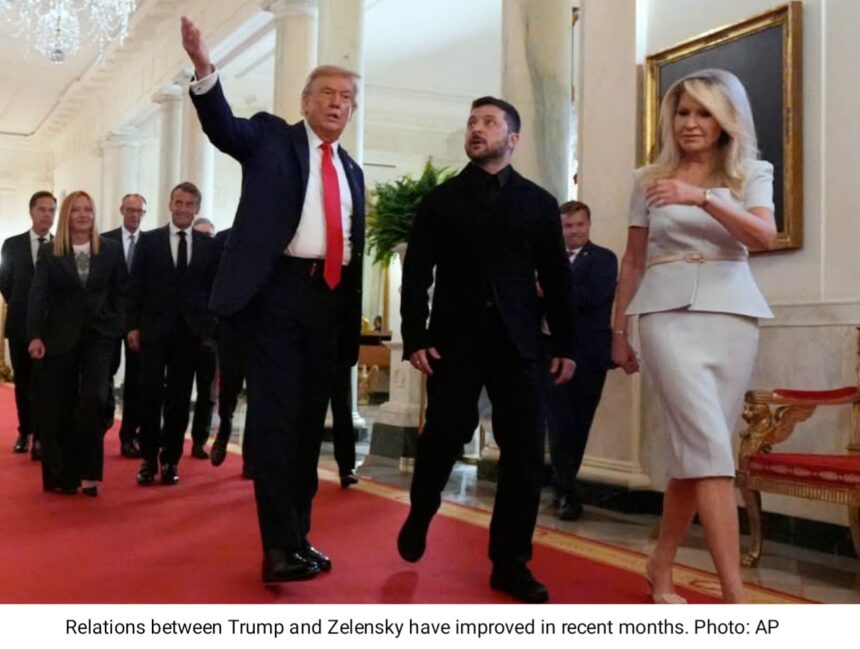
Relations between Trump and Zelenskyy have evolved considerably over the past year. After a highly publicised confrontation during a White House meeting in early 2025, the two leaders have rebuilt political and military cooperation. Earlier this month, Washington and Kyiv agreed to jointly produce Patriot air-defence interceptor missiles, a move aimed at strengthening Ukraine’s ability to counter Russia’s continuing missile and drone attacks.
The two countries are also moving closer to a joint drone production agreement. Ukraine has rapidly emerged as one of the world’s leading innovators in battlefield drone technology, with officials expecting domestic production of millions of short-range attack drones this year. The partnership is viewed as an opportunity for the United States to benefit from Ukraine’s wartime experience while expanding its own defence industrial capacity.
Meanwhile, fighting across Ukraine continues unabated. Russian missile and drone strikes killed several civilians in eastern Ukraine on Monday and injured dozens more, according to regional authorities. Ukrainian officials reported heavy combat around the strategic towns of Kostiantynivka and Pokrovsk in the Donetsk region, where Russian forces continue pressing offensive operations.
Inside Russia, officials said a Ukrainian drone struck a commercial building in the Belgorod region, killing one person and injuring two others, underscoring Kyiv’s growing ability to conduct long-range attacks beyond the front lines.
The proposed sanctions legislation represents one of the most significant economic measures considered against Moscow since the full-scale invasion of Ukraine. Should it become law, the combined pressure on Russia’s energy revenues and expanded restrictions involving Iran could reshape global energy markets, alter international trade flows, and deepen geopolitical divisions among the world’s major powers.
As diplomacy intensifies in Washington and military operations continue across Ukraine and neighbouring regions, policymakers are increasingly confronting the reality that the war has evolved beyond a regional conflict. The growing overlap between the Ukraine war, tensions with Iran, and broader competition among global powers highlights the increasingly interconnected nature of today’s international security landscape, where decisions made in one theatre can rapidly influence developments thousands of kilometres away.