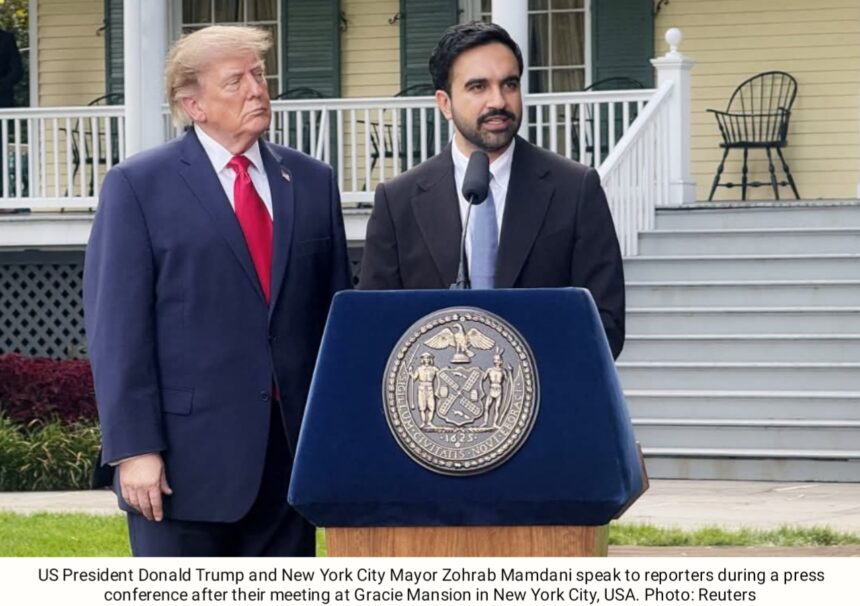
NEW YORK: US President Donald Trump made an unusual stop at New York City’s Gracie Mansion on Monday, September 21, where he held an hourlong meeting with Mayor Zohran Mamdani as world leaders gathered in the city for the United Nations General Assembly. The meeting brought together two politicians whose views differ sharply on many national and local issues, yet whose recent interactions have been notably more cordial than their earlier political exchanges. Trump arrived at the official residence of the New York mayor before his scheduled activities surrounding the United Nations and appeared alongside Mamdani on the mansion’s lawn after their private discussion. Rather than focusing only on their political differences, the two leaders emphasized areas where the federal government and New York City could potentially work together, particularly housing, development and the cost of living. Trump also reflected on his long history with Gracie Mansion, recalling previous visits to the residence during the administrations of earlier New York mayors. He described the visit as something of a return to a familiar place and spoke warmly about New York City, a place that has played a major role in his personal and business history. “Hopefully you’re going to be a great one,” Trump told Mamdani after recalling his previous experiences with New York mayors. The encounter was significant because Trump and Mamdani come from very different political traditions. Trump is a Republican president whose administration has pursued conservative policies on immigration, federal spending, trade and national security, while Mamdani, a Democratic Socialist, has campaigned around housing affordability, public services and policies aimed at reducing living costs for working-class New Yorkers. Despite those differences, the two have maintained contact since Mamdani’s election and have held several meetings. Their first major post-election encounter took place at the White House, where the tone was considerably more cooperative than many observers had expected. They met again in Washington in February, when Mamdani presented Trump with a mock New York Daily News front page carrying the message “Trump to City: Let’s Build,” a reference to the famous 1975 headline involving President Gerald Ford and New York City. That gesture was intended to highlight the potential benefits of federal investment in New York housing. Monday’s meeting at Gracie Mansion continued that pattern of pragmatic engagement. According to reports from the meeting, housing was one of the central issues discussed by Trump and Mamdani. Particular attention was given to the proposed development of Sunnyside Yard in Queens, a major transportation and development site that city officials have discussed as a potential location for thousands of new homes. Mamdani said the proposal could involve approximately 12,000 homes and create around 30,000 jobs, while turning a large rail yard into an entirely new neighborhood. The project would require substantial federal assistance, with estimates of billions of dollars in federal grants. The mayor has described housing affordability as one of the most pressing issues facing New Yorkers, and the meeting provided an opportunity to discuss whether the federal government and City Hall could cooperate on large-scale housing construction. Reports said the two sides agreed to establish further discussions between officials from the White House and New York City government on housing and related projects. The discussion is particularly notable because housing policy has been one of the areas where Mamdani has sought major changes in New York. His administration has emphasized expanding affordable housing and addressing the high cost of living. For Trump, meanwhile, federal support for major construction projects in New York would involve working directly with a mayor whose political platform differs significantly from his own. The meeting therefore demonstrated a practical dimension of federal-city relations: regardless of political disagreements, both sides have reasons to cooperate when the issue involves major infrastructure, housing investment and economic development. Mamdani later told reporters that he and Trump continue to have sharp disagreements but that their ability to communicate has remained intact. He said he would continue speaking with the president and with anyone capable of delivering relief to New Yorkers. That statement reflected the mayor’s approach to the relationship, in which disagreement over national politics has not prevented discussions about city-specific priorities. Immigration was another subject discussed during the meeting. Mamdani raised concerns related to Haitian New Yorkers and the federal government’s decision to end temporary protected status for Haitians. He argued that Haitian New Yorkers are an important part of the city’s social and economic fabric and expressed concern about the consequences of changes to their immigration status. The issue reflects one of the major areas of disagreement between the Trump administration and New York City officials. Immigration enforcement has been a central issue for Trump, while Mamdani has repeatedly emphasized protections and support for immigrant communities in New York. Their conversation therefore included both areas of cooperation and significant policy differences. The two politicians were also questioned by reporters about the Trump administration’s restrictions on certain news organizations covering the White House. Several news outlets had recently challenged the administration’s decision in court after their access was restricted. Mamdani said he believed those organizations, along with other members of the press, should be allowed to attend events at Gracie Mansion. Trump defended his administration’s position, arguing that news organizations have an obligation to report fairly. The exchange highlighted a broader national dispute over the relationship between the White House and the news media. On the same day, several major news organizations filed a lawsuit seeking to regain access to the White House after their press credentials were disabled. The organizations argued that the restrictions violated constitutional protections for the press, while the administration defended its authority to control access to White House facilities. The discussion at Gracie Mansion therefore extended beyond New York housing and included questions about press access, immigration and the relationship between federal and city governments. Yet the overall tone remained noticeably restrained compared with the political rhetoric that has often surrounded Trump and Mamdani. That change in tone has attracted attention because the two men previously exchanged strong criticism. Trump had been a frequent critic of Mamdani during the 2025 campaign, but their interactions after Mamdani’s election have generally been more cooperative. Their relationship now appears to involve an element of political pragmatism: both recognize that the federal government and New York City have overlapping responsibilities and that certain projects require cooperation across political lines. The timing of Monday’s meeting also added significance. New York was hosting the United Nations General Assembly, bringing presidents, prime ministers and senior officials from around the world into the city. Trump was in New York for his address to the United Nations and a series of bilateral meetings with foreign leaders. Reuters reported that his schedule included discussions with leaders from several countries, while Iran, the war in the Middle East, relations with major powers and other international issues were expected to dominate the broader diplomatic agenda. Against that international backdrop, Trump’s decision to spend time with New York’s mayor was notable. The meeting was not part of the United Nations diplomatic program, but it demonstrated the importance of domestic issues even during a week dominated by international diplomacy. New York’s mayor has responsibilities that directly affect millions of residents, while the president controls federal policies and resources that can have a major impact on the city. Housing, infrastructure, immigration and public safety all require coordination between different levels of government. The potential Sunnyside Yard project is a clear example. Turning the Queens rail yard into a large residential and commercial district would require cooperation among city agencies, federal authorities, transportation officials and private or public development partners. If federal funding becomes available, the project could become one of the largest housing developments in New York in decades. Mamdani has argued that New York needs large-scale housing construction because the cost of housing remains a major burden for working families. The proposed development could therefore become an important test of whether the Trump administration and the Mamdani administration can cooperate despite their political differences. Trump also has a personal connection to New York and has frequently spoken about his long history in the city. During Monday’s appearance, he recalled earlier visits to Gracie Mansion, including events involving former mayors. He described the building as an important representation of New York and spoke about his memories of spending time there. His comments reflected the broader significance of the city in his political identity and public career. Mamdani, meanwhile, has sought to present himself as a mayor focused on practical results for New Yorkers. His willingness to meet with Trump has drawn attention because of the ideological differences between the two. But from the mayor’s perspective, federal cooperation can be important for issues such as housing, immigration and infrastructure. The meeting therefore demonstrated how local governance can sometimes create areas of cooperation even when national political disputes remain unresolved. After Trump departed, Mamdani returned to the lawn and answered additional questions from reporters. He acknowledged that he and the president have serious disagreements but said their relationship had continued despite those differences. His remarks suggested that he intends to maintain communication with the White House rather than allow political disagreement to prevent discussions over issues affecting New York residents. Trump’s comments were similarly focused on the possibility of cooperation. While he did not abandon his broader political positions, his public remarks about Mamdani were considerably more positive than the rhetoric that characterized their earlier campaign-era exchanges. The meeting also demonstrated the importance of direct communication between political figures who disagree. The two men have different positions on many major issues, but their conversations have increasingly focused on areas where they can potentially find common ground. Housing appears to be one of the clearest examples. The proposed Queens development could provide a concrete opportunity to test whether those discussions can produce an agreement. If federal and city officials successfully cooperate on the project, it could become an example of how local and federal governments can work together despite major political differences. If negotiations fail, however, the project could become another point of disagreement over federal funding, planning authority and policy priorities. For now, no final federal funding agreement has been announced, and the development remains a proposal requiring further negotiations and approvals. The meeting at Gracie Mansion should therefore not be interpreted as evidence that Trump and Mamdani have resolved their broader political disagreements. Instead, it shows that both sides are willing to maintain a working relationship in selected areas. That distinction is important because their disagreements remain substantial. Immigration policy, press access, federal spending, national politics and the role of government remain areas where their positions diverge. Their willingness to cooperate on housing does not erase those differences. At the same time, their repeated meetings indicate that the relationship between the White House and New York City government may become an important part of the political and administrative environment over the coming months. The city depends on federal decisions in areas ranging from transportation and housing to immigration and public safety, while the federal government has a direct interest in the stability and economic strength of the country’s largest city. The Gracie Mansion meeting therefore carried significance beyond the personalities of Trump and Mamdani. It illustrated the complex relationship between national politics and local government in the United States. It also showed how political opponents can maintain direct communication when they share an interest in addressing specific problems. As world leaders gathered in New York for the United Nations General Assembly, Trump’s meeting with Mamdani offered a striking contrast to the international diplomacy taking place elsewhere in the city. While presidents and prime ministers focused on wars, international security, trade and global economic challenges, the US president spent part of his day discussing housing, jobs, immigration and affordability in the city where he began his political career. For New Yorkers, the most tangible outcome may ultimately be whether discussions about Sunnyside Yard and other housing projects lead to actual federal cooperation. For Trump and Mamdani, the meeting may provide another opportunity to demonstrate that political disagreement does not necessarily prevent government-to-government communication. The two leaders remain divided on many issues, but Monday’s encounter showed that their relationship has evolved from campaign confrontation toward a more practical form of engagement. Whether that cooperation can produce measurable results will depend on the negotiations that follow, particularly on housing investment, federal funding, immigration policy and other issues affecting New York City. For now, the meeting at Gracie Mansion stands as another example of an unusual political relationship unfolding in one of the world’s most closely watched cities, at a moment when New York is simultaneously serving as the center of American politics and the gathering place for governments from around the world.
New York Mayor Zohrab Mamdani meets with Trump amid world leaders’ wait