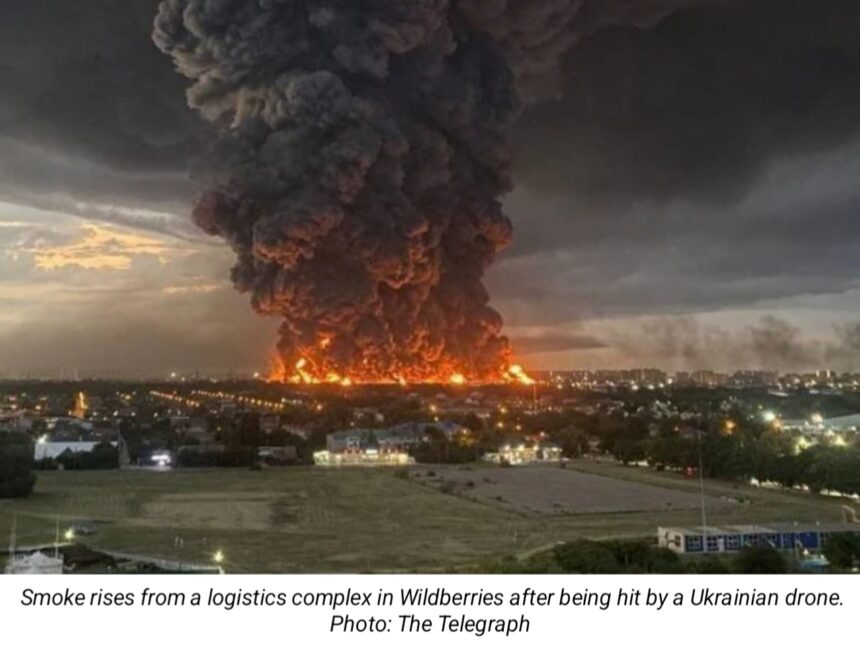
Ukraine has intensified its long-range drone campaign against targets deep inside Russian-controlled territory, with several logistics facilities linked to Russia’s largest online retailer, Wildberries, reportedly struck in recent days. According to Russian Telegram channels and multiple international media reports, explosions and fires were reported at Wildberries buildings in Russia’s Tver region and in Simferopol, the capital of Russian-occupied Crimea, adding to a series of attacks that underscore Kyiv’s growing ability to reach strategic infrastructure far from the front lines. While the full extent of the damage has not been independently verified, the incidents have renewed attention on the role of commercial logistics networks in sustaining Russia’s wartime economy.
Ukrainian President Volodymyr Zelensky has defended the attacks, arguing that certain Wildberries logistics terminals have become legitimate military objectives because they allegedly facilitate the movement of equipment used by the Russian armed forces. Ukrainian officials contend that the company’s distribution centres have handled communications equipment, combat gear, body armour and dual-use electronic components, including microchips that can be extracted from commercial devices and incorporated into drones, missiles and other military systems. On that basis, Kyiv argues that the facilities form part of Russia’s broader military supply chain and therefore constitute lawful military targets under its interpretation of the laws of armed conflict.
The campaign also appears to serve a broader strategic and psychological purpose. Robert Brovdi, the commander of Ukraine’s unmanned systems forces, said the strikes were intended not only to disrupt Russian logistics but also to shatter what he described as the “illusion of a comfortable, well-fed peacetime life” enjoyed by Russians who remain largely insulated from the realities of the war. His remarks suggest that Ukraine increasingly views deep-strike operations as a means of bringing the consequences of the conflict closer to Russia’s civilian and economic heartland, thereby increasing pressure on Moscow beyond the battlefield itself.
Russia and Wildberries have rejected the Ukrainian characterisation of the facilities. The company maintains that its warehouses and distribution centres are civilian commercial infrastructure serving millions of customers and businesses across the country. Russian officials have similarly accused Ukraine of targeting civilian facilities and disrupting normal economic activity, while claiming that air defence systems intercepted numerous Ukrainian drones. Neither side’s claims regarding the specific military use of the targeted facilities or the precise scale of the damage have been independently verified.
Military analysts say the latest attacks illustrate the evolving nature of the war, in which both sides are increasingly seeking to degrade each other’s logistics, industrial capacity and economic resilience rather than focusing exclusively on frontline positions. Ukraine’s expanding long-range drone capability has enabled it to strike strategic infrastructure hundreds of kilometres from the battlefield, while Russia continues to conduct missile and drone attacks against Ukrainian cities, energy infrastructure and industrial sites. As the conflict enters another phase of escalation, commercial logistics networks are becoming increasingly intertwined with military strategy, blurring the distinction between civilian economic assets and infrastructure alleged to support wartime operations. At the same time, independent verification remains limited, and competing narratives from both Kyiv and Moscow continue to shape public understanding of events as the information war accompanies the fighting on the ground.
War now inside Russia: New message from Kiev on attack on Wildberries facility