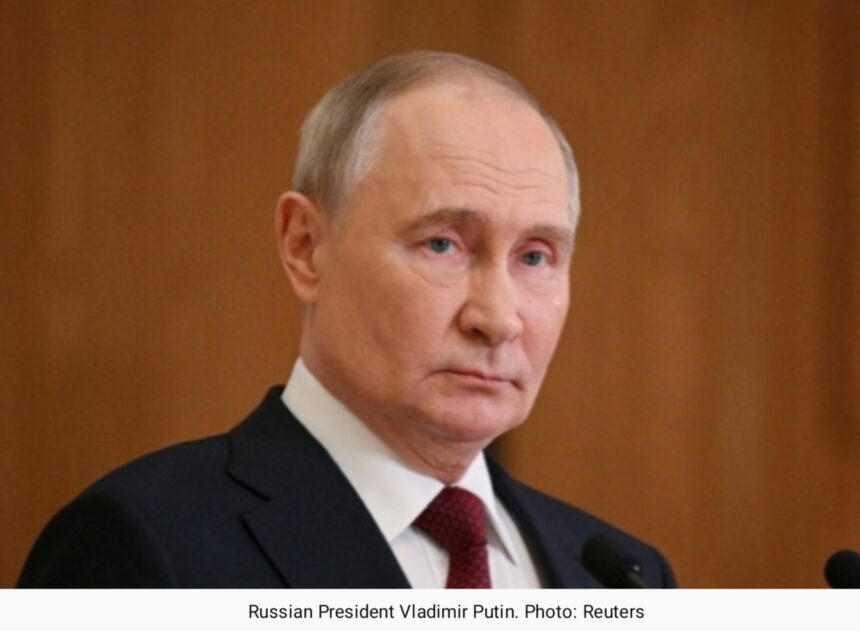
Moscow/Kyiv, August 29, 2026: As the war in Ukraine drags on, the confrontation between Russia and the Western military alliance NATO is entering an increasingly dangerous phase. Russian President Vladimir Putin could ultimately consider using tactical nuclear weapons as a last resort to secure a military outcome or avoid defeat, Bloomberg reported, citing sources close to the Kremlin. According to the report, fresh concern over a nuclear option has emerged amid an assessment in Moscow that peace negotiations with Ukraine have effectively reached an impasse. Tactical nuclear weapons generally have shorter ranges and are designed for use against specific military targets rather than for the large-scale destruction associated with strategic nuclear weapons, but their blast, radiation and long-term environmental consequences could still be devastating. There is, however, no independently confirmed public evidence that Putin has made such a decision or that Russia is preparing to launch a nuclear attack on Ukraine imminently; the issue therefore remains a serious potential risk and intelligence assessment rather than a confirmed operational decision. Meanwhile, Ukrainian and European officials say China and India have warned Russia against using nuclear weapons. Beijing, in particular, is said to have sent Moscow a clear message opposing any use of nuclear weapons in the Ukraine war. For now, Moscow may instead rely on conventional military capabilities, potentially intensifying ballistic and other long-range missile strikes against key Ukrainian infrastructure, military facilities and major cities, including Kyiv. At the same time, Ukrainian long-range drone attacks deep inside Russian territory have become another major front in the conflict. Ukrainian forces have increasingly targeted Russian oil refineries, energy infrastructure, military facilities and commercial warehouses linked to the country’s wartime economy. Kyiv argues that such attacks are intended in part to place pressure on Russia’s military supply chains and economic capacity. Moscow, however, views the involvement of Western weapons, intelligence and technology in these operations as evidence that NATO is becoming more deeply involved in the conflict against Russia. From this perspective, Putin has portrayed Ukraine’s long-range attacks as opening the door to a broader and more dangerous confrontation and has warned that Russia’s retaliation could expand. At the same time, fears of a direct confrontation between Washington and Moscow have resurfaced. The Wall Street Journal reported that CIA Director John Ratcliffe travelled to Moscow this week to warn Russia against taking military action against any NATO member and testing the alliance’s resolve and strength. The report said U.S. intelligence agencies believe Putin could consider a limited military operation against a NATO member in the coming years to test how the alliance would respond and whether it would remain united. Possible actions could range from a major cyberattack to a limited border incursion or another controlled military operation, according to the assessment cited by U.S. officials. Russia has strongly rejected such claims. Kremlin spokesman Dmitry Peskov said Ratcliffe’s meetings in Moscow were primarily with Russian intelligence officials rather than President Putin, although the substance of the discussions was conveyed to the Russian leader. Peskov also dismissed reports about a possible Russian attack on NATO as speculation and rumours, arguing that many alarmist narratives being published in Western media have no connection to reality. Nevertheless, the combination of renewed concern over possible nuclear use, Ukraine’s expanding long-range strikes inside Russia, NATO’s military and intelligence support for Kyiv and Moscow’s threatened retaliation has pushed the war into an exceptionally dangerous phase. A miscalculation, an unintended border incident or a major military escalation could create a pathway toward direct confrontation between Russia and NATO. That is why the renewed debate over the possible use of tactical nuclear weapons is being viewed by international security analysts as one of the most dangerous dimensions of the Ukraine conflict. Whether Moscow ultimately returns to a political and diplomatic track or intensifies military pressure and takes the war into a new phase could prove decisive for the future trajectory of the crisis.
Putin may use short-range nuclear weapons as a ‘last resort’ in Ukraine war