

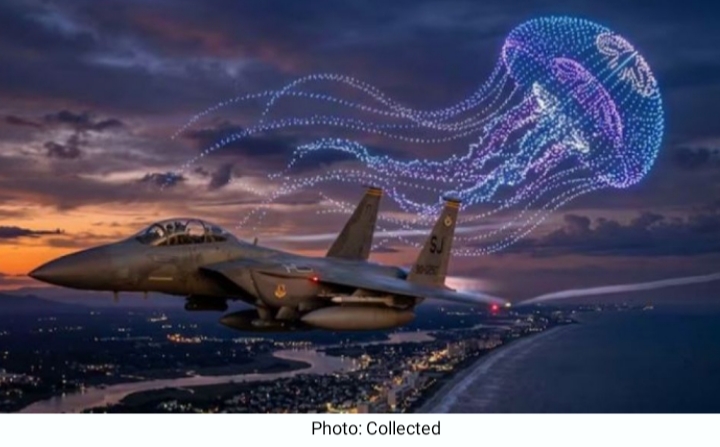
If the account provided by the U.S. pilot accurately reflects what occurred, it may signal a significant and potentially alarming advancement in Iran’s drone warfare capabilities. According to various sources, multiple drones were reportedly operating in a highly coordinated formation, moving as though they were part of a single integrated system. Observers described larger drones accompanied by smaller units arranged in an unusual and complex pattern, creating the impression of a sophisticated and highly advanced technological network.
One source compared the aerial formation to a vast “drone minefield,” with drones positioned and maneuvering in a manner designed to complicate detection and engagement. Although the exact cause of the U.S. F-15 fighter jet’s loss remains under investigation, preliminary assessments suggest that the drones’ coordinated tactics may have played a critical role in creating the conditions that led to the aircraft being brought down.
The aircraft carried a pilot and a weapons systems officer. Following the incident, U.S. forces launched an extensive search-and-rescue operation. The pilot was recovered within hours, while the second crew member reportedly spent nearly a day concealed in mountainous terrain before being safely extracted. During the rescue effort, another U.S. aircraft was also lost, though its pilot managed to land safely outside hostile airspace.
The pilot’s description of the mysterious drone formation has generated considerable debate within the U.S. intelligence community. Some analysts believe it could represent a previously undisclosed Iranian military capability, while others argue that the observations may have been influenced by the stress and confusion of combat. Questions have also been raised regarding the pilot’s condition, as he reportedly suffered a concussion during the incident, potentially affecting the accuracy of his recollections.
The emergence of these claims comes amid ongoing diplomatic discussions and a fragile ceasefire between Iran and the United States, drawing renewed international attention to Iran’s expanding drone program. Defense analysts argue that the ability to control large numbers of drones through an interconnected network could fundamentally reshape future battlefields.
Military experts warn that coordinated drone swarms carrying explosive payloads could present a formidable challenge to conventional air defense systems. If such formations can maintain precise coordination while executing mass attacks, existing defensive measures may struggle to counter them effectively. As a result, many countries may be forced to invest heavily in next-generation counter-drone technologies and defensive strategies to address the growing threat posed by advanced autonomous and networked drone systems.