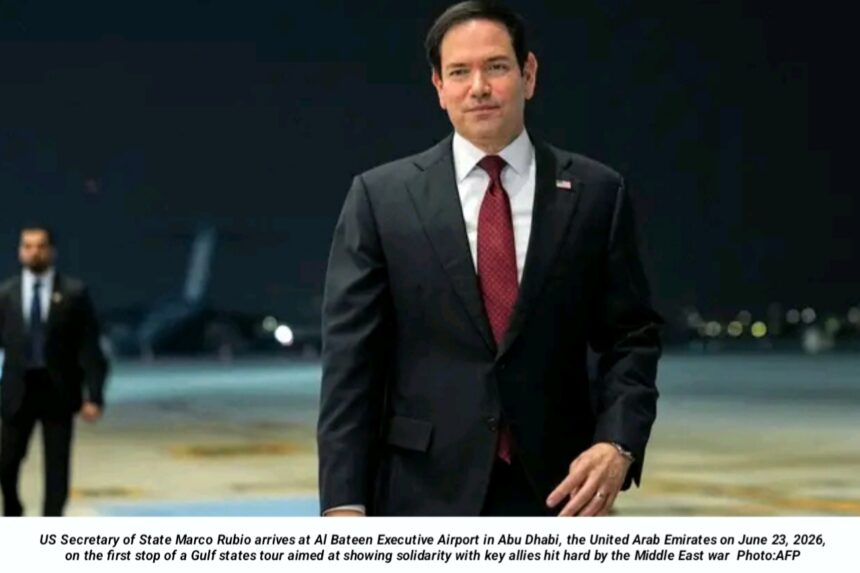
As the United States and Iran move forward with a delicate post-war diplomatic process, a new dispute over the future administration of the Strait of Hormuz has emerged as one of the most significant challenges to regional stability. At the center of the controversy is U.S. Secretary of State Marco Rubio, who has firmly rejected any attempt by Iran to impose transit fees on vessels using one of the world’s most critical maritime corridors.
Speaking during a regional tour of the Gulf, Rubio declared that the Strait of Hormuz is an international waterway and that no nation has the authority to levy tolls on commercial shipping simply for passage through the route. His remarks came after Iran announced that it would temporarily suspend planned transit charges for 60 days while negotiations with Washington continue under a recently signed memorandum of understanding in Switzerland.
The disagreement highlights a growing divide between Washington and Tehran despite a preliminary agreement aimed at ending months of conflict across the Middle East. While both sides have committed to a diplomatic framework addressing sanctions relief, Iran’s nuclear program, and regional security issues, the future governance of the Strait of Hormuz has quickly become a major point of contention.
For decades, the Strait of Hormuz has been one of the most strategically important waterways on Earth. Roughly one-fifth of the world’s oil and natural gas exports pass through the narrow channel, making it indispensable to global energy security. During the recent conflict, maritime traffic through the strait was severely disrupted, triggering sharp increases in oil prices and raising fears of a broader economic crisis. Although shipping activity has gradually resumed following the ceasefire, uncertainty continues to weigh heavily on international markets.
Rubio’s strong opposition reflects broader concerns among the United States and its regional allies that any long-term Iranian control over transit fees could establish a precedent affecting freedom of navigation and international trade. Tehran, however, argues that the post-war environment requires new security arrangements and administrative mechanisms that acknowledge Iran’s role in maintaining stability along the waterway.
Iranian officials have repeatedly signaled that the status quo before the conflict will not return. Senior negotiators in Tehran have suggested that future service-based charges, security fees, or navigation-related contributions may be necessary to support the safe operation of the strait. Such proposals have drawn skepticism from Washington, which maintains that international maritime law protects the right of transit through strategic waterways.
The dispute arrives at a particularly sensitive moment. Negotiations remain ongoing over Iran’s nuclear activities, international inspections, sanctions relief, regional military deployments, and the future of billions of dollars in frozen Iranian assets. Any breakdown in talks over Hormuz could complicate efforts to secure a comprehensive peace agreement and increase tensions throughout the Gulf region.
Analysts believe Rubio’s position will play a decisive role in shaping the next phase of negotiations. His statements signal that the United States is unlikely to accept any arrangement that it perceives as restricting international navigation or expanding Iranian leverage over global energy supplies. At the same time, Iran appears determined to transform its wartime influence into a lasting strategic advantage.
As diplomatic efforts continue, the Strait of Hormuz has become far more than a shipping route. It now represents a test of the emerging balance of power in the Middle East, a focal point of global energy security, and a symbol of the broader struggle between competing visions for the region’s future. Whether Washington and Tehran can bridge their differences may determine not only the success of the current peace process but also the stability of international energy markets for years to come.
US objects to Iran’s transit fee plan, Rubio takes a tough stance