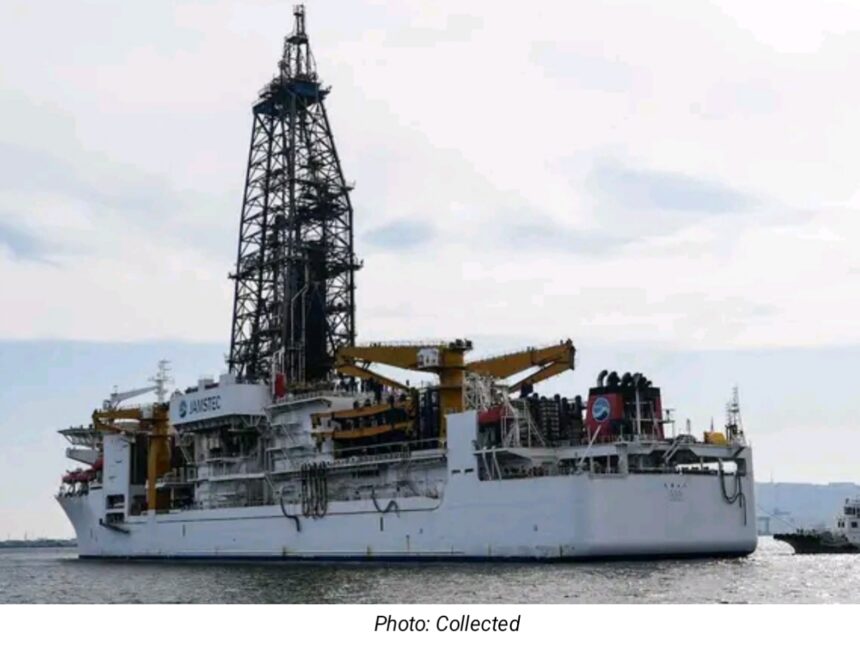
Japan has achieved a historic breakthrough in extracting rare earth-rich mud from the deep seabed of the Pacific Ocean, marking not only a major technological milestone but also a significant geopolitical development aimed at reducing strategic dependence on China and strengthening global supply chain resilience. Japan’s scientific drilling vessel CHIKYU successfully conducted continuous extraction of rare earth-bearing sediment from a depth of approximately 6,000 metres near the remote Pacific atoll of Minamitorishima, becoming the first country to achieve sustained recovery of such resources from this extreme depth. Preliminary assessments suggest that the surrounding seabed could contain more than 16 million tonnes of rare earth resources, potentially making it one of the world’s largest known rare earth deposits if commercially developed.
The achievement comes at a time when concerns are growing over China’s dominance in the global supply of critical minerals essential for advanced technologies, including electric vehicles, semiconductors, renewable energy systems, defence equipment and artificial intelligence. Japan currently imports around 70% of its rare earth materials from China, leaving its high-tech manufacturing sector vulnerable to supply disruptions. Amid rising tensions over Taiwan and broader regional security issues, Beijing has introduced tighter export controls on several dual-use technologies and critical minerals, reinforcing concerns in Tokyo about long-term supply security.
Analysts say the latest development revives memories of the 2010 rare earth dispute, when China effectively halted rare earth exports to Japan following a maritime confrontation in the East China Sea. That episode exposed the vulnerability of Japan’s industrial base and prompted Tokyo to launch a long-term strategy focused on diversifying supply chains, investing in overseas mining projects, expanding recycling technologies and exploring domestic mineral resources. The successful deep-sea extraction near Minamitorishima is widely viewed as a major milestone in implementing that strategy.
Despite the breakthrough, experts caution that commercial production remains a formidable challenge. Operating nearly six kilometres beneath the ocean surface requires overcoming immense water pressure, complete darkness and highly complex geological conditions, making deep-sea mining one of the world’s most demanding engineering tasks. Significant technological advances, substantial investment and careful environmental management will be required before large-scale commercial operations become economically viable. Nevertheless, the Japanese government and industry leaders are aiming to establish commercial production capabilities by 2028.
The project is also seen as part of the broader strategic partnership between Japan and the United States to build more secure and diversified supply chains for critical minerals outside China’s control. International analysts note that rare earth elements themselves are not exceptionally scarce; rather, the greatest challenge lies in economically extracting, refining and processing them. China has maintained a dominant position in these downstream stages for decades, giving Beijing considerable leverage over global technology and manufacturing industries.
Japan’s latest success could reshape the global rare earth market by introducing a significant new source of supply and intensifying international competition for critical minerals. It also has the potential to influence the balance of power in technology, defence and energy security, as countries increasingly seek reliable access to strategic resources. Although full commercial development will require years of further testing and investment, Japan’s achievement signals a decisive step towards securing its critical mineral independence and could redefine the geopolitics of rare earth resources over the coming decade.
16 million tons of rare minerals discovered at the bottom of the Pacific Ocean