
ISTANBUL, August 31, 2026: Senior diplomatic, defense and military officials from Saudi Arabia, Türkiye and Pakistan are holding their first formal meeting in Istanbul to begin giving institutional shape to the new Mecca Joint Defense Pact signed by the three countries. The meeting, held weeks after the agreement was signed in Mecca on August 7, marks an important step in translating the political understanding among the three states into a more structured security framework at a time of growing uncertainty across the Middle East and wider region. Turkish diplomatic sources said the talks are expected to address international security developments, defense cooperation, military coordination and ways to strengthen the three countries’ collective capabilities.
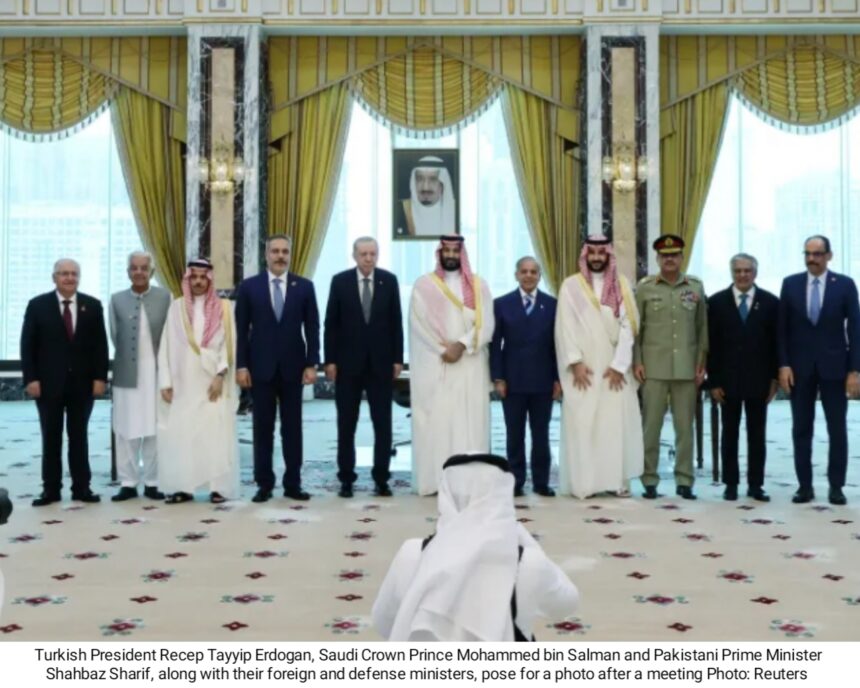
The agreement was signed in Mecca on August 7 by Turkish President Recep Tayyip Erdoğan, Saudi Crown Prince and Prime Minister Mohammed bin Salman, and Pakistani Prime Minister Shehbaz Sharif. One of its central provisions is that an armed attack against any one of the three countries would be regarded as an attack against all three. The provision has drawn comparisons with the collective-defense principle underpinning NATO, although the practical mechanisms for implementing the commitment and determining the military response remain less clearly defined.
The Istanbul meeting is particularly significant because it represents an early move toward establishing a Strategic Political and Defense Committee under the new framework. The proposed mechanism is intended to provide the three countries with a regular channel for reviewing regional and international security developments, coordinating defense policy and strengthening cooperation. Turkish officials have emphasized that the broader objective is to transform existing friendly relations among the three countries into a more institutionalized and sustainable defense partnership.
Military capability and defense-industry cooperation are also expected to feature prominently in the discussions. The three countries could explore closer military coordination, joint training and exercises, defense-technology cooperation and potential industrial partnerships. Türkiye’s rapidly expanding defense sector, Pakistan’s military and defense-production capabilities, and Saudi Arabia’s substantial defense spending and investment capacity could provide complementary strengths if the partnership develops into a deeper long-term security platform.
The pact comes as the strategic environment across the Middle East is undergoing significant change. Regional conflicts, missile threats, the security of critical energy infrastructure and broader instability have encouraged regional powers to reassess their security arrangements. Against this backdrop, closer coordination among Saudi Arabia, Türkiye and Pakistan could enhance their ability to consult and respond collectively to emerging security challenges.
Türkiye has nevertheless stressed that the new defense pact is not directed against any particular country. Foreign Minister Hakan Fidan has said that the agreement does not designate Iran or any other state as a common enemy. Turkish authorities have described the pact instead as an effort to strengthen the existing friendship and strategic cooperation among the three countries through a more durable defense and security framework.
Despite that clarification, the agreement carries considerable geopolitical weight. Türkiye is a major military power and a key NATO member; Pakistan is the world’s only nuclear-armed Muslim-majority state; and Saudi Arabia is one of the Middle East’s most influential economic and military powers. Bringing these three countries’ capabilities and strategic interests into a more coordinated framework could therefore have implications extending beyond bilateral defense relations and into the wider regional security architecture.
Another important question is whether the framework could eventually expand beyond its founding members. Turkish officials have indicated that additional countries could potentially be considered in the future, although no formal decision on expansion has been announced. Egypt has been mentioned in discussions surrounding the possible evolution of the arrangement, but any broader membership would require further political and strategic agreement among the participating states.
Such an expansion could eventually turn the Mecca pact into a broader platform for security cooperation among Muslim-majority states, although that remains a possibility rather than an established outcome. At the same time, how the new framework would interact with Türkiye’s and Pakistan’s existing international commitments and Saudi Arabia’s other security partnerships will be an important issue. Analysts are likely to watch whether the pact develops beyond its political symbolism into practical mechanisms involving intelligence cooperation, military exercises, defense planning and coordinated crisis response.
The Istanbul meeting could therefore help determine the pact’s future direction. Progress on regular consultations, joint military training, defense-technology exchanges, industrial cooperation and procedures for coordination during a crisis would strengthen the agreement’s practical significance. Conversely, if cooperation remains primarily political and declaratory, its direct military impact could remain limited.
Overall, the first high-level meeting of Saudi Arabia, Türkiye and Pakistan since the signing of the Mecca defense agreement represents an important test for an emerging security partnership linking two major Middle Eastern powers with a key South Asian state. The three governments are seeking to build a framework based on collective deterrence, defense cooperation and regional stability. Its long-term significance will ultimately depend on whether political alignment can be converted into sustained practical cooperation and whether the three countries can reconcile their differing strategic interests within an evolving regional security environment.