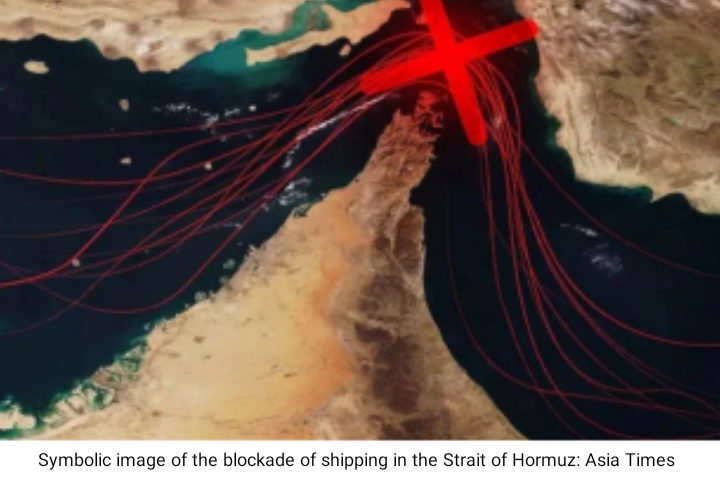
Direct talks between the United States and Iran in Islamabad have failed, prompting U.S. President Donald Trump to announce a naval blockade in the Strait of Hormuz. This move has pushed the Iran conflict into a more dangerous and volatile phase, with the potential to prolong the global oil crisis and drag the United States into a long-term military confrontation. Many observers have labeled Trump’s decision as “illegal,” arguing that it seeks to challenge Iran’s claim of sovereignty over the strait—an assertion already disputed under international law. Historically, the Strait of Hormuz has functioned as an open আন্তর্জাতিক waterway, through which nearly 20% of the world’s oil and liquefied natural gas supplies pass.
Concerns have intensified after Iran reportedly deployed naval mines in the strait, raising fears that not all of them can be detected. The U.S. Central Command has stated that it has begun mine-clearing operations, which Iran claims violates the existing ceasefire. The blockade announcement, coming after a two-week truce, has significantly increased the risk of renewed hostilities, and Washington is reportedly considering limited military operations following the collapse of talks in Pakistan.
According to analysts, Iran’s Islamic Revolutionary Guard Corps has effectively established a “toll booth” system in the Strait of Hormuz. Ships are reportedly required to submit documentation, obtain authorization codes, and travel through controlled corridors under IRGC supervision, with fees reaching up to $2 million per vessel. Critics argue this resembles maritime extortion, allowing only selected countries to pass while charging heavy tolls.
The U.S. aims to dismantle this system through its blockade, which is set to take effect from April 13. The International Maritime Organization has already condemned Iran’s actions as contrary to international law and urged nations not to comply with such toll payments, warning of a dangerous precedent for global shipping. U.S. Central Command clarified that the blockade specifically targets vessels entering or leaving Iranian ports—not all ships transiting the strait—an important distinction in determining its legality under international maritime law.
Freedom of navigation in the Strait of Hormuz remained largely unquestioned until recently, despite Iran (1959) and Oman (1972) extending their territorial waters to 12 nautical miles, effectively narrowing the passage. At its narrowest point, the strait is only 21 nautical miles wide, yet both countries had long committed to ensuring uninterrupted transit—something now clearly undermined by Iran’s recent actions.
During the 1980s Iran-Iraq War, the United States used force to keep the strait open and mistakenly shot down an Iranian passenger plane, killing 290 people. The administration of Ronald Reagan later expressed regret and paid compensation, though it did not admit legal liability. Iran revisited its claim over the strait in 2011 but did not enforce it, and the 2015 nuclear deal did not explicitly address freedom of navigation in the waterway.
Now, Iran has made sovereignty over the Strait of Hormuz a key condition in any future peace agreement, alongside demands to lift all uranium enrichment restrictions, halt dismantling of nuclear facilities, receive war reparations, and recover frozen assets abroad. These demands suggest Tehran is seeking not only strategic leverage but also permanent legal control over the strait, making negotiations increasingly difficult.
Notably, the U.S. blockade has yet to gain support from key allies. The United Kingdom has declined to participate and is instead working with France and other partners to form a broader coalition aimed at securing maritime navigation without direct U.S. military involvement. Discussions involving around 40 countries are underway, highlighting the importance of multilateral approaches under international law.
The United Nations Convention on the Law of the Sea (UNCLOS), particularly Articles 37–44, guarantees the right of transit passage through international straits, provided vessels do not delay, threaten force, or conduct unauthorized activities. While Iran argues that such provisions are not customary international law and insists on prior authorization under its 1993 legislation, most legal experts consider this position weak. Historical precedents and international court rulings support the principle of unimpeded navigation, even for warships during conflict.
No state can unilaterally impose tolls or block international waterways, yet Iran’s current actions—combined with mine deployments—have effectively paralyzed shipping through the strait. The economic and humanitarian consequences are mounting rapidly. Brent crude prices have surged beyond $120 per barrel, with further increases following the blockade announcement. Around 230 oil tankers are currently stranded in the الخليج region, disrupting 80% of food imports and threatening global fertilizer supplies, as nearly 30% of urea exports pass through this route.
A recent UN Security Council resolution reaffirmed the importance of free navigation in the Strait of Hormuz, echoing earlier measures to protect maritime rights in the Persian Gulf. However, Iran appears unlikely to compromise, and legal recourse through the International Court of Justice remains complex, as Iran does not recognize its compulsory jurisdiction.
Ultimately, the crisis may only be resolved through prolonged legal and diplomatic processes, though interim rulings could potentially call on both Iran and the U.S. to halt blockade measures—offering a face-saving exit for both sides. Still, Iran could choose to ignore such rulings, as seen in other International disputes.
Iran’s position is clear: it seeks sovereignty over the Strait of Hormuz. If such a precedent is established, it could encourage other nations—such as China in the Taiwan Strait—to pursue similar claims, posing a broader threat to global maritime security and international trade routes.
Reciprocal blockades in the Strait of Hormuz: Global economy and security in new crisis