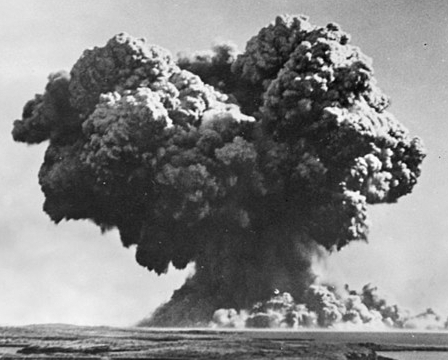
In the aftermath of the Second World War, as Cold War rivalries rapidly intensified and nuclear weapons became the defining symbol of global military power, the United Kingdom embarked on an ambitious and highly secretive effort to develop its own independent nuclear arsenal. Although Britain had collaborated closely with the United States during the wartime Manhattan Project, the strategic partnership changed significantly after Washington imposed strict restrictions on the sharing of nuclear technology under post-war legislation. Faced with growing uncertainty over long-term American cooperation and determined to preserve its status as a major world power, the British government launched an independent nuclear weapons programme aimed at securing strategic autonomy and strengthening its position alongside the emerging superpowers. That effort reached a historic milestone on October 3, 1952, when Britain successfully detonated its first atomic bomb in a test code-named Operation Hurricane. The approximately 25-kiloton plutonium device was exploded inside the hull of the decommissioned Royal Navy frigate HMS Plym, anchored off the Monte Bello Islands on the coast of Western Australia. The test marked Britain’s entry into the exclusive group of nuclear-armed states, making it the world’s third nuclear power after the United States and the Soviet Union. Because the British mainland lacked sufficiently large, isolated, and sparsely populated areas suitable for nuclear testing, London turned to Australia, a Commonwealth ally, whose vast remote territories were considered ideal for such experiments. Following the success of Operation Hurricane, Britain expanded its nuclear testing programme, conducting additional weapons trials between 1953 and 1957 at Emu Field and later at Maralinga in South Australia. These tests played a crucial role in advancing Britain’s nuclear capabilities and reinforcing its strategic deterrence during one of the most volatile periods of the Cold War. However, while the programme was celebrated by British authorities as a technological and military achievement, it carried profound humanitarian and environmental consequences that would become increasingly evident in the decades that followed. Radioactive fallout contaminated large areas of the Australian landscape, leaving behind long-term environmental damage and exposing military personnel, civilian workers, and nearby Indigenous Aboriginal communities to hazardous levels of radiation. Many Indigenous families were reportedly given little or no warning before the tests took place, with some continuing to live or travel through contaminated areas without understanding the risks they faced. Subsequent investigations and medical studies linked exposure to increased rates of cancer, chronic illness, birth defects, and other long-term health complications, while many Aboriginal communities were permanently displaced from ancestral lands that had sustained their cultural and spiritual traditions for thousands of years. The legacy of Britain’s nuclear testing programme has remained a source of political and legal controversy, prompting official inquiries, compensation claims, and continuing calls for accountability from survivors and Indigenous groups. Historians and security analysts argue that Britain’s pursuit of nuclear weapons fundamentally reshaped the strategic balance of the Cold War and cemented its position as a leading military power, yet they also emphasize that the programme serves as a powerful reminder of the human and environmental costs that often accompanied the global nuclear arms race. More than seven decades after Operation Hurricane, the debate surrounding Britain’s atomic legacy continues to resonate, reflecting the enduring tension between national security ambitions, technological advancement, environmental responsibility, and historical justice.
Britain’s Nuclear Ambition: How Atomic Tests in Australia Reshaped Military Power and Left a Lasting Human Legacy