
Venezuela’s efforts to revive crude oil exports are gaining momentum, but the country’s aging and deteriorating port infrastructure has emerged as a major obstacle to that recovery. Despite rising production in recent months, export capacity has struggled to keep pace. Shipping data, maritime documents and sources indicate that tankers at key Venezuelan oil terminals can face waits of up to 30 days to load crude. Power outages, aging equipment, slow crude transfers, limited storage capacity and quality-related problems are putting mounting pressure on the country’s export infrastructure. The bottlenecks are also creating new uncertainty for a U.S.-backed effort to rapidly revive Venezuela’s oil sector and increase supplies to international markets.
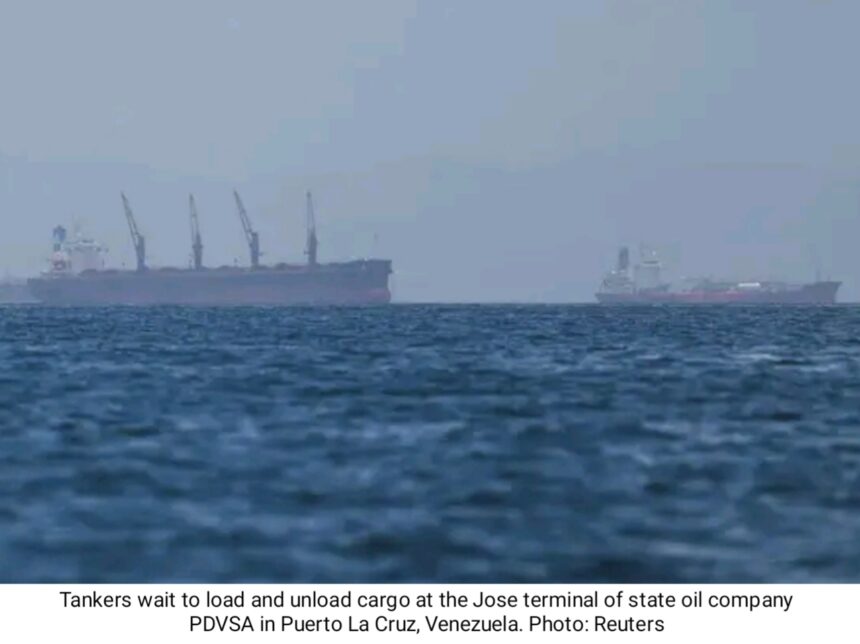
The Jose oil terminal on Venezuela’s northeastern coast is at the center of the crisis. The facility handles roughly 70% of the country’s overall oil exports, but its capacity is increasingly being stretched by demand. More than two decades ago, when Venezuelan oil production peaked at above 3 million barrels per day, the country’s terminals were capable of handling more than 2.5 million barrels per day of exports, with tankers moving through Venezuelan waters in less than a week. Today, the situation is markedly different. Even as production rises, exports have struggled to exceed around 1.25 million barrels per day in recent months, according to vessel-monitoring data.
The growing number of tankers waiting offshore offers the clearest sign of the strain. Dozens of vessels are waiting at the Jose and neighboring Pozuelos anchorages to load or discharge cargoes. Documents reviewed in connection with terminal operations show repeated disruptions at Jose this year caused by equipment failures, power outages and crude-quality issues. A source familiar with PDVSA’s operations said the transfer of crude from storage tanks to vessels has been extremely slow, forcing tankers to remain at docks well beyond their assigned loading windows. Discharging imported products can take even longer because of inadequate fuel-storage capacity.
The infrastructure crisis is also affecting Chevron, one of the world’s major oil companies and a long-standing partner of Venezuela’s state oil company, PDVSA. Sources say Chevron has been seeking ways to improve loading operations, including access to ports that have traditionally been reserved for domestic shipping. The effort underscores the broader nature of the problem: the bottleneck is no longer simply a matter of waiting vessels, but a systemic constraint involving production, storage, transportation and export infrastructure.
Venezuela’s expanded oil-export arrangements with the United States have significantly increased the flow of Venezuelan crude into international markets this year. Trading firms including Vitol and Trafigura have shipped more than 140 million barrels of crude and fuel since January, according to the information cited in the original reporting. Most cargoes have headed to the United States, while other shipments have returned Venezuelan barrels to markets such as Europe and India after years of absence. The easing of U.S. sanctions and Washington’s plans to rebuild Venezuela’s energy industry have increased the country’s importance to global oil markets. Yet questions remain over whether the recovery can be sustained without matching investment in ports, storage facilities, transportation networks and refineries.
Washington is pursuing a broader plan worth about $100 billion to rebuild Venezuela’s energy sector, with a strong focus on increasing crude production. But concerns have emerged that midstream and downstream infrastructure—including terminals, storage facilities, transportation systems and refineries—has not received the same level of priority. At energy conferences in Houston this week, U.S. and Venezuelan officials highlighted the recovery in oil exports while acknowledging infrastructure deficiencies and arguing that fresh investment could address the problems.
The condition of Venezuela’s oil ports also reflects the depth of the country’s longer-term deterioration. Years of sanctions, underinvestment and inadequate maintenance have left obsolete vessels and damaged infrastructure occupying valuable port space. At Guaraguao port in Puerto La Cruz, only two of seven docks were fully operational in mid-August, according to a terminal worker cited in the reporting. As foreign companies seek to reactivate idle terminals and expand crude exports, competition for limited port capacity is intensifying.
The shortage of terminal capacity is also pushing companies toward ship-to-ship transfer areas, where oil leaks and contamination can stain tanker hulls and create additional delays and costs. The consequences extend beyond logistics. Tankers remaining beyond their scheduled loading windows can generate substantial demurrage charges, increasing financial pressure on PDVSA. Disputes over crude quality, contamination and delay-related costs are adding further friction to an already strained export system.
Changes to Venezuela’s oil-contract structure could intensify the pressure. A sweeping energy-sector reform that took effect in late July has moved many PDVSA partnership agreements onto new terms, potentially allowing more partners to market their share of production independently. But PDVSA continues to control the country’s export terminals and cargo scheduling, at least for now. That means greater commercial autonomy among producers could collide with limited physical capacity at the ports, intensifying competition for access.
The Venezuelan case carries a broader message for global oil markets. The country possesses enormous crude resources and is increasing production, creating the potential for a significant rise in international supply. But production capacity alone cannot translate into exports without functioning ports, pipelines, storage facilities, refineries, reliable electricity and efficient maritime logistics. The long queues of tankers are therefore more than a temporary operational problem. They are evidence of years of infrastructure deterioration and underinvestment.
For Venezuela to re-emerge as a major global oil supplier, increasing crude output will have to be matched by a comprehensive reconstruction of the infrastructure needed to move that oil to market. Otherwise, no matter how quickly production recovers, the country’s aging ports could remain the critical bottleneck preventing Venezuelan crude from reaching the global market at the scale envisioned by Washington and international trading companies.