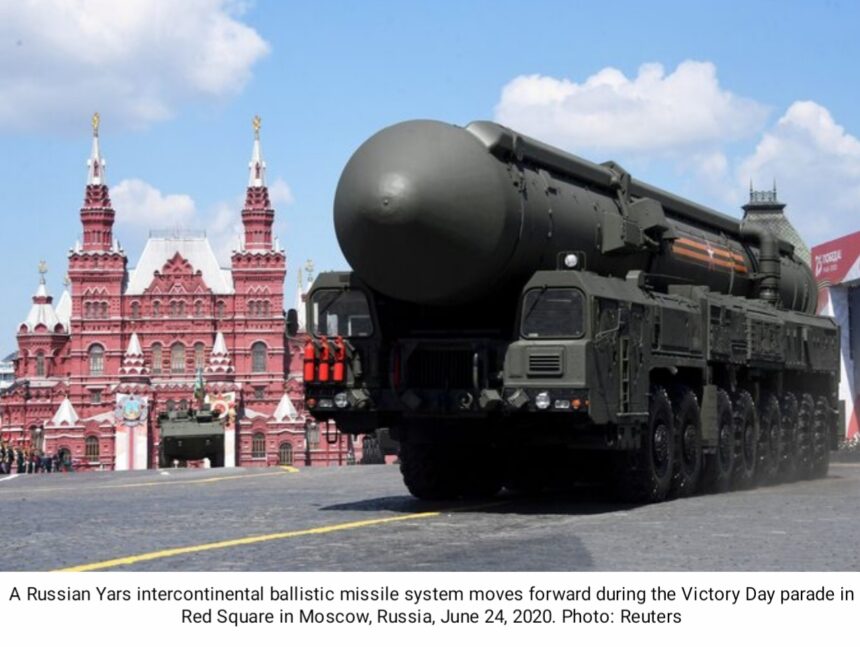
Turkey’s Foreign Minister Hakan Fidan has warned that Russia could potentially resort to the use of nuclear weapons as a “last resort” if the war in Ukraine continues to intensify and Moscow comes to view the conflict as a struggle for national survival.
Speaking during an event hosted by Turkey’s state-run Anadolu news agency, Fidan pointed to Russia’s vast nuclear arsenal and said the nature of a prolonged war could change dramatically when conventional fighting turns into a war of attrition. In such circumstances, he suggested, the question may no longer be simply about winning or losing on the battlefield but about whether a state believes its existence is at stake.
“When a frontline war turns into a war of attrition, the question is no longer simply about victory or defeat, but about survival as a nation,” Fidan said, according to comments reported by Turkish media. “At that point, you may use the last option available to you.”
Fidan did not say that Russia had decided to use nuclear weapons, nor did he provide evidence that Moscow was preparing an imminent nuclear strike. Instead, his comments highlighted what he described as a potentially dangerous escalation scenario as Ukraine continues to carry out drone and missile attacks against targets deep inside Russian territory.
The Turkish foreign minister described the situation as extremely concerning and said Ankara had already discussed the risks with its Western partners. Fidan said that during his own visits to Russia, he had also sensed that questions surrounding the possibility of a nuclear escalation could emerge.
“We have informed the West about this, and they are also aware of it,” he said, warning that developments initially considered impossible can sometimes become realities during prolonged conflicts.
His remarks come amid a sharp increase in long-range attacks between Russia and Ukraine. Both sides have expanded the use of drones and missiles against targets far from the main front lines, raising concerns that the geographical scope of the war is continuing to widen.
According to figures cited by the United Nations, Russia and Ukraine have significantly intensified long-range strikes against each other’s territory this year, with civilian casualties increasing as attacks have expanded. The escalation has also raised concerns over the vulnerability of energy facilities, industrial sites, military infrastructure and population centres.
One of the latest major incidents involved a Ukrainian drone attack in Russia’s Tatarstan region, where at least 13 people were reported killed. The attack was described as one of the largest strikes inside Russia since the beginning of the war and demonstrated Ukraine’s growing ability to conduct operations far beyond the immediate battlefield.
The incident has added to concerns in Moscow over the security of Russia’s rear areas and the vulnerability of strategically important regions to Ukrainian long-range weapons.
Ukraine, meanwhile, continues to face intense Russian attacks. Local Ukrainian authorities said five people were killed after Russian artillery struck a village near the border in the northeastern Kharkiv region. The incident was among a series of attacks that have caused civilian casualties as fighting continues across multiple areas.
Russia’s Defence Ministry said its air-defence forces had intercepted or destroyed 456 Ukrainian drones. Moscow did not provide details on how many drones successfully reached their intended targets or the extent of damage caused by the attacks.
Ukraine’s Air Force, meanwhile, said Russia had launched 126 drones against Ukrainian territory. The figures released by the two sides could not be independently verified, but they underline the scale of the ongoing aerial warfare between Russia and Ukraine.
The latest escalation has also been accompanied by warnings from Ukrainian President Volodymyr Zelenskyy that Russia could be preparing another major mobilisation of troops.
Zelenskyy has claimed that Russian President Vladimir Putin is preparing to send roughly 500,000 additional troops into the war. Citing Ukrainian intelligence assessments, Zelenskyy said Moscow could begin preparations for the mobilisation following parliamentary elections in Russia.
In a statement posted on social media after an interview with a British media outlet, Zelenskyy said Putin was not prepared to end the war and was instead preparing for another large-scale recruitment effort.
“Putin is not ready to stop this war,” Zelenskyy said, according to the statement. “According to our intelligence reports, he is preparing a new mobilisation. He wants to do it immediately after the parliamentary elections.”
The Kremlin has not publicly confirmed the scale of any planned mobilisation described by Zelenskyy, and the Ukrainian claims have not been independently verified.
The possibility of a new Russian mobilisation comes as both sides continue to rely heavily on drones, missiles and long-range strike capabilities. The battlefield has increasingly extended beyond Ukraine’s front lines, with attacks reaching deep into Russian territory while Russian strikes continue to hit Ukrainian cities and infrastructure.
The development has created a difficult strategic dilemma for Moscow. While Ukrainian attacks inside Russia are intended to disrupt military capabilities and demonstrate Kyiv’s ability to strike strategic targets, they also increase the possibility of a stronger Russian response.
That is where Fidan’s nuclear warning becomes particularly significant.
Russia possesses one of the world’s largest nuclear arsenals and has repeatedly emphasised its nuclear deterrent during the conflict. Moscow has previously issued warnings over what it considers direct threats to Russian national security, although Russia has not announced any decision to use nuclear weapons in the current circumstances.
Fidan’s comments therefore appear to be a warning about the potential consequences of continued escalation rather than an announcement of an imminent nuclear strike.
The Turkish warning is also significant because Ankara maintains relations with both Moscow and Kyiv and has repeatedly sought to position itself as a potential mediator in the conflict. Turkey has been a member of NATO while maintaining extensive political, economic and security ties with Russia, giving Ankara a distinctive position in discussions surrounding the war.
Any actual use of a nuclear weapon would have consequences far beyond Ukraine and Russia. Such an event could trigger a major international crisis, fundamentally alter European security arrangements and place unprecedented pressure on NATO and other Western governments to respond.
It could also have severe consequences for the global economy, financial markets, energy supplies and international diplomacy.
For now, however, there is no publicly available evidence that Russia has decided to cross the nuclear threshold. The immediate concern remains the continued expansion of conventional warfare and the possibility that repeated attacks, counterattacks and military mobilisation could create conditions for further escalation.
The war has already entered its fifth year, with diplomatic efforts struggling to produce a durable settlement. Both Moscow and Kyiv continue to pursue military objectives while accusing the other side of blocking meaningful negotiations.
The increasing use of long-range weapons has made the conflict more unpredictable. Military planners must now consider not only developments along the front but also attacks hundreds of kilometres away from the battlefield, including strikes against strategic infrastructure and industrial facilities.
For Western governments, the challenge is to support Ukraine while preventing the conflict from escalating into a direct confrontation with Russia. For Turkey, the priority remains maintaining communication with both sides while warning against developments that could push the war beyond conventional warfare.
Fidan’s remarks underscore the central fear surrounding the conflict: that a prolonged war of attrition could gradually remove the political and military restraints that have so far prevented the use of nuclear weapons.
The key question now is whether Russia and Ukraine can return to meaningful negotiations before continued battlefield escalation creates an irreversible crisis. As attacks intensify and both sides prepare for a potentially longer war, international efforts to contain the conflict and reduce the risk of nuclear escalation are becoming increasingly urgent.
‘Situation is very dangerous’ – Türkiye fears Russia using nuclear weapons