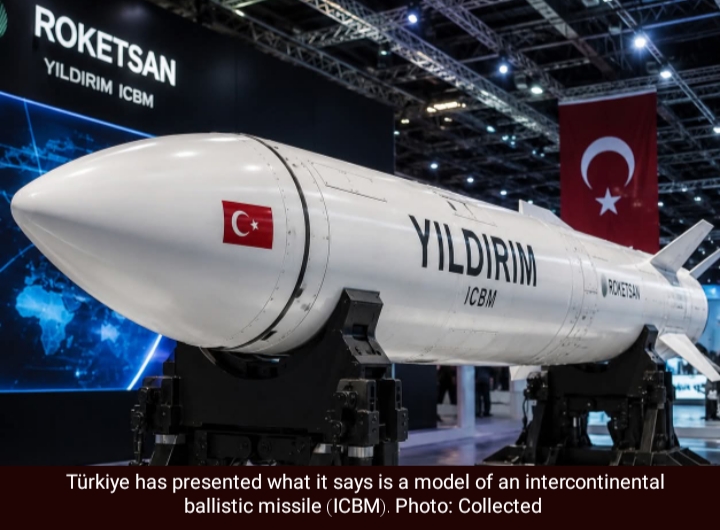
Amid rising geopolitical tensions and an increasingly fragile security environment across the Middle East, Turkey’s newly showcased “YILDIRIM” long-range missile system has emerged as a major subject of international strategic discussion. During a recent defense technology exhibition, Turkish state defense manufacturer ROKETSAN� presented a massive missile model identified as YILDIRIM ICBM, attracting significant attention from global military analysts, diplomatic observers, and security experts. The missile was publicly displayed with the designation “Intercontinental Ballistic Missile,” a classification associated with some of the world’s most advanced strategic weapons capable of striking targets across vast distances. Defense analysts argue that the unveiling of such a system represents far more than a technological demonstration; it reflects Ankara’s broader ambition to expand its strategic influence and long-range deterrence capabilities in an era marked by intense global competition and regional instability. Experts note that only a limited number of nations currently possess operational intercontinental missile technology, making Turkey’s public presentation particularly significant in the evolving balance of military power. Over the past decade, Turkey has invested heavily in strengthening its domestic defense industry, achieving remarkable progress in unmanned combat systems, missile technology, naval defense platforms, aerospace development, and advanced military manufacturing. Under the leadership of Recep Tayyip Erdoğan, the country has pursued an aggressive strategy aimed at reducing dependence on foreign arms suppliers while expanding indigenous military production and strategic autonomy. International security observers believe the presentation of the “YILDIRIM” missile carries not only technological significance but also a clear political and strategic message directed toward both regional rivals and global powers. Although internationally recognized military monitoring institutions have not officially confirmed Turkey as an operational intercontinental ballistic missile power, many analysts believe the showcased system may represent a developmental project, a strategic concept, or an indication of Ankara’s long-term military ambitions rather than a fully deployed capability. In the context of intensifying global rivalry among major powers and continuing instability throughout the Middle East, Turkey’s expanding defense ambitions are being closely monitored across Europe, the Middle East, and the wider international community. Strategic experts warn that if Ankara eventually succeeds in developing a fully operational intercontinental missile capability, it could significantly alter regional military balances, reshape strategic calculations within international alliances, and introduce a new dimension to the evolving global security order.
Global discussion surrounding Turkey’s ‘Yildirim’ missile