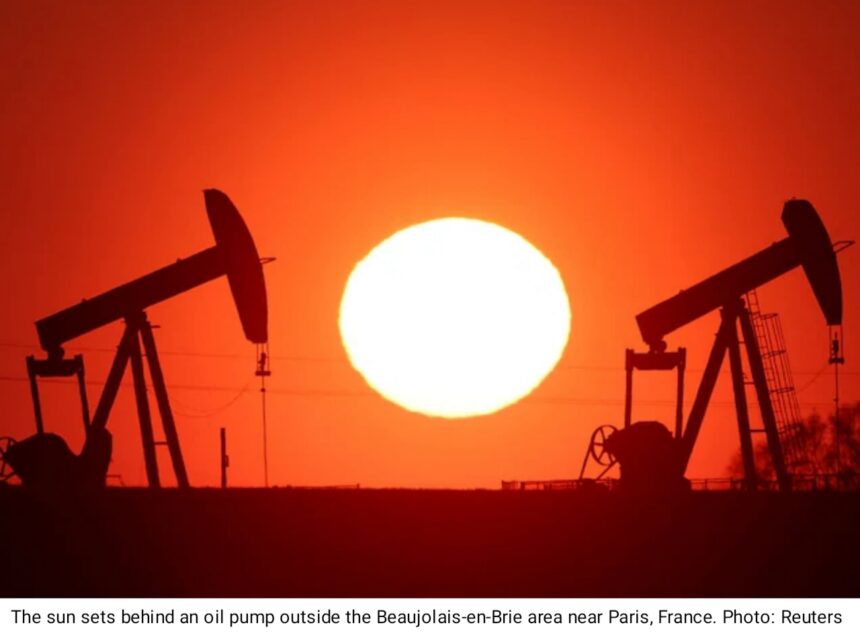
Global oil prices fell by more than 3% on Tuesday to their lowest level in a week, as investors largely shrugged off the latest U.S. sanctions against Iran, judging that Washington’s renewed economic pressure posed less immediate risk to global oil supplies than a further escalation of direct military confrontation. Brent crude futures fell $2.96, or 3.21%, to $89.21 a barrel, while U.S. West Texas Intermediate crude declined $2.84, or 3.34%, to $82.17 a barrel, with both benchmarks trading at their lowest levels since August 17. Market analysts said the apparent shift from direct military escalation toward economic coercion and sanctions has eased some of the market’s immediate fears over a potentially broader disruption to Middle Eastern oil supplies, particularly as U.S. Treasury Secretary Scott Bessent announced the latest measures without immediately identifying the countries or entities that would be targeted or specifying when the penalties would take effect, instead saying affected parties would be given time to comply with the new directives. Tehran has vowed to retaliate against the expanded U.S. sanctions while expressing confidence that its major trading partners will resist Washington’s pressure campaign. Although U.S. Defense Secretary Pete Hegseth has not ruled out the possibility of military force against Iran, analysts said the apparent preference for economic pressure has reduced some concerns about an immediate widening of the conflict and its potential impact on global energy supplies. The relative calm in oil markets, however, does not mean that supply risks have disappeared. Shipping through the Strait of Hormuz, one of the world’s most strategically important energy corridors, remains severely restricted, with only two commodity vessels passing through the waterway on Monday, the lowest daily figure since early May. The situation was further complicated on Tuesday when an oil tanker was struck and disabled by an unidentified projectile about nine nautical miles, or 16.7 kilometres, northeast of Ash Shishah in Oman, according to the United Kingdom Maritime Trade Operations agency, highlighting the continuing security risks facing commercial shipping in the region. Analysts warned that Iran still retains the ability to disrupt maritime traffic, leaving a residual risk premium embedded in oil prices. At the same time, countries affected by supply uncertainty have been drawing down commercial and strategic petroleum reserves, adding another layer of pressure to the global energy system. Oil-market concerns are also being reinforced by incidents outside the Middle East. In Russia’s southern Rostov region, the Novoshakhtinsk oil refinery was damaged by a Ukrainian drone attack and suspended operations, according to the regional governor, while a fire broke out at the Atyrau oil refinery in western Kazakhstan, its owner KazMunayGas said. Taken together, the combination of expanding U.S. economic pressure on Iran, restricted shipping through the Strait of Hormuz and continuing maritime security threats has left global oil markets in a delicate balance. For now, traders appear to be placing greater weight on the possibility that military escalation may remain contained than on the immediate risks of a wider supply shock. But that fragile market calm could quickly reverse if shipping through the Strait of Hormuz remains disrupted for an extended period or if tensions between Iran and the United States escalate into renewed military confrontation, potentially sending crude prices sharply higher once again.
Supply risks in Hormuz persist, Brent oil drops to $89