
Oman’s producer prices rose sharply in the second quarter of 2026, with the country’s Producer Price Index (PPI) increasing 32.7 percent year-on-year as higher prices for crude oil, natural gas and refined petroleum products pushed industrial input costs significantly higher.
The latest figures, released by Oman’s National Centre for Statistics and Information (NCSI), mark a sharp reversal from the previous quarter, when the country’s producer prices had declined by 3.9 percent compared with the same period a year earlier. The second-quarter increase was driven largely by the mining and quarrying sector, as well as a substantial rise in manufacturing prices.
The figures provide a snapshot of the changing price environment facing Oman’s producers at a time when the Gulf economy remains closely linked to developments in the energy market while pursuing efforts to expand activity beyond hydrocarbons.
Mining and Energy Prices Lead the Increase
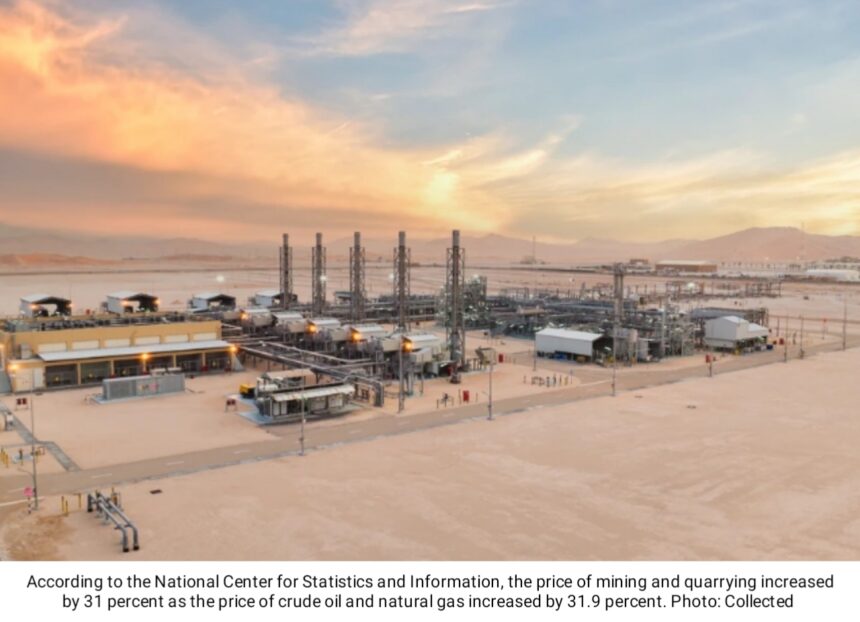
Mining and quarrying prices increased 31 percent year-on-year in the second quarter, according to NCSI data reported by Oman News Agency.
Within the sector, prices for crude oil and natural gas increased by 31.9 percent. The movement represents a major turnaround from the first quarter of 2026, when mining and quarrying prices had fallen 11.3 percent and crude oil and natural gas prices had declined 11.6 percent.
The sharp quarterly shift highlights the sensitivity of Oman’s producer-price index to changes in the energy sector. Oil and gas remain major components of the Omani economy, government revenue and exports, meaning movements in hydrocarbon prices can have a significant influence on broader industrial price indicators.
The increase in producer prices, however, does not mean that consumer prices have risen at the same pace. Producer prices measure changes in prices received by producers and manufacturers, while consumer inflation reflects the prices paid by households for goods and services.
That distinction is important in understanding Oman’s current economic position. While producer prices accelerated sharply during the second quarter, consumer-price pressures remained considerably more contained.
Refined Petroleum Products See Exceptional Increase
Manufacturing recorded an even stronger increase during the second quarter, with prices rising 40.3 percent from a year earlier.
The largest contribution came from the group classified as other transportable goods, where prices increased 55.3 percent. Within that category, refined petroleum products recorded an 88.2 percent increase, while chemical products rose 21.4 percent.
The steep increase in refined petroleum prices was one of the most significant movements in the latest producer-price data.
Higher prices for refined petroleum products can affect a wide range of industrial activities because petroleum-derived products are used across transportation, manufacturing, construction and other parts of the economy. The impact on individual businesses and sectors can vary depending on how much of their production depends on petroleum-based inputs and how effectively they can pass higher costs through to customers.
The manufacturing data therefore provide an important complement to the headline 32.7 percent increase in Oman’s overall producer-price index.
Metal Products, Machinery and Equipment Also Become More Expensive
Prices for metal products, machinery and equipment increased 31.7 percent year-on-year during the second quarter.
Products made from iron, steel and aluminum recorded a 48.9 percent increase. Prices for power transformers, electricity distribution equipment and cables rose 39.8 percent.
Such increases are relevant to construction, infrastructure development and industrial investment because metals and electrical equipment are commonly used in large projects.
The increase in these categories also indicates that the rise in producer prices was not confined to crude oil and refined petroleum products. A number of industrial inputs experienced substantial price movements during the quarter.
At the same time, not every component of the mining and industrial economy moved higher. Prices of metal ore products declined by 14.3 percent, while stone and sand products increased by a comparatively modest 0.5 percent.
The differences between individual categories underline the fact that Oman’s producer-price increase was driven by specific sectors rather than by a uniform rise across every type of industrial product.
Food, Utilities and Consumer-Related Categories
Prices of food products, beverages and textiles increased 2.8 percent year-on-year in the second quarter.
Within this group, footwear prices recorded the largest increase at 6.7 percent, while woven fabrics rose 2.8 percent.
Utility prices also moved higher. Water prices increased 4.4 percent, while electricity prices rose 13 percent compared with the second quarter of 2025.
These increases are substantially smaller than the movements recorded in refined petroleum, mining and some manufacturing categories. Nevertheless, they show that the second-quarter price increase extended beyond the energy and heavy-industrial sectors.
For households and businesses, the effect of producer-price changes depends on whether increased production costs are passed through into retail prices and service charges. A rise in producer prices can therefore precede or contribute to consumer-price pressure, although the two measures do not necessarily move together or at the same speed.
A Sharp Reversal From the First Quarter
The latest data stand out because of the contrast with the beginning of 2026.
Oman’s Producer Price Index fell 3.9 percent year-on-year in the first quarter. Mining and quarrying prices declined 11.3 percent, while crude oil and natural gas prices fell 11.6 percent.
By the second quarter, the direction had reversed dramatically. Overall producer prices were up 32.7 percent, mining and quarrying prices were 31 percent higher and crude oil and natural gas prices had increased 31.9 percent.
The reversal illustrates the influence of energy-market movements on Oman’s industrial price environment.
For an economy with significant hydrocarbon production and exports, changes in oil and gas prices can affect government revenues, corporate earnings, investment decisions and external trade. At the same time, Oman has been pursuing a long-term strategy aimed at increasing the contribution of non-hydrocarbon sectors.
Oman’s Economic Diversification Strategy
Oman has been implementing economic reforms under Oman Vision 2040, which seeks to reduce the economy’s dependence on hydrocarbons and expand sectors such as manufacturing, logistics, tourism, mining, fisheries and other non-oil activities.
The latest producer-price figures arrive against that broader economic backdrop.
The International Monetary Fund expects Oman’s real GDP to grow by around 3.7 percent in 2026, with growth supported partly by higher oil production. The IMF also expects non-hydrocarbon growth of around 2.5 percent this year, followed by stronger expansion in 2027.
The IMF has also said that Oman’s economic transformation agenda includes measures to develop the financial sector, improve the business environment, strengthen state-owned enterprises, expand renewable-energy production and advance digital initiatives.
This means that the sharp rise in producer prices should be viewed alongside the country’s longer-term effort to broaden its economic base.
Inflation Remains More Contained
Despite the substantial increase in producer prices, consumer inflation in Oman has remained comparatively moderate.
According to the IMF, average inflation was 1 percent in 2025 before rising to 2.8 percent year-on-year during January-May 2026. The increase was driven mainly by higher food and transportation prices.
The difference between producer and consumer inflation is significant.
Producer prices can rise sharply because of changes in commodity markets, energy prices or industrial input costs without producing an immediate equivalent increase in consumer prices. Businesses may absorb part of the higher costs, use existing inventories, improve efficiency or pass only a portion of the increase to customers.
The latest Omani data therefore show strong price pressure at the production level, while consumer inflation remains much lower.
Fiscal Position Could Benefit From Higher Hydrocarbon Revenues
Higher energy prices can also have implications for Oman’s public finances.
The IMF expects Oman’s fiscal position to strengthen in 2026, with the fiscal surplus projected to widen to 4.5 percent of GDP from 0.6 percent in 2025. The fund has linked the expected improvement to higher oil revenues and continued fiscal discipline.
The IMF also expects Oman’s external position to improve, with the current account projected to move into a surplus of about 3 percent of GDP in 2026 and 2027, supported by stronger hydrocarbon revenues and growth in non-hydrocarbon exports.
This creates an important connection between the country’s producer-price developments and its broader economic outlook. Higher energy-related revenues can strengthen government finances, but Oman remains exposed to fluctuations in international oil and gas markets.
What the Data Mean for Oman’s Industrial Economy
The second-quarter PPI figures show that Oman’s industrial economy is experiencing substantial changes in input and output prices.
The 32.7 percent overall increase was supported by several large movements:
– Mining and quarrying prices rose 31 percent.
– Crude oil and natural gas prices increased 31.9 percent.
– Manufacturing prices increased 40.3 percent.
– Refined petroleum product prices rose 88.2 percent.
– Chemical product prices increased 21.4 percent.
– Metal products, machinery and equipment rose 31.7 percent.
– Iron, steel and aluminum products increased 48.9 percent.
– Power transformers, electricity distribution equipment and cables rose 39.8 percent.
– Food products, beverages and textiles increased 2.8 percent.
– Electricity prices increased 13 percent.
– Water prices rose 4.4 percent.
Taken together, these figures show that the rise was concentrated particularly in energy and industrial categories.
Implications for Businesses and Investment
For Omani businesses, rapidly rising producer prices can create both opportunities and challenges.
Companies operating in energy-related sectors may benefit from higher selling prices, while manufacturers and businesses that rely heavily on petroleum, metals, chemicals or electricity may face increased production costs.
The impact on investment will depend on how persistent the price increases prove to be.
If higher prices are largely connected to temporary movements in international commodity markets, businesses may adjust once those markets stabilize. If higher input costs persist, companies could face pressure to raise prices, reduce operating costs or delay some investments.
For Oman’s diversification strategy, maintaining investment in non-hydrocarbon sectors will remain important. The government’s broader economic program seeks to increase private-sector activity and expand sectors capable of generating growth outside traditional oil and gas activities.
Outlook
Oman enters the second half of 2026 with a mixed economic picture.
On one side, the country is benefiting from stronger hydrocarbon-related activity, higher oil production and an improved fiscal outlook. The IMF expects real economic growth of around 3.7 percent this year and sees continued expansion in the medium term.
On the other side, the 32.7 percent increase in producer prices shows the degree to which Oman’s industrial price environment can respond to changes in energy and commodity markets.
The key question for the coming quarters will be whether the sharp second-quarter increase in producer prices continues or begins to moderate.
The answer will depend on developments in crude oil and natural gas prices, refined petroleum markets, manufacturing costs and domestic economic activity.
For Oman, the latest figures underline the continuing importance of the energy sector while also highlighting the economic significance of the country’s efforts to expand non-hydrocarbon industries.
The second-quarter Producer Price Index data therefore offer a detailed view of an economy undergoing two processes at the same time: strong price movements in energy-linked industries and a longer-term transition toward a more diversified economic structure.