
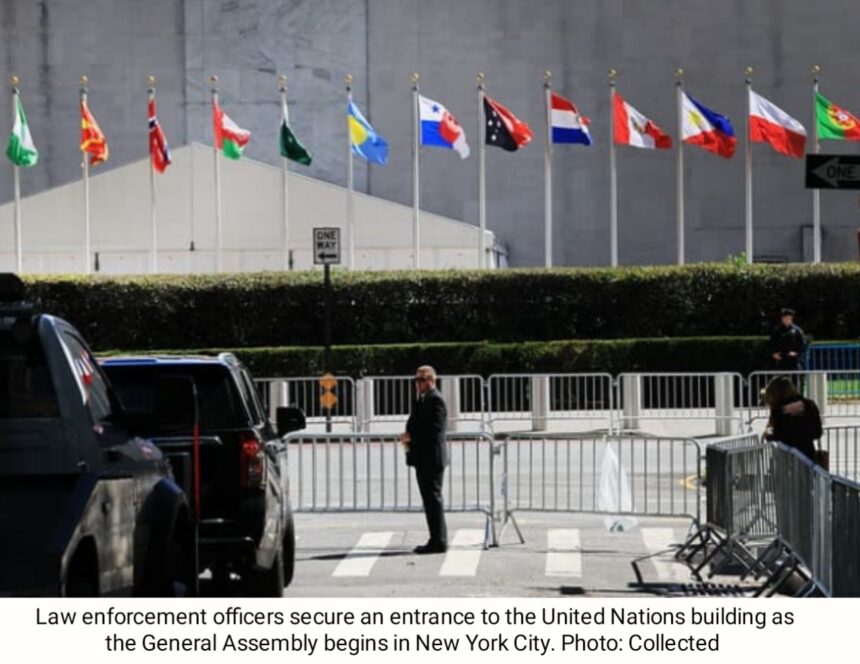
NEW YORK, September 22, 2026 — The United Nations General Assembly is opening this week under intense international scrutiny as senior U.S. and Iranian officials arrive in New York while the two countries remain locked in a prolonged military confrontation. The presence of U.S. President Donald Trump and Iranian President Masoud Pezeshkian at the same diplomatic gathering has raised the possibility of renewed contact between Washington and Tehran, even as both sides continue to exchange warnings and major disagreements remain unresolved.
The 81st session of the United Nations General Assembly comes at a particularly tense moment for the Middle East. The conflict involving the United States, Israel and Iran has disrupted regional security, affected shipping through strategically important waterways and contributed to volatility in global energy markets. At the same time, efforts to establish a lasting diplomatic arrangement between Washington and Tehran have remained stalled.
The arrival of Iranian officials in New York is significant because Washington and Tehran remain adversaries. The U.S. administration has approved visas for Iran’s president and foreign minister, Abbas Araghchi, allowing them to participate in the high-level UN meetings despite the ongoing conflict. The U.S. State Department said Iran’s core delegation would be permitted to attend in accordance with Washington’s obligations as the host country, while restrictions have been placed on the delegation’s movement and activities in New York.
Araghchi arrived in New York ahead of Pezeshkian after traveling through Doha, where Qatar has been involved in diplomatic efforts connected to the conflict. Pezeshkian is expected to address the General Assembly and meet with foreign leaders and other officials during his visit.
Trump is also scheduled to address the General Assembly and hold a series of meetings with foreign leaders during his time in New York. His agenda includes discussions with leaders from the Gulf region, where the conflict has created direct security and economic concerns. Reuters reported that Trump is scheduled to meet leaders from several Gulf countries as part of a wider series of diplomatic meetings during the UN gathering.
One of the most closely watched questions is whether Trump and Pezeshkian could meet directly. Trump has said he is probably open to meeting the Iranian president during the UN gathering. However, as of September 22, no formal meeting between the two presidents had been announced. Pezeshkian’s name was not included on Trump’s publicly announced schedule of meetings, leaving the possibility of a direct encounter uncertain.
Even an informal meeting could attract significant international attention because Washington and Tehran have spent months confronting each other through military action, economic pressure and diplomatic exchanges. A direct conversation would not by itself resolve the conflict, but it could provide a channel for discussing the conditions under which negotiations might resume.
The possibility of diplomacy comes against a backdrop of increasingly strong statements from both governments. Trump has warned that Tehran could face severe consequences if it does not reach an agreement with Washington. Iranian officials, meanwhile, have repeatedly warned that any new U.S. attack could trigger a broader response.
The Iranian military and security establishment has indicated that it could expand the geographic and military scope of its response if hostilities intensify. Such statements have raised concerns that another round of attacks could spread beyond the existing areas of confrontation and further involve regional actors.
The Strait of Hormuz remains one of the central issues in the crisis. The narrow waterway connecting the Persian Gulf with the Gulf of Oman is one of the world’s most important routes for energy shipments. Any prolonged disruption to shipping through the strait could have consequences far beyond the Middle East, affecting oil prices, transportation costs and global supply chains.
Oil markets are already reacting to developments surrounding the possibility of U.S.-Iran contacts. Reuters reported on September 22 that oil prices rose modestly as investors watched for signs of potential talks between Washington and Tehran during the UN General Assembly. The market has remained highly sensitive to developments involving the Strait of Hormuz and the possibility of increased or reduced oil supplies.
The recent movement in oil prices also reflects uncertainty over the actual level of shipping through the strait. Additional supplies moving through the waterway have helped ease some pressure on the market, while traders continue to monitor military and diplomatic developments closely.
The crisis is not limited to Iran and the United States. Yemen’s Houthi movement, which is backed by Iran, has become another major factor in the regional conflict. Attacks linked to the wider confrontation have raised concerns about shipping routes around the Red Sea and the Bab el-Mandeb Strait, another strategically important maritime passage.
For Gulf countries, the situation has created a difficult security environment. Saudi Arabia, the United Arab Emirates, Qatar, Kuwait, Bahrain and Oman all have significant interests in preventing further escalation. These countries are geographically close to the conflict and are also closely connected to international energy markets and maritime trade.
This explains why Gulf diplomacy is expected to play an important role during the UN General Assembly. Trump is expected to discuss the conflict and regional security with Gulf leaders. The talks could focus on the situation in Yemen, maritime security, Iran and possible steps after the current phase of the conflict.
Qatar is likely to remain particularly important because of its previous role as an intermediary between Washington and Tehran. Iranian Foreign Minister Araghchi’s stop in Doha before traveling to New York highlights the importance of Qatar’s diplomatic channel at a time when direct U.S.-Iranian communication remains difficult.
Oman has also historically maintained communication channels with both Washington and Tehran. Along with Qatar and other regional states, it could potentially assist efforts aimed at reducing tensions or establishing conditions for renewed negotiations.
However, major obstacles remain. The two governments have significant differences over security, sanctions, Iran’s military capabilities, regional activities and the future of the conflict. Years of mutual distrust have made direct negotiations politically difficult.
For Iran, economic pressure remains a major concern. U.S. sanctions have placed substantial restrictions on Iran’s economy, while the war has created additional economic difficulties. Any future diplomatic arrangement would therefore likely involve discussions about sanctions relief or other forms of economic pressure.
For Washington, any agreement would require assurances on issues that the U.S. considers central to regional security. The Trump administration has repeatedly linked negotiations with broader questions about Iran’s military and regional activities.
The two sides therefore face a complicated negotiating environment. A diplomatic process would require agreement on what issues should be discussed first, what concessions each side would be prepared to make and how any future agreement could be monitored.
The United Nations could provide an additional diplomatic framework. One possibility discussed by analysts is a Security Council resolution that could establish internationally recognized conditions for a future agreement. Such a resolution could potentially include monitoring arrangements designed to address disputes over compliance.
However, securing a Security Council resolution would be difficult. The council has 15 members, including five permanent members with veto power: the United States, Russia, China, France and the United Kingdom. Any disagreement among the permanent members could prevent the adoption of a resolution.
The General Assembly itself cannot impose the same type of binding obligations as a Security Council resolution, but the annual gathering provides an important platform for direct diplomatic contact. Leaders can meet privately on the sidelines, while foreign ministers and diplomatic teams can hold discussions away from the main chamber.
That makes New York particularly important this week. Even if Trump and Pezeshkian do not meet, their diplomats and intermediaries have opportunities to communicate.
The possibility of a direct encounter has already attracted international attention. Trump has indicated that he would be willing to meet Pezeshkian, while Iranian officials have not publicly confirmed an agreement for such a meeting.
Pezeshkian’s appearance also gives Iran an opportunity to present its position directly to the international community. The Iranian president is expected to use his UN address to discuss the conflict and Tehran’s position on international developments. His delegation’s presence is particularly notable because Iranian officials are attending while the two countries remain engaged in an active confrontation.
For Trump, the General Assembly provides an opportunity to explain Washington’s position to world leaders while holding a large number of bilateral meetings. Reuters reported that his schedule includes talks with leaders from Europe, Asia, Ukraine and Gulf countries in addition to his UN address.
The diplomatic activity comes as international markets remain highly sensitive to the conflict. Oil prices, shipping costs and investor sentiment have all been affected by developments in the Middle East. Reuters reported that financial markets were watching the possibility of U.S.-Iran talks, with oil prices hovering around the $100-per-barrel level amid continuing uncertainty.
A reduction in military tensions could therefore have consequences beyond the immediate conflict. Improved shipping conditions through the Strait of Hormuz could reduce pressure on energy markets, while renewed fighting could have the opposite effect.
The wider international community is also concerned about the possibility of further regional escalation. A conflict involving Iran, the United States, Israel and Iranian-backed armed groups could affect several countries simultaneously. Any expansion of the fighting could place additional pressure on governments already dealing with economic and security challenges.
For this reason, the UN General Assembly is being closely watched as a potential diplomatic opening. The gathering does not guarantee negotiations, and there is no confirmed agreement between Washington and Tehran. But the presence of senior officials from both countries creates opportunities that would not exist if their delegations remained completely separated.
The immediate question is whether those opportunities will produce substantive discussions. A short meeting between the presidents could be politically significant, but a durable settlement would require detailed negotiations involving sanctions, security arrangements, military activity, regional issues and mechanisms for verifying compliance.
The coming days will therefore be closely monitored by governments, financial markets and international organizations. Any announcement involving Trump, Pezeshkian, Araghchi or Gulf mediators could quickly influence expectations about the direction of the conflict.
For now, the situation remains uncertain. Diplomatic channels are open enough to allow both sides to appear at the same international gathering, but the fundamental disagreements between Washington and Tehran remain. The UN General Assembly may provide an opportunity for communication, but whether that opportunity develops into formal negotiations or a broader diplomatic process will depend on decisions made by the two governments and their regional intermediaries.
As world leaders gather in New York, the central issue is therefore not simply whether Trump and Pezeshkian will meet. The larger question is whether the diplomatic contacts surrounding the UN General Assembly can reduce the risk of further escalation and create a framework for renewed negotiations between the United States and Iran.
For a region facing continuing military tension and for global markets watching the Strait of Hormuz, the outcome of those diplomatic efforts could have consequences well beyond the walls of the United Nations.