
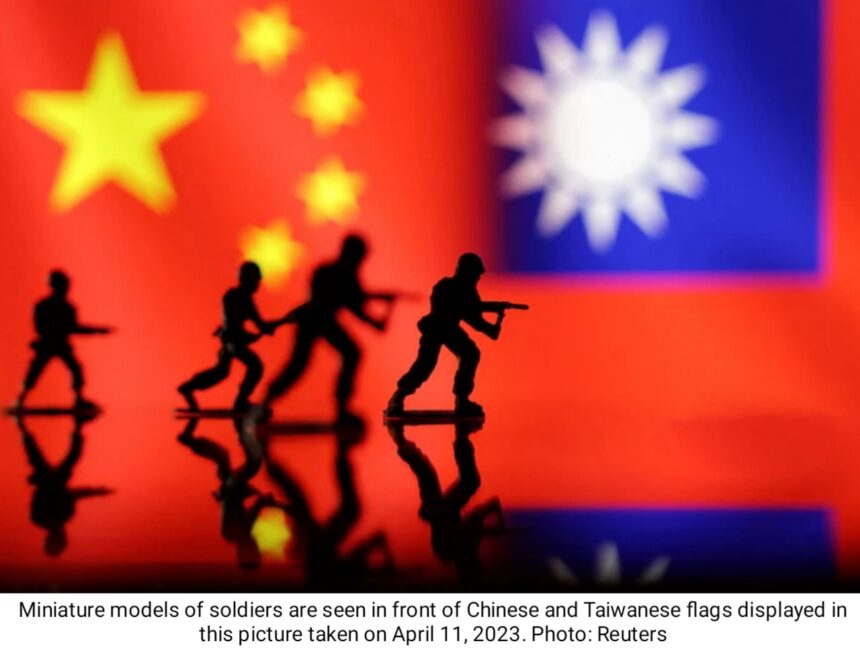
US officials increasingly assess that China is unlikely to launch an invasion of Taiwan before 2028, despite President Xi Jinping’s instruction that the People’s Liberation Army (PLA) should be ready by 2027 to carry out a military operation against the island if necessary, according to an exclusive Reuters report published on October 1, 2026.
The assessment marks an important change in how some US officials view the often-discussed “2027 timeline.” Rather than treating 2027 as a fixed date for a possible Chinese invasion, the latest assessment described by Reuters points to a more complicated picture involving military preparedness, China’s domestic political environment, Taiwan’s electoral calendar and the future role of the United States.
Reuters reported that its assessment was based on conversations with two current US officials, a former US official and another person familiar with the matter. The sources said Beijing may be more likely to consider the use of force in 2028 or later, depending on developments in Taiwan and China’s assessment of the military and political environment.
The distinction between military readiness and an actual invasion date is important. The 2027 benchmark has frequently been discussed in Washington and other capitals as the year by which the PLA should possess the capabilities needed for a potential Taiwan operation. It does not necessarily mean that Beijing has decided to attack Taiwan in that year.
The US intelligence community made a similar distinction in its 2026 Annual Threat Assessment. The report said Chinese leaders did not currently have a plan to invade Taiwan in 2027 and did not have a fixed timeline for achieving unification. It said Beijing would likely consider several factors, including PLA readiness, developments in Taiwan and the possibility of US military intervention.
Why 2027 became such an important date
The year 2027 has become one of the most closely watched dates in discussions about the Taiwan Strait.
Chinese President Xi Jinping has directed the PLA to develop the capabilities necessary for a potential Taiwan operation. US officials and military planners have consequently spent years examining whether the PLA could reach a level of readiness by 2027 that would allow Beijing to seriously consider military options.
But readiness does not automatically translate into a decision to use force.
A military can possess the ability to conduct an operation without its political leadership deciding that the operation is necessary or worth the risks. The US intelligence assessment published earlier this year explicitly reflected that distinction, saying China was continuing to develop military capabilities while still preferring, if possible, to achieve unification without war.
That assessment is consistent with the broader picture described by Reuters. The latest US view is that several factors could make an immediate invasion less likely, even as China continues preparing its military for a possible conflict.
Taiwan’s 2028 election could influence Beijing’s calculations
One factor identified by the people familiar with the US assessment is Taiwan’s 2028 presidential election.
Reuters reported that some Chinese officials hope Taiwan’s next election could produce a government more willing to accommodate Beijing’s position on unification. If the Democratic Progressive Party, or DPP, wins another presidential term, particularly if President Lai Ching-te remains in office, Beijing could view the political situation differently.
Taiwan’s political leadership strongly rejects Beijing’s sovereignty claims. Lai and the DPP have promoted Taiwan’s separate political identity, a position that Beijing strongly opposes.
Taiwan’s presidential office said under Lai’s leadership the island would continue strengthening its self-defense capabilities and working with international democratic partners, including the United States. Taipei has also repeatedly said that Taiwan’s future should be determined by its people.
This creates an important political variable for Beijing.
If Taiwan’s electorate chooses a government that Beijing considers more willing to engage on cross-Strait relations, China could have different political options. If the DPP remains in power, the relationship could remain highly confrontational.
Reuters quoted one US official as saying that the situation could become significantly more concerning from 2028 if the DPP wins a fourth consecutive presidential term, particularly if Lai is reelected. That statement represents the assessment of an unnamed US official rather than a prediction of what China will ultimately do.
China’s anti-corruption campaign and military readiness
Another major factor identified by the US officials is China’s extensive anti-corruption campaign.
Since Xi came to power in 2012, his government has conducted a broad campaign against corruption and violations of party discipline. The campaign has affected senior officials across the Chinese political, government and military systems.
The PLA has also been affected.
According to the people cited by Reuters, investigations and removals of senior military officials have disrupted some aspects of military development and readiness. Reuters reported that the US officials believed the PLA had not made as much military progress during the previous year as it might have expected because of the effects of the anti-corruption drive.
The US intelligence community has also described China’s military progress as uneven. Its 2026 assessment said the PLA was making steady but uneven progress toward capabilities that could be used in an attempt to seize Taiwan and to deter or defeat possible US intervention.
This does not mean that China lacks significant military capabilities. Rather, it suggests that preparing for a Taiwan invasion involves many separate systems that must work together at the same time.
Why invading Taiwan would be extremely difficult
A military operation against Taiwan would present an unusually difficult challenge.
Taiwan is separated from mainland China by the Taiwan Strait. A large-scale invasion would require China to coordinate naval, air, missile, ground, cyber and logistical operations while moving large numbers of troops and equipment across a body of water.
The US Department of Defense has described a major amphibious invasion of Taiwan as a highly complex operation requiring the PLA to establish and maintain air and maritime superiority and then sustain forces after landing.
The operation would also have to overcome Taiwan’s defenses and potentially deal with intervention by outside powers.
The 2026 US intelligence assessment said Chinese officials recognize that an amphibious invasion would be extremely challenging and could carry a high risk of failure, particularly if the United States intervened.
That helps explain why Chinese military planning includes options beyond a traditional invasion.
China has several possible military options
An invasion involving large numbers of troops crossing the Taiwan Strait is only one possible scenario.
China could potentially consider a range of military and non-military measures, including missile strikes, cyber operations, maritime pressure, air operations, blockades or quarantine-style measures, and other coercive actions.
The Pentagon’s 2025 report on China’s military and security developments described the PLA as preparing for multiple potential courses of action against Taiwan. It identified an amphibious landing campaign as one option while also discussing broader efforts to isolate and weaken the island.
This matters because the absence of an invasion does not necessarily mean the absence of pressure.
Taiwan has faced frequent Chinese military activity around the island, including aircraft and naval operations. Reuters reported separately on October 1 that Taiwan had reassigned a senior naval officer to a leadership position in its Coast Guard as part of efforts to improve coordination between naval and maritime security forces amid continued Chinese military and coast guard activity.
Beijing still says unification is its objective
China considers Taiwan part of its territory and has repeatedly stated that it seeks eventual reunification.
Beijing has not renounced the use of force.
At the same time, China’s stated preference has often included peaceful means when possible. The 2026 US intelligence assessment said Beijing would probably continue seeking to create conditions for eventual unification without conflict, while maintaining military capabilities for a forced option if Chinese leaders decide it is necessary.
That creates a strategic balance between political pressure, economic ties, military coercion and the possibility of armed conflict.
Xi has continued to speak about peaceful development of cross-Strait relations while also emphasizing national reunification. Reuters reported that in a speech this week, Xi again discussed Taiwan in the context of achieving reunification.
The United States remains a central factor
Any discussion of a potential Taiwan conflict must also consider the United States.
Washington does not have formal diplomatic relations with Taiwan, but it is Taiwan’s principal international security partner and arms supplier. US policy includes providing Taiwan with defensive capabilities, while Washington maintains a longstanding policy of strategic ambiguity over exactly how it would respond to a Chinese attack.
The Taiwan Relations Act provides the legal framework for US support for Taiwan’s self-defense.
Recent US policy has continued to attract attention in Beijing and Taipei. Reuters reported in September that Taiwan was still awaiting a proposed US arms package worth about $14 billion, while US officials said Washington’s policy toward Taiwan had not changed.
The issue became even more complicated after the recent meeting between US President Donald Trump and Xi.
According to Reuters, Trump has sought to maintain dialogue with Beijing while also dealing with disputes over trade, Taiwan and other strategic issues. Trump has previously said Xi told him China would not invade Taiwan during his presidency.
What about the 2028 US election?
The US presidential election scheduled for 2028 could also become part of Beijing’s calculations, although the officials cited by Reuters offered differing assessments of its importance.
Some people familiar with the matter said Beijing may want to assess the outcome of the US election before making major decisions regarding Taiwan. The reasoning is that a change in Washington could affect US policy toward Taiwan and the broader Indo-Pacific.
Another US official, however, told Reuters that China might have a preference regarding the American election but that the result would not necessarily be as decisive a factor as it might have been in the past.
This illustrates the uncertainty surrounding any attempt to identify a specific date for military action.
China would have to consider not only Taiwan’s government but also the likely response from Washington and other countries.
Lessons from Ukraine and other wars
The war in Ukraine has also influenced military thinking in Beijing and Washington.
According to the Reuters report, US officials believe Chinese military planners have studied the difficulties experienced by Russia and others in recent conflicts.
One lesson Beijing may draw is that a Taiwan operation would need to move rapidly and avoid becoming a prolonged war.
This would be particularly important because a drawn-out conflict could impose enormous economic and military costs on China while giving Taiwan and potential partners additional time to mobilize.
The US intelligence community has warned that a conflict over Taiwan could have consequences far beyond East Asia. A major conflict could disrupt global trade, semiconductor production, financial markets and technology supply chains.
Taiwan is a major center of advanced semiconductor manufacturing, making any prolonged conflict potentially damaging to industries around the world.
The semiconductor and global economic factor
The Taiwan Strait is also important because of its role in international trade.
Taiwan is deeply integrated into global technology supply chains. Advanced semiconductor production on the island supports industries ranging from consumer electronics and telecommunications to automobiles and artificial intelligence.
A war could therefore affect companies and consumers far beyond China and Taiwan.
The US intelligence community’s 2026 assessment said a conflict could cause major disruption to technology supply chains and create significant economic costs even if the United States did not intervene directly. If Washington became involved, the economic and security consequences could be substantially wider.
This economic dimension is one reason governments and businesses continue to monitor developments in the Taiwan Strait closely.
Taiwan continues to strengthen its defenses
Taiwan has been preparing for a range of potential scenarios.
The government under Lai has emphasized military modernization, civil preparedness and cooperation with international partners. Reuters reported on October 1 that Taiwan had moved a senior naval officer to the Coast Guard as part of an effort to improve coordination between maritime forces.
Taiwan has also conducted military exercises designed to test its ability to respond to blockades, missile attacks and other forms of pressure.
The island’s defense planning reflects the fact that a potential conflict might not begin with a conventional amphibious invasion. A blockade or sustained military pressure could create a different set of challenges.
The meaning of the latest US assessment
The latest Reuters report does not mean that the possibility of a Taiwan conflict has disappeared.
It also does not establish that China will wait until 2028 or beyond before using military force.
Instead, it provides a more detailed picture of how some US officials currently assess the timing.
The main point is that 2027 should not automatically be interpreted as an invasion deadline.
US intelligence said earlier this year that Chinese leaders did not currently have a plan to invade Taiwan in 2027 and had not established a fixed timeline for unification.
The Reuters report adds that US officials now see several reasons why a major invasion before 2028 may be less likely, including military readiness issues and Beijing’s interest in seeing the outcome of Taiwan’s 2028 election.
At the same time, China continues to build military capabilities that could be used against Taiwan if its leadership chooses that path.
A timeline without a fixed deadline
For years, the 2027 date has shaped discussions about Taiwan’s security. It has influenced defense planning in Washington, Taipei and other capitals.
But the latest information suggests that the date is better understood as a military capability benchmark than as a confirmed invasion deadline.
That distinction is important.
China can continue developing the capabilities needed for a Taiwan operation without deciding to use them. Beijing can also alter its strategy depending on developments in Taiwan, the United States and the wider region.
For Taiwan, the immediate challenge remains maintaining its defense capabilities while managing relations with Beijing.
For the United States, the challenge involves balancing support for Taiwan with efforts to avoid a direct military confrontation with China.
For China, the central question remains how to pursue its stated goal of reunification while weighing the military, political and economic costs of using force.
As of October 1, 2026, the latest public US intelligence assessment says Beijing does not have a fixed timetable for unification and does not currently plan an invasion in 2027. Reuters now reports that US officials increasingly see an invasion before 2028 as unlikely, while warning that developments after Taiwan’s 2028 election could affect Beijing’s calculations.
The situation therefore remains fluid. Military readiness, Taiwan’s politics, US policy and China’s internal decision-making will all continue to shape the security environment across the Taiwan Strait.
For now, the 2027 date remains a benchmark for military preparedness rather than a confirmed date for war. The distinction is central to understanding the latest assessment and the continuing debate over Taiwan’s future security.
Source: Reuters, U.S. intelligence community, U.S. Department of Defense.