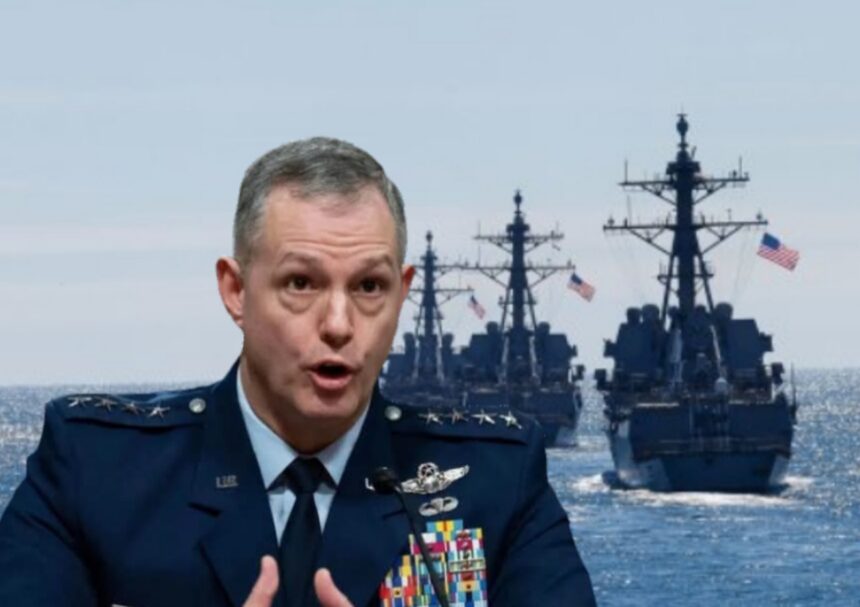
A senior U.S. military commander has warned that growing security commitments across multiple regions are placing unprecedented pressure on America’s armed forces, highlighting the increasingly difficult balance Washington faces as it seeks to maintain global deterrence amid simultaneous crises. The assessment comes at a time when the United States continues to support allies in Europe, sustain its military presence in the Middle East, and strengthen its strategic posture in the Indo-Pacific, where competition with China has intensified. Defense analysts say the convergence of these challenges is testing the capacity of the U.S. military to respond rapidly to multiple high-intensity conflicts at the same time.
According to reports, the senior general expressed concern that shortages of key naval assets, particularly missile-defense capable destroyers and other high-readiness platforms, could force difficult strategic decisions if several regional crises escalate simultaneously. Military planners have increasingly emphasized that maintaining credible deterrence requires not only advanced weapons systems but also sufficient force availability, logistical support, and sustained operational readiness. As global tensions continue to evolve, the demand for these capabilities has grown significantly.
Security experts note that the changing character of modern warfare—including the widespread use of drones, long-range precision missiles, cyber operations, and artificial intelligence-enabled military technologies—has expanded the range of threats facing the United States and its allies. This evolving battlefield has increased the need for integrated air and missile defense networks, stronger intelligence cooperation, and closer coordination among allied militaries. Analysts argue that future conflicts are likely to be more complex, requiring rapid deployment, technological superiority, and seamless multinational cooperation.
While U.S. officials have repeatedly reaffirmed Washington’s commitment to its alliance obligations and global security responsibilities, defense observers say the latest warning underscores the strategic reality that military resources are finite. They argue that sustaining long-term commitments across Europe, the Middle East, and the Indo-Pacific may require continued investment in defense modernization, expanded industrial production, and greater burden-sharing among allies. The assessment has renewed debate over whether the United States can simultaneously deter multiple adversaries while preserving the flexibility needed to respond to emerging crises without overstretching its military capabilities.
Strategic analysts believe the warning reflects broader questions about the future of the international security architecture. As geopolitical competition intensifies and regional flashpoints become increasingly interconnected, policymakers face mounting pressure to adapt military planning to a more unpredictable global environment. Whether through increased defense spending, accelerated procurement of advanced naval platforms, or deeper cooperation with allies, the United States is expected to reassess how it allocates military resources to safeguard its national interests while maintaining stability across several of the world’s most strategically important regions.
Choose either Israel or the United States: US general