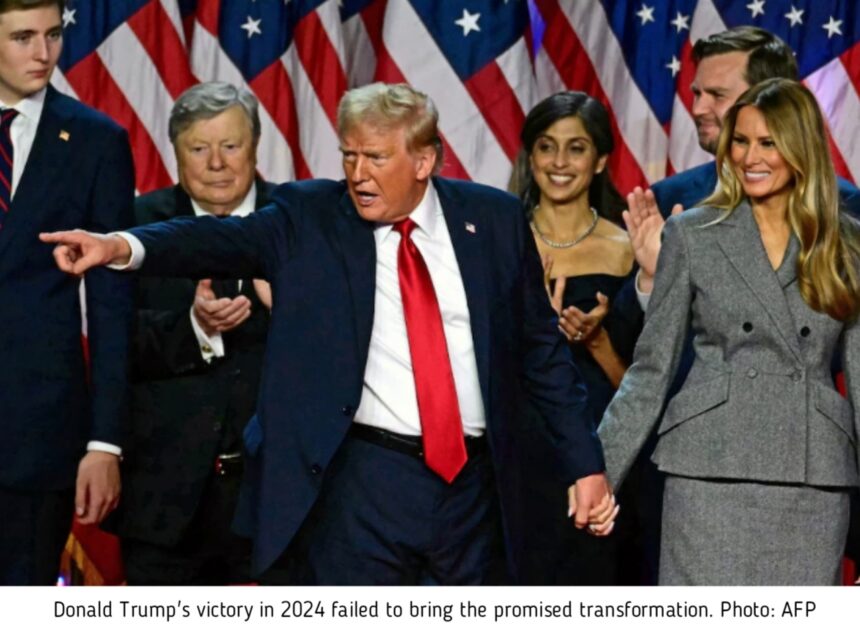
Nearly two years after Donald Trump returned to the White House following his victory in the 2024 presidential election, the political and cultural transformation promised by his supporters continues to reshape American public life. Yet as the administration celebrates what it describes as a decisive rollback of progressive influence, critics argue that the United States has not escaped the era of identity politics. Instead, they contend, the country has entered a new phase in which one form of ideological polarization is being replaced by another.
Trump’s return to office was widely interpreted by supporters as more than an electoral victory. It was viewed as the beginning of a broader cultural realignment that would dismantle the influence of “woke” politics across government, education, media, and corporate America. Unlike his first presidential victory in 2016, Trump’s 2024 campaign secured a broader coalition of voters, including significant gains among Latino, Asian-American, younger, and some Black voters. The result strengthened Republican claims that political loyalties were becoming less defined by traditional demographic divisions and more by economic concerns, immigration, public safety, and cultural values.
In the months following the election, many of America’s most influential institutions moved quickly to adapt to the new political environment. Universities that had previously invested heavily in Diversity, Equity, and Inclusion (DEI) initiatives began restructuring or eliminating departments, quietly removing titles and programs that had become symbols of progressive activism. Several higher education institutions revised internal policies amid growing political pressure and legal scrutiny, reflecting a significant shift in institutional priorities.
The retreat from affirmative action represented another major turning point. Following the U.S. Supreme Court’s landmark 2023 decision restricting the consideration of race in university admissions, many leading universities adjusted their admissions practices rather than mounting sustained political campaigns to restore previous policies. While progressive organizations continued to criticize the ruling, the issue gradually faded from the center of Democratic political messaging, suggesting a broader reassessment of electoral priorities.
For many conservatives, these developments appeared to confirm that the cultural dominance of progressive identity politics had reached its limits. Campaigns centered on race, gender identity, mandatory diversity training, and language reforms lost visibility in many public institutions. Corporate diversity programs were scaled back, several state governments introduced restrictions on identity-based educational curricula, and debates over free speech once again moved to the forefront of national politics.
However, political analysts caution that declaring the end of identity politics may be premature. Instead, they argue, American politics has entered a different form of cultural conflict in which competing visions of national identity have become central to public debate. Rather than removing identity from politics altogether, the emphasis has shifted toward questions of patriotism, national sovereignty, immigration, religion, and traditional cultural values.
Critics of the administration argue that this transition represents not the disappearance of cultural politics but its transformation. They contend that while progressive identity frameworks have lost institutional influence, they have increasingly been replaced by narratives emphasizing national identity and ideological loyalty. According to these observers, the political divide remains deeply rooted in competing understandings of what defines the American nation and who represents its cultural mainstream.
Supporters of the administration reject that characterization. They argue that the government’s actions are restoring political neutrality to public institutions rather than promoting a competing ideology. From their perspective, reducing the influence of DEI programs, revising educational standards, and limiting race-conscious public policies represent efforts to return merit, equal treatment under the law, and freedom of expression to the center of public life.
The debate extends beyond domestic politics. International observers continue to watch developments in the United States closely, viewing the country’s cultural transformation as a potential model—or warning—for democracies across Europe and elsewhere. Governments in several Western countries are engaged in similar discussions over immigration, multiculturalism, free speech, national identity, and the role of public institutions in addressing historical inequalities.
Political commentators note that the broader struggle reflects a deeper challenge facing liberal democracies. As societies become increasingly diverse while political polarization intensifies, governments must balance competing demands for equality, social cohesion, and individual liberty. Whether through progressive identity-based policies or conservative nationalist narratives, cultural questions have become inseparable from modern democratic governance.
The long-term political consequences remain uncertain. While Republicans argue that they have successfully disrupted the institutional foundations of progressive activism, Democrats continue to adapt their electoral strategy, placing greater emphasis on economic issues, healthcare, and democratic institutions while remaining divided over how prominently identity-related issues should feature in future campaigns.
As the United States approaches another election cycle, analysts suggest that the country’s political future may depend less on whether identity politics survives than on which version of national identity ultimately proves more persuasive to voters. The ideological struggle that has defined American public life for more than a decade shows few signs of disappearing, even as its language, priorities, and political champions continue to evolve.
For allies and rivals alike, America’s internal cultural contest remains more than a domestic debate. It is increasingly viewed as a reflection of wider questions confronting democratic societies around the world: how to preserve social unity amid diversity, protect freedom while ensuring equality, and reconcile competing visions of national identity in an era of profound political change.
The world’s eyes are now on Washington: Is Trump changing America’s cultural balance?