
The United States has completed the withdrawal of its remaining military forces from Iraq, closing a major chapter in a military presence that began with the US-led invasion of 2003 and continued, with interruptions, for more than two decades.
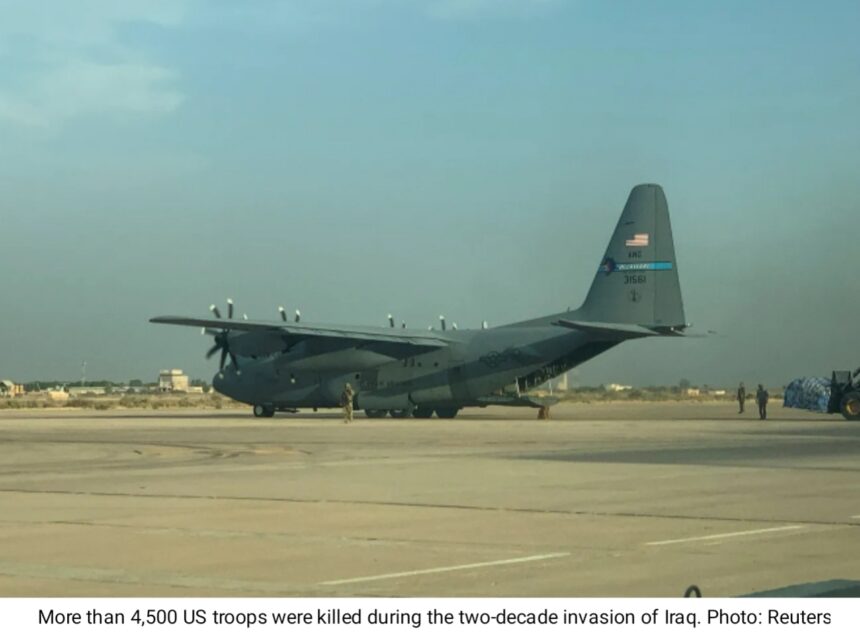
The final departure was completed on September 30, 2026, when US forces and equipment left Erbil Air Base in Iraq’s Kurdistan region. The move formally ended the Iraq-based military mission of Operation Inherent Resolve, the US-led international campaign created to fight the Islamic State group, also known as ISIS. The coalition’s counter-ISIS mission has now shifted its headquarters to Jordan, while operations against ISIS remnants in Syria continue.
The withdrawal was not an unexpected decision made suddenly by the administration of President Donald Trump. It follows a transition agreement reached between Washington and Baghdad in 2024, when Joe Biden was president. Under that agreement, the US-led coalition was scheduled to end its military mission in Iraq and move toward a longer-term bilateral security relationship. The second phase of the plan allowed coalition operations connected to counter-ISIS efforts in Syria to continue from Iraq until at least September 2026, subject to conditions on the ground and consultations between the two governments.
The completion of the withdrawal therefore represents both an end and a transition. The United States is ending its permanent military presence and its coalition combat mission in Iraq, but the two countries are expected to maintain security cooperation through other channels, including military training, counterterrorism cooperation, equipment support and intelligence-related coordination.
For Iraq, however, the departure comes at a complicated moment. The country is attempting to strengthen its own security institutions while balancing relations with Washington, Tehran and other regional powers. Iraq also remains home to armed groups with varying degrees of political and military influence, while ISIS continues to maintain clandestine networks despite losing the territory it once controlled.
The question now is not simply what happens after American troops leave Iraq, but how Baghdad will manage security in a country that has spent much of the past two decades at the center of regional and international military competition.
From invasion to withdrawal
The US military entered Iraq in March 2003 as part of a US-led invasion that removed President Saddam Hussein from power. The operation quickly became one of the defining military interventions of the early 21st century.
After the fall of Saddam Hussein’s government, American forces remained in Iraq for years as the country experienced an insurgency, sectarian violence and political instability. The US military shifted from major combat operations toward counterinsurgency and support for the development of Iraqi security forces.
The first major US military withdrawal was completed in December 2011. At that point, Washington declared the end of its military mission in Iraq and withdrew its remaining combat forces.
That departure did not permanently end American involvement.
The rise of ISIS changed the situation dramatically. In 2014, the armed group captured large areas of Iraq and Syria, including the major Iraqi city of Mosul. Its rapid territorial expansion prompted the United States and its international partners to return militarily to Iraq.
US forces returned as part of Operation Inherent Resolve, working with Iraqi security forces and Kurdish Peshmerga forces against ISIS. The campaign relied heavily on air power, intelligence, surveillance, training and logistical assistance.
By the end of the campaign, ISIS had lost its territorial control in Iraq. But the organization was not completely eliminated. Its fighters moved toward clandestine operations, relying on small cells, rural hideouts and attacks against security forces.
The US military’s final departure therefore comes after two very different periods of involvement: the invasion and occupation that began in 2003, followed by the later international campaign against ISIS that began in 2014.
A war that cost thousands of American lives
The human cost of the Iraq war was substantial.
More than 4,500 American service members died during the US military’s long involvement in Iraq. Reuters has described the American death toll as about 4,500 during more than two decades of war.
The number does not capture the much wider human cost of the conflict. Hundreds of thousands of Iraqis were killed during the years of war and instability, according to different estimates and methodologies, while millions were displaced at various points during the conflict.
The war also transformed Iraq’s political system and altered the regional balance of power.
The fall of Saddam Hussein removed a government that had been a major Arab counterweight to Iran. Over the following years, political parties and armed groups with close relations to Tehran became important forces within Iraq’s political and security system.
That development is one reason the American departure is being closely watched in Tehran as well as Baghdad and Washington.
The 2024 agreement shaped the final exit
The current withdrawal was formally set in motion in 2024.
Washington and Baghdad agreed to gradually end the US-led coalition’s military mission in Iraq and move toward a bilateral security relationship. The initial plan called for the coalition’s military mission in Iraq to end during the first phase, followed by a second phase lasting through at least September 2026.
At the time, US officials emphasized that the transition was not intended to mean the complete disappearance of American-Iraqi security relations.
Instead, Washington described the plan as a move away from a coalition military mission and toward a more conventional bilateral security partnership. That could include counterterrorism cooperation, military training, arms and equipment support and other forms of defence cooperation.
The final withdrawal therefore reflects a change in the nature of the relationship rather than the complete disappearance of security ties.
Earlier in 2026, US forces had already left major positions elsewhere in Iraq. In January, Iraqi authorities said they had taken full control of Ain al-Asad Airbase in western Iraq following the withdrawal of US forces. The base had been repeatedly targeted by Iran-aligned armed groups during periods of regional tension.
The last remaining American forces were concentrated largely in northern Iraq, particularly in the Kurdistan region.
Why northern Iraq matters
The final US departure from Erbil is particularly significant because the Kurdistan region has long been an important partner for Washington in the fight against ISIS.
Kurdish Peshmerga forces worked closely with the US-led coalition during the campaign against ISIS. American support included training, intelligence and military assistance.
The region also became exposed to the wider confrontation between the United States, Israel and Iran.
US positions in northern Iraq have faced attacks by armed groups during periods of regional escalation. The withdrawal therefore involves more than simply removing troops. It also means the removal of certain American military capabilities, including air-defence systems that had helped protect US personnel and installations.
The Washington Post reported that military equipment, including air-defence systems, would also be removed as the remaining US troops left northern Iraq.
That has raised particular concern in the Kurdish region about how Iraq will respond to future missile and drone threats.
At the same time, US officials have argued that reducing the American military footprint in Iraq also reduces the risk to American personnel from attacks by Iran and Iran-aligned armed groups.
Iran’s influence becomes a central question
The withdrawal has significant implications for the regional balance of power.
Iran has maintained deep political, economic and security relationships with influential Iraqi parties and armed groups. Some of these groups are incorporated into Iraq’s formal security structure through the Popular Mobilization Forces, while others maintain varying degrees of independence from the central government.
The departure of American forces removes a major foreign military presence that has acted as a counterweight to Iran’s influence in Iraq.
Reuters reported that Iranian officials and Iran-aligned groups view the American departure as a strategic development in their favor, while some Iraqi security analysts have warned that Tehran and its allies could gain greater freedom to shape Iraq’s security environment.
That does not necessarily mean Iraq will become politically or militarily controlled by Iran. Baghdad has its own interests, institutions and relationships with a range of regional and international powers.
Iraq has repeatedly attempted to maintain balanced relations with the United States, Iran, Gulf Arab states and neighboring countries.
The challenge for the Iraqi government will be maintaining that balance while ensuring that the authority to use military force remains concentrated within state institutions.
The ISIS question remains
The defeat of ISIS as a territorial power is one of the main reasons Washington and Baghdad were able to move toward the current transition.
But the group has not disappeared.
ISIS no longer controls major Iraqi cities or large stretches of territory as it did between 2014 and 2017. Its remaining networks operate differently, relying on small cells and attacks rather than conventional military formations.
The US military has acknowledged that the organization remains a threat even though its capabilities have been sharply reduced.
The end of the Iraq-based coalition mission therefore does not mean the end of the campaign against ISIS in the wider region. The coalition’s headquarters has moved to Jordan, and US forces continue to support counter-ISIS operations in Syria.
The key question for Iraq is whether its own security forces can maintain enough intelligence, surveillance and operational capacity to prevent ISIS from rebuilding.
American forces provided significant intelligence and logistical support during the years of the anti-ISIS campaign. Iraqi forces now have to carry more of that responsibility themselves.
Iraq seeks full control over its security
For Iraqi political leaders, the withdrawal carries a strong sovereignty message.
The presence of foreign troops has been controversial inside Iraq for years. Some political factions have demanded their departure, arguing that Iraq should have full control over its territory and security decisions.
The Iraqi government has welcomed the completion of the withdrawal as an important step toward national sovereignty.
At the same time, sovereignty is closely connected to the government’s ability to control armed forces operating inside the country.
The presence of powerful armed groups outside the direct control of Baghdad remains one of the most difficult issues facing Iraq.
The question of militia disarmament and integration into state institutions has been politically sensitive. The Washington Post reported in September that some armed groups continued to signal that they would retain their weapons despite government efforts to establish a timetable for disarmament.
This means that the end of the American military presence does not automatically solve Iraq’s internal security problem.
Instead, more responsibility now falls on Iraqi institutions.
A different relationship with Washington
The United States is not ending all relations with Iraq.
Washington and Baghdad are expected to maintain a bilateral security relationship even after the coalition mission ends. US officials previously described this model as similar to security relationships Washington maintains with other partner countries.
The difference is that American military forces will no longer be stationed in Iraq as part of the international coalition’s Iraq mission.
Training, military education, equipment sales, counterterrorism cooperation and intelligence-sharing can continue without a large permanent US military footprint.
The shift could also reduce the frequency with which Iraq becomes a direct battlefield in the confrontation between Washington and Tehran.
For years, American bases in Iraq were targeted by Iran-aligned armed groups, particularly during periods of intense US-Iranian confrontation. The 2020 US killing of Iranian General Qassem Soleimani in Baghdad further demonstrated how quickly Iraq could become a battlefield between outside powers.
The withdrawal changes that equation, although it does not eliminate the possibility of future confrontation.
What comes next for Iraq?
The future security structure will depend largely on the ability of Iraqi institutions to manage several challenges at the same time.
First, Baghdad must prevent ISIS from rebuilding its operational networks.
Second, it must maintain control over armed groups and ensure that major military decisions remain under state authority.
Third, Iraq must manage its relations with Iran without allowing regional confrontation to destabilize its territory.
Fourth, it must maintain working relations with the United States and other international partners even after the end of the coalition mission.
And finally, Iraq must address the security concerns of the Kurdistan region while maintaining cooperation between federal and Kurdish authorities.
These challenges are interconnected.
A weakened state security structure could create space for armed groups or ISIS. A rise in militia activity could increase tensions with neighboring states. Regional conflict could again turn Iraqi territory into a battleground.
The withdrawal therefore represents a major test for Iraq’s security institutions.
The end of one era
The final departure of US forces closes a military chapter that began with the invasion of Iraq in 2003.
For Washington, it ends a long period in which American soldiers were repeatedly deployed in Iraq, first in a war to overthrow Saddam Hussein, later in counterinsurgency operations and finally in a multinational campaign against ISIS.
For Iraq, the departure marks another stage in the country’s effort to take full responsibility for its own security.
But the consequences will extend beyond the borders of Iraq.
Iran’s influence, the future of armed groups, the continuing ISIS threat and the security of the Kurdistan region will all shape what comes next.
The United States has now left its remaining military bases in Iraq, but its relationship with Baghdad has not necessarily ended. The two countries are moving toward a different form of security cooperation, one without the large coalition military presence that defined much of the past decade.
The significance of September 30, 2026, therefore lies in more than the departure of the last American soldiers.
It marks the closing of a cycle that began with the 2003 invasion, passed through the withdrawal of 2011, the return of US forces in 2014 and the long campaign against ISIS.
The next chapter will be written primarily by Iraq itself.
Whether the country can maintain security, contain armed groups, prevent an ISIS resurgence and preserve a balanced foreign policy will determine how successful the transition becomes.
The American military presence has ended. The security questions created by more than two decades of war, intervention and regional rivalry remain.