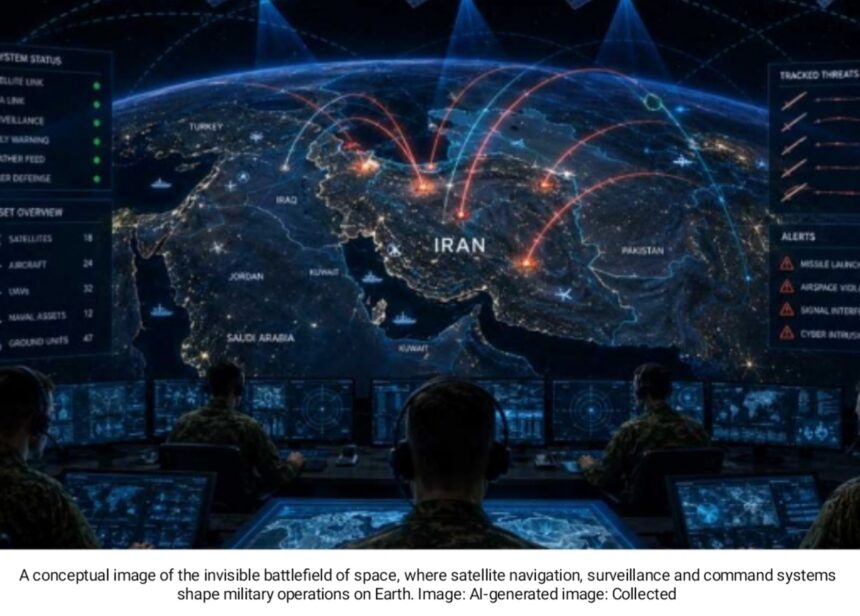
The most consequential battlefield in the Iran conflict may not lie in the skies above the Middle East or on the ground where missiles and drones are launched, but hundreds of kilometres above Earth in space. As modern warfare becomes increasingly dependent on satellites, electronic warfare, intelligence gathering and precision navigation, analysts argue that the struggle for dominance in orbit is beginning to shape the outcome of conflicts as decisively as conventional military power. The growing role of China’s space capabilities in supporting Iran has intensified debate over whether the world is witnessing the emergence of the first major proxy conflict fought through space-based technologies.
For years, China has identified space as a strategic domain central to national security and military competitiveness. Beijing has invested heavily in satellite constellations, navigation systems, reconnaissance platforms, anti-jamming technologies and electronic warfare capabilities. Numerous Western defence assessments have concluded that China’s long-term objective is to reduce dependence on Western-controlled infrastructure while creating an independent military space architecture capable of supporting both domestic and allied operations during times of crisis.
The recent Iran conflict has brought renewed attention to those investments. Military analysts suggest that while Iran’s arsenal of ballistic missiles, cruise missiles and unmanned aerial vehicles remains significant, the effectiveness of those weapons increasingly depends on access to reliable positioning, communications and battlefield intelligence. Satellites capable of providing navigation signals, secure communications and real-time imagery can substantially improve targeting accuracy, operational coordination and situational awareness even without direct military intervention.
Electronic warfare has also emerged as a decisive factor. Modern conflicts extend beyond kinetic strikes to include efforts to jam communications, disrupt navigation signals, interfere with radar systems and degrade command-and-control networks. Countries possessing advanced space-based surveillance and electronic intelligence capabilities can monitor military deployments, detect missile launches, identify vulnerabilities and rapidly transmit critical information to partners on the ground. Such capabilities may influence the battlefield without requiring the deployment of combat troops.
The conflict has therefore highlighted how the nature of warfare is evolving. Rather than relying solely on tanks, aircraft and naval fleets, military planners increasingly compete for superiority across multiple domains, including cyberspace, the electromagnetic spectrum and outer space. Satellites have become indispensable infrastructure supporting everything from precision-guided munitions and drone operations to logistics, intelligence collection and secure communications. Their importance has elevated space into one of the world’s most strategically contested environments.
Western security experts have repeatedly warned that future conflicts involving major powers are likely to include efforts to disable or degrade an adversary’s space assets. These operations may involve cyberattacks, electronic interference, directed-energy systems or anti-satellite weapons designed to disrupt orbital infrastructure without triggering immediate large-scale escalation. Such scenarios have encouraged governments to accelerate investments in resilient satellite networks and alternative navigation systems.
China’s expanding space programme has attracted particular scrutiny because of its rapid technological progress and growing integration between civilian and military sectors. The country has launched hundreds of satellites over the past decade while expanding its BeiDou global navigation satellite system, improving remote-sensing capabilities and strengthening secure military communications. Beijing maintains that its space programme is intended for peaceful development and technological advancement, but many governments view its expanding capabilities through the broader lens of strategic competition.
The United States and its allies have responded by strengthening their own military space capabilities. Washington has established the US Space Force, expanded investments in resilient satellite constellations and increased cooperation with allied nations on space security, intelligence sharing and missile warning systems. NATO has likewise recognised space as an operational domain alongside land, sea, air and cyberspace, reflecting the growing importance of orbital assets to collective defence.
Despite mounting speculation, publicly available evidence remains limited regarding the precise extent of any Chinese operational support provided to Iran during the conflict. Independent verification of classified military intelligence is often difficult, and governments rarely disclose sensitive information concerning satellite operations, electronic warfare or intelligence-sharing arrangements. As a result, many assessments remain based on defence analyses rather than officially confirmed operational details.
Nevertheless, the broader trend is increasingly clear. Modern wars are no longer determined solely by the number of missiles launched or aircraft deployed. Information dominance, satellite resilience, electronic superiority and control of critical technological infrastructure are becoming central pillars of military power. The contest for influence in orbit is reshaping strategic calculations, reducing the distinction between civilian and military space systems and expanding the battlefield far beyond national borders.
Whether the Iran conflict ultimately becomes remembered as history’s first proxy war in space remains a matter of debate. Yet it has undeniably underscored a profound transformation in global security. As technological competition intensifies among the world’s leading powers, future conflicts are likely to be influenced as much by invisible struggles unfolding above the Earth as by battles fought on its surface, marking a new era in which space has become an indispensable frontier of international power and modern warfare.
Is the war with Iran being decided in space, not on Earth?