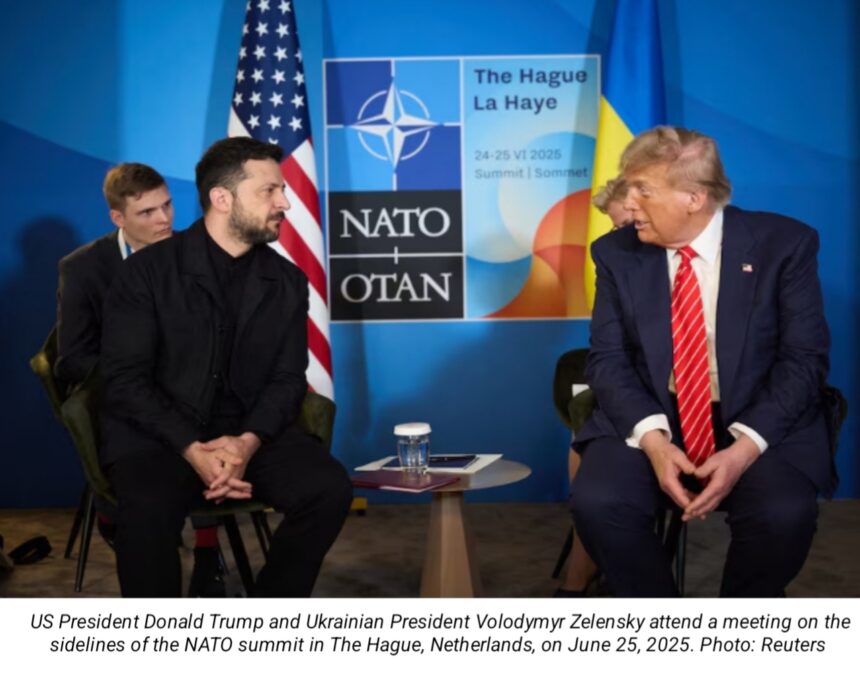
At the NATO Summit in Ankara, U.S. President Donald Trump announced what could become one of the most consequential shifts in Western military support for Ukraine since the full-scale Russian invasion began, revealing plans to grant Kyiv a license to manufacture Patriot air defense missile systems domestically rather than relying solely on foreign deliveries. Presenting the initiative as a long-term defensive strategy, Trump stated that the United States would “teach Ukraine how to build them,” emphasizing that Patriot systems are purely defensive weapons designed to protect civilian populations and critical infrastructure from missile and drone attacks. If fully implemented, the decision would mark a historic turning point by allowing Ukraine to develop indigenous production of one of the world’s most advanced air defense systems, potentially making it only the fourth country capable of producing PAC-3 Patriot interceptors under U.S. authorization. The announcement also represents a significant departure from previous U.S. policy, as earlier administrations were generally reluctant to transfer such sensitive defense manufacturing technology. Military analysts argue that domestic production would reduce Ukraine’s dependence on Western stockpiles, accelerate the replenishment of interceptor missiles, strengthen long-term national defense capabilities, and improve NATO’s collective security architecture in Eastern Europe. Ukrainian President Volodymyr Zelenskyy has repeatedly emphasized that control of the skies remains the decisive factor in modern warfare, arguing that effective air defense is essential for protecting cities, energy infrastructure, military bases, and civilians from sustained Russian missile and drone strikes. Behind the political symbolism lies a broader strategic calculation: the United States and its allies have faced mounting pressure on missile inventories following years of military assistance to Ukraine, while additional demand generated by instability in the Middle East, including the Iran-Israel conflict, has further strained advanced interceptor stockpiles. Encouraging licensed production inside Ukraine offers Washington a way to strengthen Kyiv’s defenses without indefinitely drawing down American reserves. The proposal also follows another wave of large-scale Russian missile and drone attacks on Kyiv, underscoring the urgent need for expanded and sustainable air defense capabilities. Defense experts note that if the licensing agreement proceeds with technology transfer, industrial investment, and NATO coordination, Ukraine could gradually transform from a recipient of advanced air defense systems into a producer capable of supporting its own security requirements over the long term. Such a development would carry profound geopolitical implications, potentially reshaping the balance of military power in Eastern Europe, challenging Russia’s air superiority strategy, deepening defense-industrial cooperation between Ukraine and Western allies, and signaling a transition from an era defined primarily by foreign military assistance to one increasingly focused on strategic defense self-reliance and domestic production capacity.
Trump’s big announcement: Ukraine will manufacture Patriot missile systems domestically