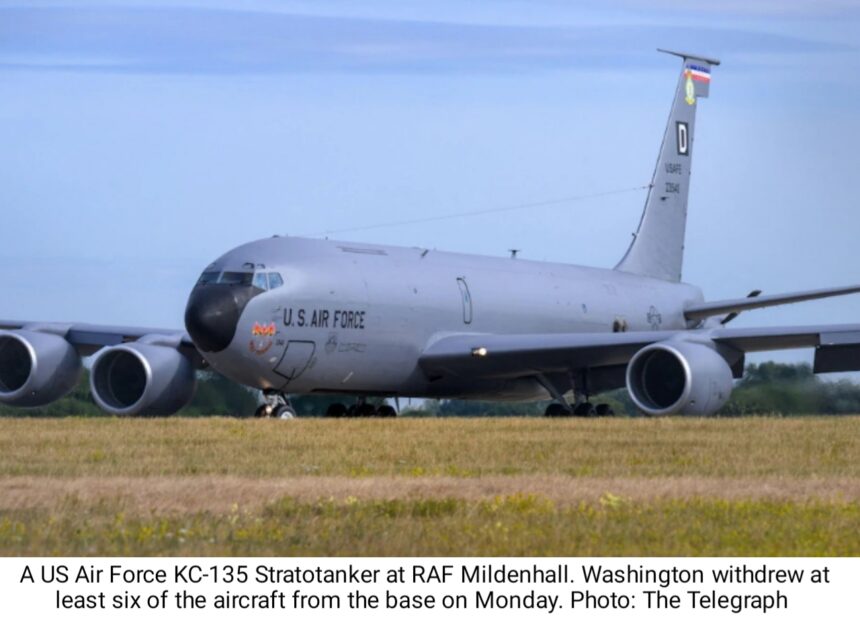
The United States has reportedly increased security measures at two strategically important Royal Air Force (RAF) installations in the United Kingdom, placing RAF Mildenhall and RAF Lakenheath under Force Protection Condition (FPCON) Charlie, a heightened security status that indicates intelligence suggests a terrorist attack or other hostile action may be likely. The development has drawn attention to the security situation surrounding US military facilities in Britain, particularly amid growing international tensions and concerns over the potential consequences of escalating conflicts in the Middle East. According to a report by The Wall Street Journal (WSJ), the security level at both installations was upgraded to FPCON Charlie, a measure that reflects an increased assessment of potential threats to military personnel, facilities and operations. Although authorities have not publicly disclosed the specific intelligence behind the decision, the heightened alert suggests that security agencies are taking possible threats seriously. The report also highlighted movements of US military aircraft and other assets between different military installations and operational locations, raising questions about the nature and purpose of recent deployments. However, US military officials have declined to provide specific details about the movement of aircraft, citing operational security requirements. A spokesman for the US Air Force declined to comment on the details of the reported movements, while a US European Command official explained that American military aircraft regularly rotate between installations and operational locations for a range of reasons, including training activities and real-world operational requirements. The official stressed that US military aircraft operate from allied facilities under established access, basing and overflight agreements with partner countries. The official added that the military would not disclose further information about the movement of assets because of operational security considerations. The White House referred requests for comment on the matter to the Pentagon, leaving several questions about the reported aircraft movements and the precise security concerns unanswered. The United Kingdom’s Ministry of Defence also declined to provide specific information about the activities of foreign military forces operating from British facilities. A Ministry of Defence spokesman said the department did not routinely comment on the activities of other nations, noting that aircraft and other military assets move regularly according to operational requirements. The comments reflect the longstanding arrangement under which US military forces use facilities in the United Kingdom as part of broader defence cooperation between Washington and London. RAF Mildenhall and RAF Lakenheath are among the important military installations supporting American air operations in Europe. Their strategic position and role in transatlantic defence cooperation make security arrangements at both bases particularly significant. The decision to raise their protection status therefore comes at a time when developments in international security are receiving increased attention. The issue also attracted questions from British political figures. Speaking to Sky News on Tuesday morning, Education Secretary Lucy Powell declined to comment on the details of what she described as live operations, saying that such matters could not be discussed publicly. However, she stressed that the security of military bases remained under continuous review. Powell said the government was closely monitoring security arrangements and would take firm and rapid action whenever necessary, referring to other recent cases in which authorities had responded to emerging security concerns. Her remarks indicated that the British government was maintaining vigilance over the security of military facilities, although she did not confirm the intelligence assessments or operational details behind the reported increase in security measures. The development comes against the backdrop of wider geopolitical instability and renewed international debate over the consequences of military interventions, regional conflicts and the strategic role of Western powers in the Middle East. In a separate political context, criticism has also been directed at the historical policies of major powers in the region, including allegations that foreign interventions, the dismantling of Islamic countries, the establishment of authoritarian governments and the creation of Israel have contributed to the suffering and instability experienced by people across the region. Such statements reflect a broader political dispute over the historical roots of Middle Eastern conflicts and the responsibility of international actors for the region’s continuing crises. Nevertheless, there is currently no publicly confirmed evidence in the information reported that directly links these political criticisms to the specific security measures introduced at the two British bases. The reported FPCON Charlie status should also be understood in its proper security context. It represents an elevated level of protection based on an assessment of potential threats and does not, by itself, establish that an attack has occurred or that an attack is certain. Security agencies may introduce additional protective measures, restrict access, increase surveillance and review personnel safety arrangements as part of their response to intelligence assessments. For now, the precise nature of the intelligence prompting the reported security upgrade remains undisclosed. Neither the US military nor the British government has publicly provided a detailed explanation of the threat assessment or confirmed whether the movements of American military aircraft are directly connected to the heightened security measures. The situation therefore remains subject to further clarification from the relevant authorities. As Washington and London continue their close defence cooperation, developments at RAF Mildenhall and RAF Lakenheath are likely to remain under scrutiny, particularly as international tensions and security concerns continue to shape military planning across Europe and beyond. The absence of detailed official explanations has left important questions unanswered, including the specific nature of the perceived threat, the scope of the additional security measures and whether the reported aircraft movements form part of routine military rotations or wider operational requirements. Until further information is released, the reported security upgrade stands as an indication of heightened vigilance at two important US-linked military installations in Britain rather than confirmation of an imminent attack.
Security alert raised at two key US military bases in Britain, ‘FPCON Charlie’ declared over terror threat