China has significantly expanded its deployment of fifth-generation J-20 “Mighty Dragon” stealth fighter jets at airbases close to the disputed Himalayan frontier with India, according to recently released commercial satellite imagery, highlighting Beijing’s growing air power projection and intensifying strategic competition between Asia’s two largest military powers.
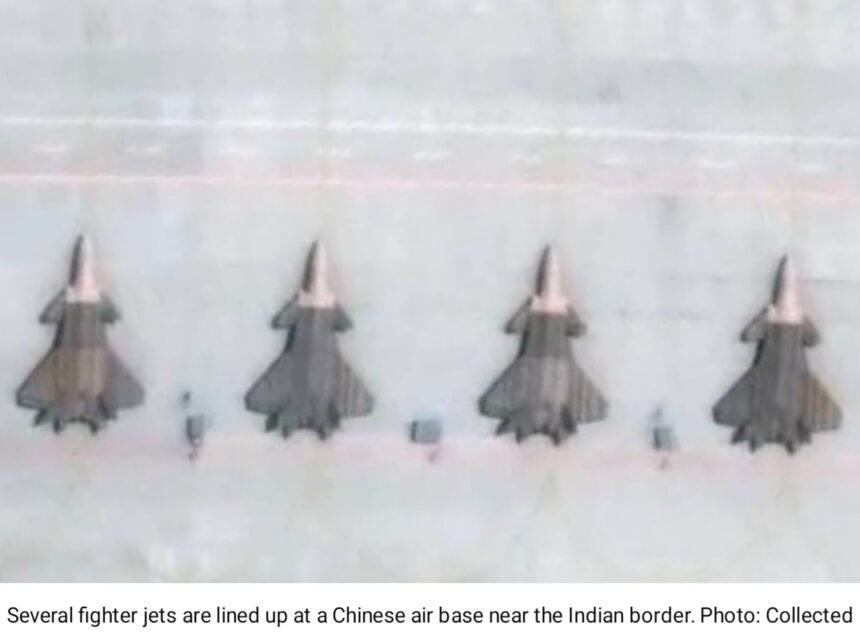
Satellite images captured in late June and early July show at least 11 J-20 stealth fighters stationed at two key People’s Liberation Army Air Force (PLAAF) bases facing India’s northern frontier. Defence analysts say the deployment reflects an increasingly permanent operational posture rather than a temporary military signal, underscoring China’s confidence in operating advanced stealth aircraft from high-altitude airfields near the Line of Actual Control (LAC).
One satellite image dated 9 July shows seven J-20 fighters lined up on the runway at Hotan Air Base in China’s Xinjiang Uyghur Autonomous Region. The base lies approximately 389 kilometres northeast of Leh in India’s Ladakh region and about 245 kilometres from the strategically important Daulat Beg Oldi military airfield, one of India’s northernmost operational bases.
A second satellite image shows four additional J-20 aircraft parked at Damxung Air Base in Tibet, roughly 344 kilometres northwest of Tawang in India’s Arunachal Pradesh, another region that has remained a longstanding source of territorial disputes between Beijing and New Delhi.
Defence observers note that this is the first time commercially available satellite imagery has revealed such a large concentration of J-20 stealth fighters at forward-operating airbases near the Indian frontier. The Indian Air Force has not publicly commented on the reported deployment.
Former Indian Air Force fighter pilot and NewSpace Research & Technologies co-founder Sameer Joshi said the presence of seven J-20s at Hotan and four at Damxung suggests that China’s fifth-generation fighter operations from high-altitude bases have become routine rather than symbolic.
According to Joshi, the deployment demonstrates that the Indian Air Force must increasingly prepare for persistent stealth threats along its northern border, requiring accelerated investment in counter-stealth sensors, integrated air defence networks, advanced surveillance systems and long-range precision strike capabilities.
The J-20 is widely regarded as China’s premier fifth-generation combat aircraft, designed with low-observable stealth characteristics, advanced avionics, sophisticated sensors and long-range air-to-air missile capabilities. Its reduced radar signature gives it a significant advantage in penetrating defended airspace and conducting beyond-visual-range operations against conventional fourth-generation fighters.
Military analysts argue that while India’s French-built Rafale fighters remain among the most capable fourth-generation multirole aircraft in the region, they lack true stealth capability, leaving New Delhi without an operational indigenous fifth-generation platform.
India’s Advanced Medium Combat Aircraft (AMCA), the country’s first domestically developed stealth fighter programme, remains under development. Although key technologies continue to progress through testing phases, defence experts believe the aircraft is unlikely to enter frontline squadron service for several more years, creating a capability gap as China continues expanding its fifth-generation fleet.
China’s production capacity has also drawn increasing international attention. Defence assessments indicate that the number of operational J-20 fighters has grown rapidly over recent years, reflecting Beijing’s ability to scale advanced military aircraft production at an unprecedented pace.
Analysts estimate that China’s annual production of the J-20 has risen sharply, allowing the aircraft to equip an increasing number of PLAAF combat brigades. Some defence research institutions project that the fleet could approach around 1,000 aircraft by the end of the decade if current production rates continue, potentially making it the world’s largest fifth-generation fighter force.
Retired Indian Air Marshal Narmdeshwar Tiwari has previously argued that China’s ability to manufacture well over one hundred advanced fighters annually demonstrates an exceptionally mature defence-industrial ecosystem, supported by efficient supply chains, sustained investment and a highly skilled aerospace workforce.
For India, maintaining air superiority along the Himalayan frontier increasingly depends not only on acquiring additional fighter aircraft but also on modernising surveillance infrastructure, strengthening integrated air defence systems and accelerating indigenous aerospace development.
The latest deployment comes against the backdrop of continuing military competition between China and India following years of border tensions. Since the deadly Galwan Valley clashes in 2020, both countries have reinforced troop deployments, expanded military infrastructure and upgraded airbases across the Himalayan region.
India currently operates 36 Rafale fighters based at Ambala and Hasimara, alongside more than 260 Russian-designed Su-30MKI aircraft, supported by Mirage 2000 and MiG-29 fleets. New Delhi is also pursuing additional fighter acquisitions while continuing discussions on expanding its future combat aviation capabilities.
Although neither Beijing nor New Delhi has indicated any immediate escalation in military tensions, the growing concentration of advanced combat aircraft near disputed border regions reflects the accelerating technological competition shaping Asia’s strategic security environment. As both nuclear-armed neighbours continue investing heavily in next-generation military capabilities, defence analysts believe air power will remain one of the defining elements of the evolving balance of power across the Himalayas.
Show of stealth power: Beijing deploys J-20 fighter jets near Indian border