
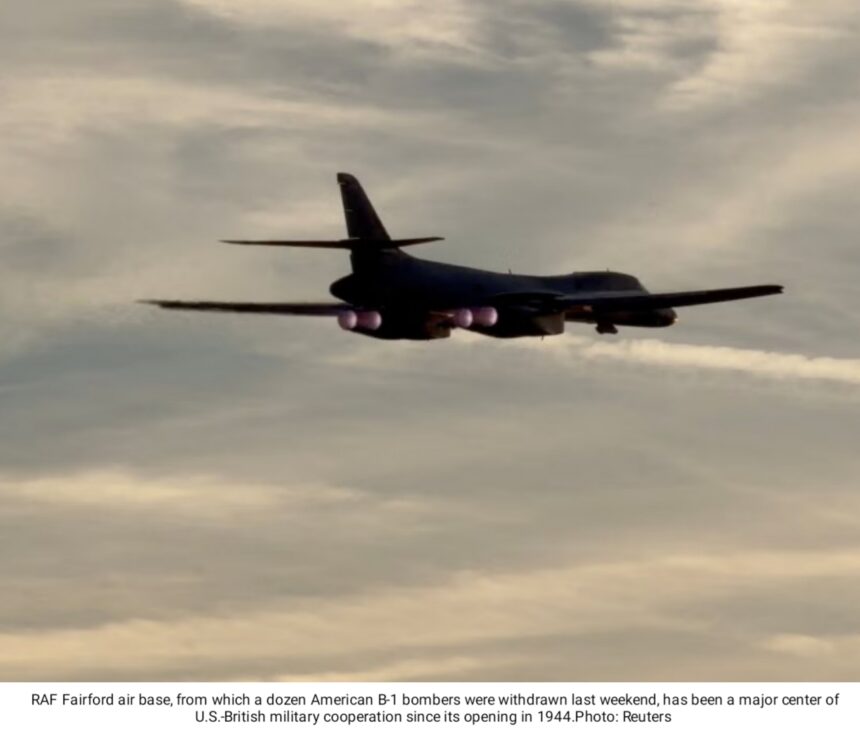
The sudden withdrawal of a dozen American B-1 bombers from Britain has drawn fresh attention to the growing difficulties facing the United States as it tries to maintain military pressure across the Middle East while protecting its forces from emerging threats.
The bombers were stationed at RAF Fairford, a major U.S.-British military facility in Gloucestershire that has supported American strategic operations in Europe for decades. Their departure over the weekend was described by President Donald Trump and senior administration officials as a precautionary move in response to a security threat that Washington has not publicly identified.
Secretary of State Marco Rubio sought to play down the significance of the move, saying that the Pentagon regularly shifts military resources according to operational requirements. Trump likewise presented the withdrawal as a routine decision rather than a sign of a major change in American military strategy.
Yet the development comes at a sensitive moment for U.S. forces.
For months, Washington has been dealing with the consequences of its military campaign against Iran and the wider instability that followed. American forces have faced growing pressure to maintain their ability to strike distant targets while reducing their exposure to attacks against bases, ships and other military facilities.
The decision involving the B-1 bombers illustrates the difficult balance confronting U.S. planners. Washington still possesses enormous military capabilities, including long-range bombers, aircraft carriers, intelligence systems and a network of overseas bases. But the ability to use those capabilities quickly and safely has become more complicated.
Fairford’s Long Role in American Military Operations
RAF Fairford has been closely associated with U.S. military operations since the Second World War. The base has played an important role in American-British defense cooperation and has repeatedly been used to support long-range bomber deployments.
The airfield is particularly valuable because of its location and infrastructure. From Britain, American aircraft can operate closer to Europe, the Middle East and other strategic areas than they could from the continental United States.
The presence of B-1 bombers therefore carries more than symbolic importance.
The B-1B Lancer is designed for long-range missions and can carry a substantial weapons load. Its ability to travel long distances at high speed has made it an important part of U.S. conventional strike capabilities.
Moving such aircraft back to the United States does not eliminate their ability to conduct missions. Instead, it increases the distance they must travel before reaching potential targets. Longer missions can require additional aerial refueling, more complicated planning and greater logistical support.
That difference can become significant during a rapidly developing military crisis.
A War That Has Changed Washington’s Calculations
The withdrawal also reflects a broader problem that has emerged during the conflict with Iran.
When Washington launched its military campaign, the objective was partly to demonstrate that American military power could impose enormous costs on an adversary. The United States has traditionally relied on its global network of bases and forward-deployed forces to demonstrate that it can respond rapidly almost anywhere.
But prolonged conflict can expose weaknesses that are less visible during short military operations.
Bases located close to potential adversaries provide speed and convenience, but they also become potential targets. Aircraft carriers provide mobility, but their movements can be tracked and their surrounding support systems can come under pressure. Aircraft stationed overseas can respond quickly, but their presence may also create political and security risks for host countries.
The result is a difficult strategic calculation.
The United States wants its forces close enough to respond rapidly, but not so close that they become easy targets.
That tension has become increasingly visible as the Iran conflict has continued.
The Cost of Moving American Forces
Military power is often measured by the number of aircraft, ships or troops a country possesses. But the ability to use those assets depends heavily on logistics.
A bomber operating from Britain has a very different operational profile from the same bomber operating from a base in the United States.
A longer flight means additional fuel requirements. It can require more tanker aircraft, more crew support and more maintenance planning. It also gives commanders fewer options when weather, mechanical problems or changing intelligence conditions affect an operation.
The same principle applies to aircraft carriers.
American carrier strike groups remain among the most powerful military formations in the world. But they cannot remain everywhere at once. Their movements require extensive planning, and their presence in one region inevitably affects Washington’s ability to respond elsewhere.
The more difficult it becomes to use overseas bases, the more pressure falls on other elements of the American military system.
This does not mean that the United States has lost the ability to project military power. It means that projecting that power may require greater time, fuel, resources and risk.
The Importance of Overseas Bases
For decades, the United States has maintained a military network stretching across Europe, the Middle East and the Indo-Pacific.
The system was built around a basic strategic idea: American forces positioned overseas can respond faster than forces sent from the continental United States.
That advantage has helped Washington respond to wars and crises from Europe to the Middle East and Asia.
But the security environment has changed.
Long-range missiles, drones, cyberattacks and other technologies have made fixed military installations more vulnerable. A base that once appeared safely distant from a battlefield can now fall within the range of weapons launched hundreds or even thousands of miles away.
This has forced American military planners to reconsider how forces should be distributed.
Instead of concentrating large numbers of valuable aircraft and personnel at a small number of major bases, the Pentagon has increasingly emphasized flexibility, dispersal and the ability to move forces between locations.
The B-1 withdrawal from Fairford fits into this broader challenge.
A Difficult Message for Allies
There is also a political dimension to the decision.
Britain has been one of America’s closest military partners for generations. RAF Fairford is a visible symbol of that relationship.
When American strategic aircraft operate from British territory, the deployment sends a message to allies and potential adversaries alike. It demonstrates that Washington can use European bases to support operations far beyond Europe.
When those aircraft leave, the military consequences may be limited, but the political questions can be larger.
European allies are watching how the United States manages its military commitments while facing simultaneous challenges in different regions.
For countries that depend heavily on American security guarantees, changes in U.S. force deployments can raise questions about Washington’s priorities and the durability of its commitments.
The issue is particularly sensitive because the United States is simultaneously attempting to manage tensions involving Russia, Iran and China.
American officials have repeatedly emphasized that Washington remains capable of responding to threats in multiple regions. But every redeployment creates questions about where resources are being concentrated and what risks are being accepted elsewhere.
Iran and the Changing Military Equation
The conflict with Iran has demonstrated another reality of modern warfare: military superiority does not automatically translate into freedom of action.
The United States possesses unmatched capabilities in areas such as long-range aviation, intelligence gathering, satellite surveillance, naval power and precision weapons.
Yet a powerful military still depends on access.
Aircraft need bases. Ships need ports and supply networks. Forces need fuel, spare parts, communications and intelligence. Even the most advanced weapons systems cannot operate indefinitely without a supporting logistical structure.
Iran’s geographic position also matters.
The Middle East contains a dense network of American facilities, commercial shipping routes and energy infrastructure. Any major confrontation can create pressure far beyond the immediate battlefield.
The Strait of Hormuz, the Persian Gulf, the Red Sea and surrounding airspace are all strategically important. Disruption in any of these areas can affect military operations, global energy markets and international trade.
That makes the protection of American forces a major consideration in Washington’s strategy.
The Return to the United States
The withdrawal of the B-1 aircraft does not mean that American bombers have become irrelevant.
The United States can still launch long-range aircraft from bases on its own territory. Modern bombers are specifically designed to operate over enormous distances.
But distance changes the equation.
Aircraft flying from the United States need to spend more time in the air before reaching a distant theater. They may require multiple tanker aircraft to remain airborne. The longer the mission, the greater the demand on crews and maintenance personnel.
This can reduce the number of missions that can be conducted in a given period and increase the overall cost of military operations.
It can also affect the speed with which Washington responds to a sudden crisis.
That is why overseas bases have remained so important despite their vulnerabilities.
A Broader Test of American Strategy
The B-1 deployment is therefore only one part of a much larger strategic question.
Can the United States continue to maintain a global military presence while facing increasingly sophisticated threats to its bases and supply networks?
Washington has spent decades building a military system designed for global reach. That system remains extraordinarily powerful, but it was developed during an era when American forces often enjoyed greater freedom of movement and greater confidence in the security of overseas installations.
The current environment is different.
Potential adversaries have developed longer-range missiles, larger drone arsenals and new methods of surveillance. They can threaten military facilities without possessing an air force or navy comparable to that of the United States.
The result is a form of asymmetric pressure.
An adversary does not necessarily have to defeat an American aircraft carrier or destroy a bomber fleet. It may simply need to make a particular base too dangerous or politically difficult to use.
That can force Washington to move its forces, complicate planning and spend additional resources maintaining the same level of military pressure.
What Comes Next
The withdrawal of the B-1 bombers from Fairford should therefore be viewed in the context of a broader adjustment in American military strategy.
The United States is unlikely to abandon its global military presence. Nor does the movement of 12 bombers represent a collapse of American military capability.
Instead, it highlights the growing importance of flexibility.
The Pentagon may increasingly rely on a combination of long-range aircraft based in the United States, rotating deployments, dispersed bases, aerial refueling and naval forces capable of moving between theaters.
Such an approach can reduce the vulnerability of individual bases, but it also comes with costs.
More movement requires more logistics. More dispersal requires more coordination. Longer-range missions require more fuel and tanker support. And maintaining forces across several regions simultaneously places pressure on American defense resources.
For Washington, the challenge is not simply how to defeat an opponent in a particular conflict. It is how to preserve the ability to respond to multiple crises without allowing any single theater to consume too much of the military resources needed elsewhere.
The B-1 bombers leaving Britain are therefore part of a much larger story.
Their withdrawal reflects a changing calculation about risk, distance and access. It also shows how the realities of modern warfare can force even the world’s most powerful military to reconsider where it places its most valuable assets.
For decades, American military strategy depended heavily on the ability to position forces close to potential conflicts. The experience of the Iran war suggests that this advantage can no longer be taken for granted.
The United States still has the aircraft, ships, weapons and personnel needed to project power across the globe. The harder question is how safely, quickly and sustainably it can use them.
That may become one of the defining military questions of the years ahead.