
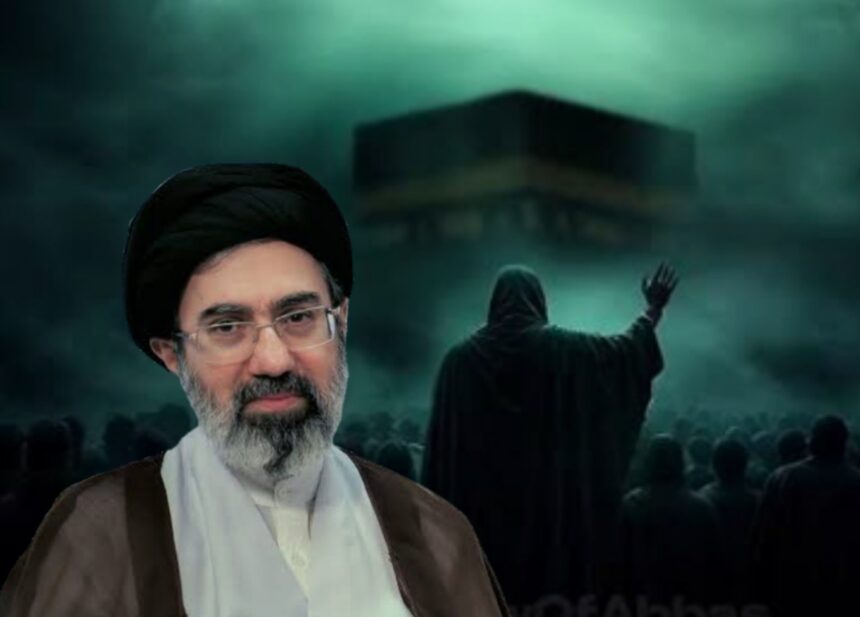
Iran’s Supreme Leader and Commander-in-Chief of the Armed Forces, Ayatollah Seyed Mojtaba Hosseini Khamenei, has praised the country’s police force for its role in maintaining national security, calling for further improvements in personnel, equipment and technology, including the targeted use of artificial intelligence in data analysis.
In a message marking Iran’s National Police Week, Khamenei described security as one of God’s greatest blessings and credited police officers with helping maintain order across the country, from major urban centres to remote villages and border regions. He also expressed hope that the force would achieve further success through the prayers of Imam Mahdi, whose return holds particular religious significance in Shiite Islam.
The message was reported by Iran’s Tasnim News Agency on October 9 and focused on the contribution of the Law Enforcement Command of the Islamic Republic of Iran, commonly known as FARAJA, to the country’s internal security.
Khamenei highlights police role amid regional tensions
Khamenei said police personnel remained committed to their duties despite attacks and security challenges that, according to his statement, targeted the force at different levels of its command structure.
Referring to what Iranian officials describe as the second and third imposed wars against the country, he said the police had faced repeated pressure from the United States and Israel. He accused the two countries of targeting personnel ranging from senior commanders to officers serving on the front lines.
Despite those challenges, Khamenei said, police officers continued their work without abandoning their responsibilities. He noted that personnel had carried out their duties in streets and vehicles as well as at their regular stations and posts.
The statement reflects Tehran’s emphasis on the role of domestic security institutions during periods of military confrontation and heightened regional tension. However, the message did not provide an independent account of the alleged attacks or identify specific incidents, dates or casualty figures.
Iran’s police force is responsible for law enforcement, public order and a range of internal security functions. Its responsibilities extend across major cities, rural communities and border areas, making it an important component of the country’s wider security structure.
Security described as a foundation of public welfare
In his message, Khamenei linked national security with social stability, public welfare and what he described as the moral well-being of society.
He said police personnel helped protect communities in geographically diverse parts of Iran, including mountainous areas, forests, plains and coastal regions. He also praised officers responsible for difficult border duties, where working conditions can be demanding because of terrain and weather.
Khamenei described the police as one of the principal pillars of Iran’s national security system. He said their contribution had become increasingly visible in recent years, particularly during periods of conflict.
The message also sought to strengthen the relationship between law enforcement agencies and the public. Khamenei said police officers, like members of the regular armed forces and the Islamic Revolutionary Guard Corps, came from within Iranian society and could reinforce public confidence through their conduct.
He argued that the sacrifices of security personnel were sometimes taken for granted. According to the message, officers could strengthen public trust by demonstrating responsibility and behaviour that earned the confidence of the communities they served.
The emphasis on public confidence is significant because effective policing depends partly on cooperation between security agencies and residents. Public trust can influence whether people report crimes, share information with authorities and comply with law enforcement measures.
The message, however, did not outline specific reforms or independent measures for assessing public confidence in the police.
Call for modernisation and artificial intelligence
A central element of Khamenei’s statement was the need to strengthen the police force through improvements in human resources, equipment and software.
He called for a comprehensive approach to modernisation, highlighting technological development as a way to improve the force’s ability to perform its duties.
In particular, he referred to the targeted use of artificial intelligence in data analysis. The statement presented the technology as a potential tool for improving police operations and making their work more efficient.
Artificial intelligence can be used in law enforcement for tasks such as analysing large volumes of information, identifying patterns in reported incidents and supporting the allocation of personnel. Depending on how systems are designed and deployed, such tools may also assist with administrative work and the assessment of security risks.
Their use, however, raises questions about privacy, data protection, accuracy and accountability. Automated systems can produce misleading results when they rely on incomplete or biased information. Their application in policing therefore requires appropriate safeguards and human oversight.
Khamenei’s message did not specify which AI systems Iran intends to introduce, how much funding would be allocated to technological upgrades or whether new operational programmes had already been approved.
The reference nevertheless signals an interest in incorporating advanced data-analysis capabilities into the country’s internal security infrastructure.
Recognition of police personnel and commanders
Khamenei expressed gratitude to police officers and commanders for their efforts to maintain security. He singled out the force’s commander for particular praise, describing him as courageous, tireless and capable.
The message also acknowledged the demanding nature of police work and the sacrifices made by personnel serving in different parts of the country.
Khamenei said the Iranian public appreciated those who worked to protect the country’s security. He also framed service in this field in religious terms, describing the protection of society as a form of service on the path of God.
The statement placed police personnel within Iran’s broader system of national institutions, alongside the regular military and the Islamic Revolutionary Guard Corps. While the institutions have different responsibilities, all play roles in the country’s security arrangements.
The message did not announce a new police operation, a change in command or a specific restructuring plan. Its main focus was recognition of existing service and a call for continued improvements in the force’s capabilities.
Reference to Imam Mahdi carries religious significance
Toward the end of the message, Khamenei expressed hope that the police would achieve further success through the prayers of Imam Mahdi, adding the phrase, “may God hasten his noble reappearance.”
The statement was a religious invocation rather than an announcement about the timing of the Imam’s return.
Imam Mahdi occupies a central place in Twelver Shiite belief, the dominant religious tradition in Iran. According to this tradition, the Twelfth Imam entered occultation and is expected to reappear in the future to establish justice. The expectation of his return has a longstanding place in Shiite religious thought and is reflected in Iranian religious and political discourse.
Khamenei’s wording placed the police force’s work within this religious framework, linking hopes for greater national security and strength with prayers for the awaited Imam.
Although the phrase can attract attention in political headlines, the message itself did not provide a date, prediction or timetable for the Imam’s reappearance. Its direct subject remained the performance and future development of Iran’s police force.
A broader message about Iran’s security priorities
The statement combines three themes: appreciation for police personnel, a claim that the force has continued operating despite external attacks, and a call to strengthen its technological and operational capabilities.
It also reflects the Iranian leadership’s broader presentation of national security as a matter involving military readiness, public order and religious identity.
For Tehran, the police are an important part of maintaining stability inside the country while Iran faces tensions with the United States and Israel. Khamenei’s remarks sought to recognise their contribution and encourage further investment in the personnel and technology needed to carry out their duties.
At the same time, the practical implications of the message remain unclear. No specific budget, procurement programme, implementation schedule or new AI initiative was announced in the statement.
The extent to which the proposed technological improvements will translate into changes in police operations will depend on future decisions by the relevant authorities.
For now, the message serves primarily as an expression of support for Iran’s law enforcement personnel and a call for a stronger, better-equipped police force. It closes with Khamenei’s hope that the institution will continue to enhance what he described as the security, strength and honour of the Islamic Republic of Iran.
Source: Tasnim News Agency, “Leader Lauds Police Force for Safeguarding Iran’s Security,” October 9, 2026.