
AL-MUKALLA, Yemen — Yemen’s Hadramout province has established a new unified political body aimed at consolidating the region’s political, social and tribal forces and strengthening its representation in an anticipated Saudi-hosted dialogue on the country’s political future, in a move that could shape negotiations over the future status and resources of Yemen’s largest and oil-richest province.
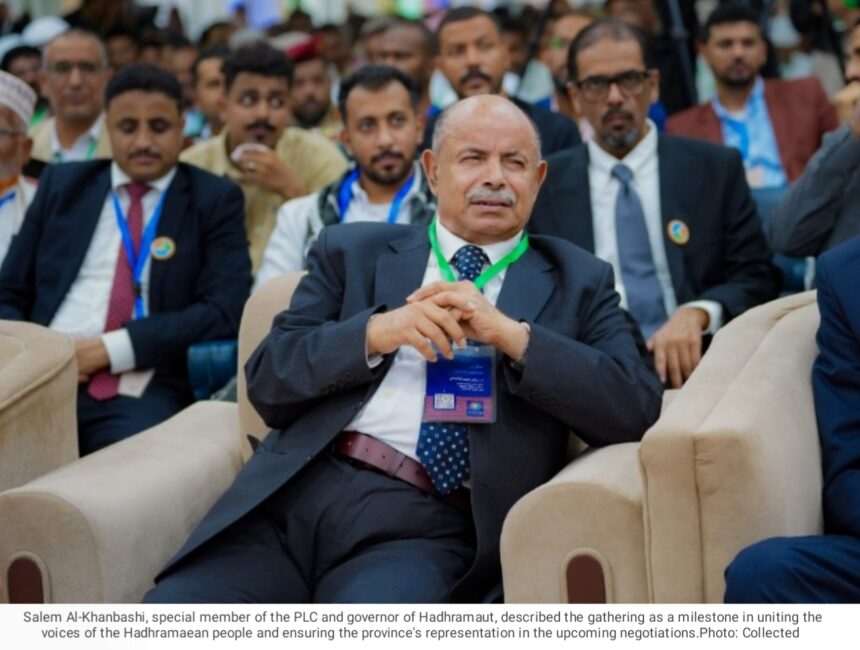
More than 1,000 political, social, tribal, religious and civil society figures gathered in Al-Mukalla to launch the Supreme Hadrami Coordination Council, with Hadramout Governor and Presidential Leadership Council member Salem Ahmed Al-Khanbashi appointed to lead the new body.
Al-Khanbashi said the council would seek to end what he described as Hadramout’s political marginalization and ensure that the province has an independent and meaningful voice in future negotiations concerning Yemen and the southern regions.
“Hadramout wants to be a partner in decision making, not merely a recipient of decisions,” Al-Khanbashi said, stressing that the province’s natural resources should contribute to economic development rather than deepen its existing crisis.
The governor also called for political representation reflecting Hadramout’s population, historical importance and social and economic weight. He emphasized that the province should participate in any comprehensive southern dialogue with its own political agenda and interests.
The formation of the council comes after months of political and military upheaval in southern Yemen, where competing forces have sought influence over strategic territories and energy-producing areas. Hadramout, which accounts for a large share of Yemen’s oil production, has long been at the center of disputes over control of resources and political representation.
Participants at the conference called for greater local authority over Hadramout’s economic resources, particularly oil revenues, while stressing the need for political forces inside the province to coordinate their positions ahead of the expected talks.
The council’s founding communique appointed Al-Khanbashi as president and authorized him to form its presidency within two weeks. It also tasked the leadership with expanding consultations with other Hadrami political and social groups and preparing a delegation to represent the province at forthcoming negotiations.
Among 56 resolutions adopted at the gathering, participants called for 20 percent of revenues generated from Hadramout’s oil exports to be allocated to the province and expressed support for military operations by Yemen’s internationally recognized government against the Houthi movement.
The initiative follows a period of intense instability in southern Yemen. Forces affiliated with the UAE-backed Southern Transitional Council previously expanded their presence in Hadramout and neighboring Al-Mahra, prompting opposition from Yemeni government officials and local actors. Saudi-backed government forces later moved to regain control of the two provinces, developments that contributed to the subsequent collapse of the STC’s influence in the region.
For Hadrami leaders, the new council represents an attempt to translate the province’s economic and demographic importance into greater political influence. Supporters argue that a unified local position could strengthen Hadramout’s bargaining power in negotiations over Yemen’s future.
The development also highlights the increasingly complex political landscape in southern Yemen, where demands for greater autonomy, resource-sharing and political representation intersect with broader regional competition and efforts to reach a lasting settlement to the country’s prolonged conflict.
With Saudi Arabia expected to host talks involving southern Yemeni political forces, the newly established council is seeking to ensure that Hadramout enters the negotiating process with a unified delegation and a clearly defined political position, potentially making the province a central actor in discussions over Yemen’s future political and economic order.