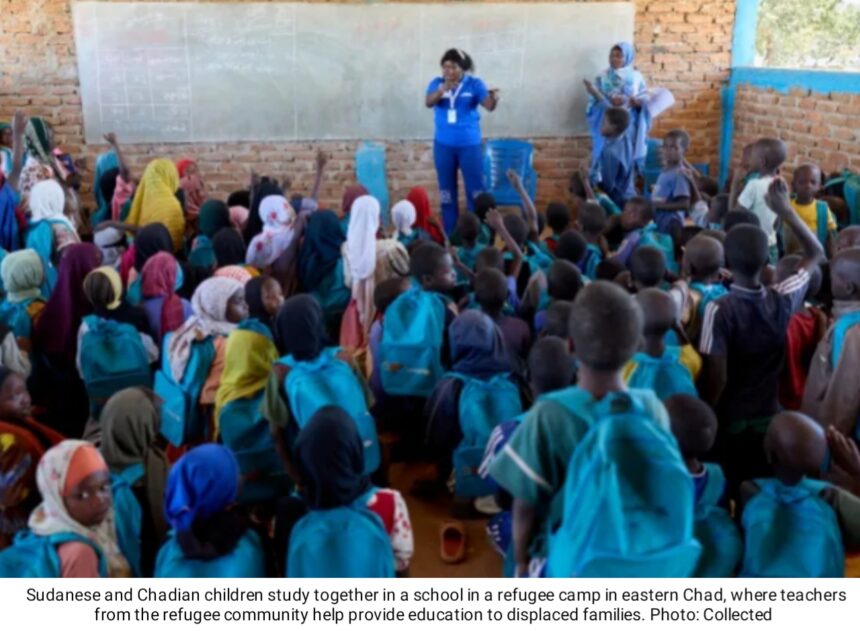
ADRE, Chad — Sudan’s war has taken away her home, her normal life and her sense of security, but it has not been able to extinguish her strongest weapon: an unwavering belief in education; Sahra grew up in El Geneina in West Darfur, determined from an early age to pursue education and build a future through the classroom, and after sitting national examinations in 2005 and 2006, she chose teaching as her profession, volunteering in classrooms while studying at university and developing experience in education administration, but when war erupted between Sudan’s army and the paramilitary Rapid Support Forces in April 2023, the life she had built was shattered almost overnight; in June 2023, Sahra crossed the border with her parents and three sisters and sought refuge in Chad, joining a vast movement of Sudanese displaced by the conflict, while eastern Chad became a fragile refuge for families who had lost homes, livelihoods and security, and for thousands of children whose most urgent question was no longer simply when they would return home, but whether they would have a future at all; amid that uncertainty, when Plan International and its partners established a primary school in a refugee camp in 2024, Sahra returned to the classroom—not merely as a teacher, but as a leader determined to help an entire generation of children who had witnessed war, violence and displacement rebuild their lives through education; the school now has more than 1,000 students and dozens of teachers, many of them members of the refugee community themselves, meaning that people who have experienced the trauma of war firsthand are now standing at the front of classrooms, placing books in children’s hands and fighting to protect their futures; this is not simply a school where children learn mathematics, science, history, geography, Arabic and French—it is a place of safety, dignity and hope, where the sound of a school bell can, even briefly, drown out the memory of gunfire and where children can experience something resembling a normal childhood again; the scale of displacement has forced schools to operate in shifts, while Sudanese teachers must adapt their experience and teaching methods to Chad’s education system, and language remains another major challenge as many Sudanese children speak Arabic while communities in Chad use a range of local languages; yet Sahra’s message is powerful: education does far more than teach a child to read and write—it can protect children from exploitation, violence, early marriage, criminal recruitment and despair while giving them the tools to imagine a life beyond the refugee camp; in a crisis where displacement threatens to erase an entire generation’s prospects, every classroom becomes an act of resistance, every teacher becomes a guardian of hope and every book becomes a declaration that war will not have the final word; for parents living in the camps, the school is also a symbol of protection, giving children a structured and safer environment where they can learn, play and rebuild relationships with their peers after experiences that no child should have to endure; but the crisis remains immense, with children who have lost parents or become separated from their families still at risk of being left outside the education system, while Chad’s already limited classrooms, teachers and infrastructure face additional pressure from the arrival of large numbers of Sudanese refugees; nevertheless, Sahra’s journey carries a message far beyond the boundaries of one refugee camp: war can turn a teacher into a refugee, force a family across a border and destroy a home, but it cannot necessarily destroy a person’s knowledge, dignity or determination to build a future for others; the woman who once crossed a border simply to survive now stands on the other side of that border helping hundreds of children reclaim something the war tried to steal from them—their future; her story is therefore not only the story of a Sudanese refugee who became a head teacher, but a powerful portrait of education as a quiet form of resistance, where weapons are replaced by books, fear by knowledge, displacement by purpose and destruction by the possibility of a new beginning.
Books in hand instead of weapons: The Sahara’s fight for education in Chad’s refugee camps