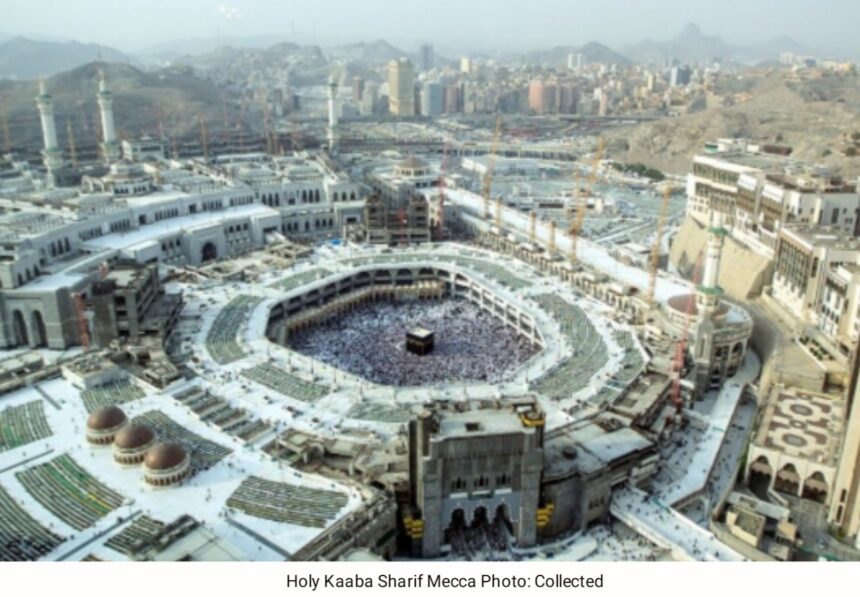
Tensions between Saudi Arabia and Yemen’s Houthis have risen again following the interception of a drone south of the holy city of Makkah. The Saudi-led coalition says an enemy drone was approaching Makkah on September 15 and was destroyed by Saudi air defenses before it could enter the protected airspace around the holy city. Coalition spokesman Turki Al-Maliki said the drone’s debris fell in an uninhabited area south of Makkah and that the incident caused no damage to the holy city. Saudi authorities have described the incident as a serious security threat and said there would be no compromise over the safety of the holy sites in Makkah and Madinah or the worshippers visiting them. Yet one key question remains unanswered: who actually launched the drone? While the Saudi-led coalition has directly blamed the Houthis, the Yemeni group has denied involvement. Houthi officials said they had not launched any drone toward Makkah or targeted any holy site, dismissing the Saudi accusation as baseless propaganda. As a result, independently verifiable information about the drone’s origin, intended target and operator remains limited.
The incident comes as military tensions between Saudi Arabia and the Houthis have been increasing. On September 15, air-raid warnings were issued in several parts of western Saudi Arabia, including Jeddah and Taif, amid reports of a possible aerial threat. The warnings were later lifted after the situation was declared under control. According to the Saudi side, the drone heading toward Makkah was intercepted before entering the protected airspace. There has been no indication that the holy city itself was directly struck. Rather, the reported incident involved the interception of a suspected drone, while the question of Houthi involvement remains disputed by the two sides.
Accusations involving Makkah are not new. In July 2017, Saudi Arabia accused the Houthis of launching a ballistic missile toward the holy city. Riyadh said the missile was heading toward Makkah and had been intercepted by Saudi defenses. The Houthis denied the accusation at the time and said they did not target holy sites. The group has taken a similar position in the latest incident. Nearly a decade after the 2017 episode, the renewed allegations involving Makkah have once again placed the issue at the center of the sensitive Saudi-Houthi conflict.
Amid the dispute over the Makkah drone, the Houthis have also claimed that they shot down a Saudi F-15 fighter jet in Yemen’s Marib governorate. Houthi military spokesman Yahya Saree said the aircraft was destroyed using a locally developed surface-to-air missile. Videos released by the Houthis reportedly showed the wreckage of a fighter aircraft. However, the footage and the claim have not been independently verified, and neither the Saudi government nor the Saudi-led coalition has officially confirmed the loss of an F-15.
The two incidents have raised new questions about the military dimension of the Saudi-Houthi conflict. The Houthis claim to be carrying out attacks against Saudi territory as well as Saudi aircraft and military facilities, while Saudi Arabia continues to conduct strikes against Houthi positions in Yemen. The conflicting military claims and reports of attacks are making the situation increasingly difficult to assess, particularly because independent verification of several of the claims remains limited.
The consequences of the conflict also extend beyond the Saudi-Yemeni border. Security concerns are growing around the Red Sea and the Bab al-Mandeb Strait, a strategically important maritime route for international trade and energy shipments. Any further escalation in the region could affect both regional security and commercial shipping. Continued Houthi attacks and Saudi military responses have therefore renewed international attention on maritime security in the Red Sea.
Saudi Arabia is also seeking greater cooperation from regional and international partners. According to an Associated Press report, Saudi Arabia has sought air-defense assistance from France, Britain, Pakistan and Egypt, citing two regional officials. The report also said concerns had emerged over the availability of missile interceptors after years of conflict. Saudi authorities had not publicly confirmed the reported requests at the time.
Saudi Arabia’s recent contacts with Egypt are also part of the wider regional security picture. Saudi Crown Prince Mohammed bin Salman and Egyptian President Abdel Fattah el-Sisi discussed maritime security in the Red Sea and the Bab al-Mandeb region during their meeting. Cairo has sought to maintain diplomatic channels in the Yemen conflict while avoiding direct military involvement on the scale seen earlier in the war. Balancing Saudi security concerns with broader regional diplomacy therefore remains an important issue for Egypt.
For now, several questions surrounding the drone incident near Makkah remain unanswered. Saudi Arabia says the drone was launched by the Houthis and was heading toward the holy city, while the Houthis deny any involvement. No publicly available independent evidence has conclusively established the drone’s origin or operator. At the same time, the Houthi claim that a Saudi F-15 was shot down has not been confirmed by Saudi authorities. The Makkah drone incident and the reported fighter-jet loss therefore remain part of a wider series of competing military claims. What is clear is that the latest developments have brought renewed attention to the security of Saudi territory, the airspace around the holy city of Makkah and the strategic maritime routes of the Red Sea. Whether the tensions continue to escalate or regional diplomatic efforts succeed in reducing them remains an important question for the wider Middle East.